The most commonly used procedures include radiofrequency ablation (RFA), microwave ablation (MWA), and laser ablation (LTA). The treatment is performed under ultrasound guidance and is particularly suitable for patients with symptomatic or cosmetically bothersome thyroid nodules, as well as for those who wish to avoid surgery.
Thermoablation is characterized by a short treatment duration, a quick recovery, and a low risk of complications. In many cases, symptoms such as a feeling of pressure, difficulty swallowing, or visible swelling can be permanently reduced. As a result, thermal ablation is now an effective and minimally invasive alternative to surgical treatment of the thyroid.
What is thyroid thermal ablation?
Thermoablation is a modern, minimally invasive treatment procedure designed to selectively reduce the size of thyroid nodules. It involves destroying diseased tissue using controlled heat, without the need for surgical removal of the thyroid gland. The procedure is performed under ultrasound guidance, allowing for precise treatment while preserving healthy thyroid tissue.
Thermoablation has established itself in recent years as an effective alternative to surgery, particularly for benign thyroid nodules. The goal of the treatment is to alleviate symptoms, permanently reduce the size of the nodule, and preserve thyroid function as fully as possible. Today, thermal ablation is one of the established local ablative procedures in interventional radiology and endocrinology.
When is thyroid thermal ablation an option?
Thyroid nodules are among the most common thyroid conditions. Many patients do not initially notice any symptoms. However, as the nodules grow larger, symptoms such as a feeling of pressure in the neck, difficulty swallowing, hoarseness, or cosmetically bothersome swelling may occur.
Thermoablation may be recommended in particular for the following findings:
- Benign thyroid nodules with confirmed benignity
- Growing nodules causing a sensation of pressure or a foreign body
- Cosmetically bothersome thyroid enlargements
- Autonomous (“hot”) thyroid nodules with hormone overproduction
- Patients who wish to avoid surgery
- Patients with an increased risk of complications from surgery
Before treatment, the benign nature of the nodule must generally be confirmed by fine-needle aspiration or tissue biopsy.
What types of thermal ablation procedures are available?
The term “thermoablation” encompasses various procedures that selectively destroy tissue using heat.
Radiofrequency ablation (RFA)
Radiofrequency ablation is the most commonly used thermal ablation procedure worldwide for thyroid nodules. High-frequency alternating electrical currents are delivered to the tissue via a thin probe. The resulting heat causes controlled destruction of the nodule cells. The treated tissue is then gradually broken down by the body.
Radiofrequency ablation can often reduce the volume of benign thyroid nodules by 50 to 90 percent within a few months.
Microwave Ablation (MWA)
In microwave ablation, electromagnetic waves generate heat directly within the tissue. This procedure enables rapid and effective treatment of even larger nodules and is becoming increasingly important.
Laser ablation (LTA)
Laser ablation uses laser energy that is delivered to the nodule via fine optical fibers. The heat generated selectively destroys the diseased tissue while sparing the surrounding structures.
How is thermal ablation of the thyroid performed?
The treatment is usually performed on an outpatient basis or with a short observation period at a specialized clinic.
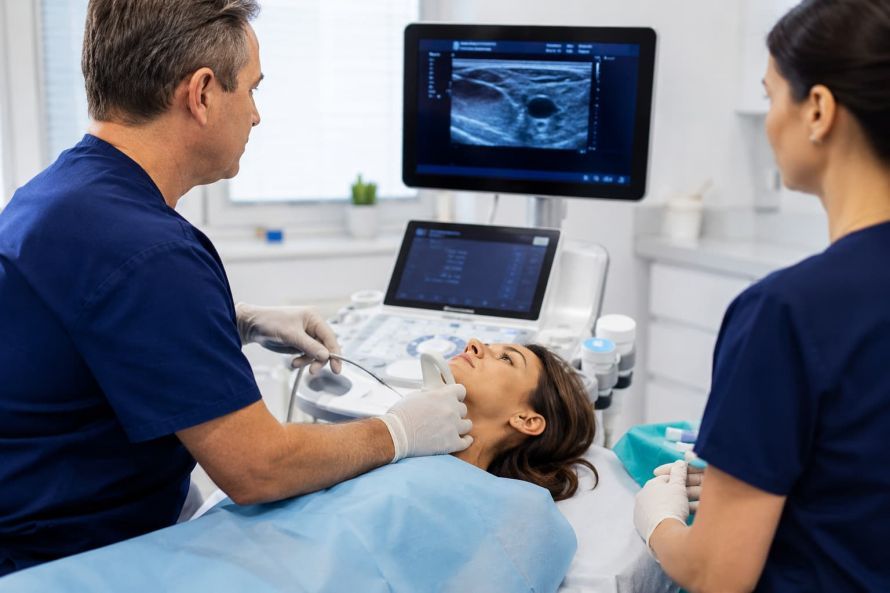
After a thorough thyroid evaluation, the skin in the neck area is locally anesthetized. The treating specialist then inserts a fine probe into the thyroid nodule under continuous ultrasound guidance. The required thermal energy is delivered precisely through this probe.
Throughout the entire procedure, important anatomical structures such as the vocal cord nerves, blood vessels, and the healthy thyroid gland can be precisely monitored. The procedure usually takes between 20 and 60 minutes. Many patients are able to leave the clinic shortly afterward.
What are the advantages of thermal ablation?
Thermoablation offers numerous advantages over traditional thyroid surgery:
- No surgical incision
- No visible scar on the neck
- Preservation of a large portion of the thyroid gland
- Lower risk of vocal cord nerve injury
- Short treatment duration
- Quick return to daily life
- Usually performed on an outpatient basis
- Less strain on older patients or those with pre-existing conditions
Organ preservation, in particular, is a significant advantage, as natural thyroid function is often preserved and lifelong hormone replacement therapy can frequently be avoided.
What are the potential risks and side effects?
Thermoablation is considered a very safe procedure. However, as with any medical procedure, complications can occur.
Possible side effects include:
- Temporary pain in the neck area
- Swelling or bruising
- Mild hoarseness
- Temporary difficulty swallowing
- Rare injuries to adjacent structures
Serious complications are rare when performed by experienced specialists. The risk can be further minimized through continuous ultrasound monitoring.
What results can be expected after treatment?
After thermal ablation, the body begins to gradually break down the treated tissue. The reduction in the size of the nodule therefore does not occur immediately, but rather over several weeks and months.
Studies show that the volume of benign thyroid nodules can be significantly reduced over the long term. At the same time, pressure-related symptoms, swallowing difficulties, and cosmetic concerns usually improve considerably. In the case of autonomous nodules, normal thyroid function can also be restored.
Regular ultrasound follow-ups are used to monitor the success of the treatment.
For which patients is thermal ablation particularly suitable?
Thermoablation is particularly suitable for patients who:
- suffer from symptomatic benign thyroid nodules,
- wish to avoid surgery,
- have an increased surgical risk due to comorbidities,
- value preserving their thyroid gland,
- prefer a scar-free treatment.
Whether this procedure is an option for an individual should be determined following a comprehensive examination by experienced specialists in thyroid disorders.
Which specialists perform thyroid thermal ablation?
Thyroid thermal ablation is primarily performed by specialized interventional radiologists, nuclear medicine specialists, endocrinologists, and thyroid surgeons with appropriate additional training. Precise diagnostics, modern imaging, and extensive experience with ultrasound-guided ablation procedures are crucial to the success of the treatment.
FAQs on Thyroid Thermoablation
Is thyroid thermal ablation painful?
The procedure is performed under local anesthesia. Most patients experience only a slight sensation of pressure or warmth.
Do I have to stay in the hospital after thermal ablation?
In many cases, the treatment can be performed on an outpatient basis. After a brief observation period, patients can usually go home the same day.
Can a thyroid nodule grow back?
In most cases, a permanent reduction in size is achieved. However, in some patients, residual tissue may remain or regrow, which may require further treatment.
Does health insurance cover the costs?
Coverage depends on your individual situation, insurance status, and the specific policies of your health insurance provider.