Here you’ll find information about thyroid surgery and the right thyroid specialists near you. All listed doctors are specialists in their field and have been handpicked for you according to strict guidelines. Please select a location or area of expertise. The thyroid specialists look forward to hearing from you.
The thyroid gland—also known in medical terms as the glandula thyroidea—is an organ located in the lower part of the neck, lying against the trachea from the front and sides. As a vital gland, its two lobes produce the thyroid hormones triiodothyronine (T3) and thyroxine (T4, tetraiodothyronine), as well as calcitonin.
These hormones are involved in complex metabolic processes in the body, such as the regulation of basal metabolic rate, heart function, and blood calcium levels. The production of thyroid hormones itself is in turn controlled by hormones released from specific areas of the brain.
Closely associated with the thyroid gland are the (usually four) parathyroid glands; they are located against the posterior wall of the thyroid gland and also produce a hormone called parathyroid hormone. Parathyroid hormone maintains a constant level of calcium in the blood; among other things, it releases calcium from the bones when blood calcium levels are too low.
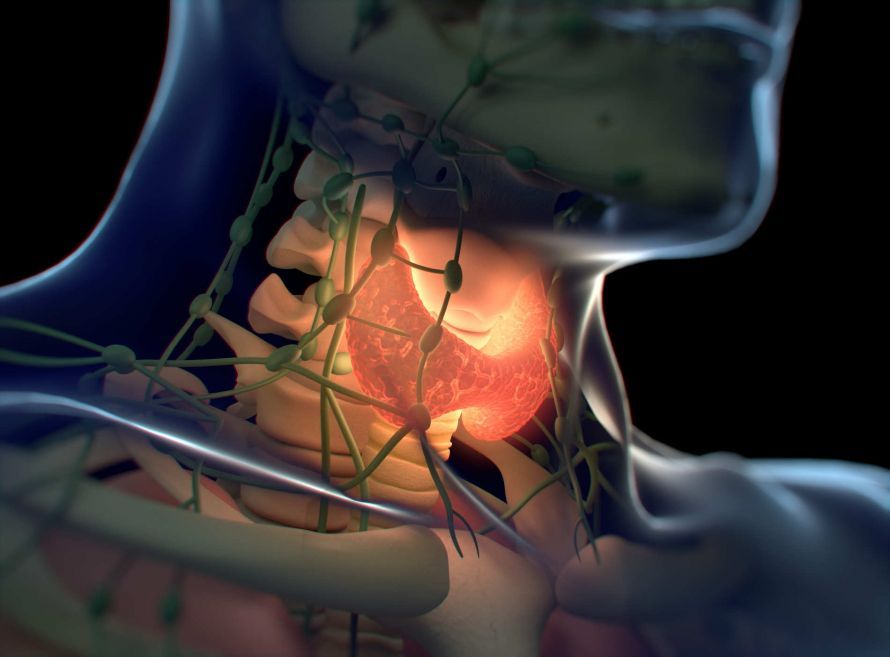
The entire hormonal and metabolic system of the human body is extremely complex, and its individual components are finely tuned to work together. If disturbances occur—which can be triggered, for example, by an iodine deficiency—the system becomes unbalanced. This can cause the thyroid gland to produce too much or too little hormone—with corresponding health consequences for the body.
What conditions do thyroid specialists treat?
If the thyroid gland is enlarged and produces too much hormone, this is known as hyperthyroidism, also called hyperthyreosis or hyperthyreodism. Patients suffer from increased sensitivity to heat and sweating, diarrhea, restlessness and sleep disturbances, a rapid heartbeat, and weight loss.
If, on the other hand, the thyroid gland produces too few hormones, this results in an underactive thyroid, known as hypothyroidism. Consequences can include, among other things, reduced performance, fatigue, or weakness. The causes of hyperthyroidism or hypothyroidism can vary widely. Sometimes medication alone is sufficient, but often surgical treatment by a thyroid surgeon is necessary.
A goiter, medically known as struma, is a visible and palpable enlargement of the thyroid gland.
Generally, specialists in thyroid surgery distinguish between benign thyroid disorders (such as goiter or hyperthyroidism), malignant thyroid disorders, and thyroid inflammation. Conditions that are frequently treated—or treated in specific situations—in thyroid surgery include, for example:
- Euthyroid nodular goiter is a benign thyroid condition characterized by an enlarged thyroid gland and hyperthyroidism.
- Autonomous nodular goiter is also benign; in this condition, the thyroid is no longer controlled by the brain, leading to growth of thyroid tissue and hyperthyroidism.
- Graves’ disease (also known as autoimmune hyperthyroidism or immunogenic hyperthyroidism) is an autoimmune disorder in which the body produces antibodies that stimulate the thyroid gland to grow and produce hormones at an increased rate.
- Thyroid autonomy is benign and is also characterized by hyperthyroidism.
- Thyroid cancer (thyroid carcinoma) can originate in the various cell types of the thyroid gland. Signs of this malignant thyroid disease usually include rapid growth of the thyroid gland, hoarseness, and/or breathing difficulties.
- Thyroid inflammations, such as acute thyroiditis, Hashimoto’s thyroiditis, and Riedel’s fibrosing thyroiditis, are treated surgically only in exceptional cases.
- Overactivity of the parathyroid glands (hyperparathyroidism) is associated with, among other things, increased bone resorption and cardiovascular dysfunction. If symptoms occur, the thyroid surgeon will remove all four parathyroid glands.
What diagnostic procedures do thyroid surgery specialists use?
During the medical history interview (patient consultation), the surgeon will inquire about symptoms, psychological distress, and family history. This can already provide initial clues regarding a possible treatment. As part of functional testing—that is, to determine whether the thyroid is overactive or underactive—laboratory measurement of thyroid hormone levels is essential. By palpating the thyroid gland, the doctor can determine whether it is enlarged, movable, or has nodular changes.
An ultrasound examination (sonography) can accurately identify changes such as cysts and nodules. Occasionally, tissue samples (biopsies, fine-needle aspiration) are also taken under ultrasound guidance for further examination. To determine which areas of the thyroid gland are overactive or underactive, scintigraphy is often used, in which a radioactively labeled substance is administered. This allows for the identification of, for example, cold nodules and hot nodules. It plays an important role in the preparation for thyroid surgery.
Occasionally, or in cases of specific symptoms and when malignant thyroid diseases are suspected, additional imaging techniques are used, such as chest X-rays, possibly involving the ingestion of a barium swallow, computed tomography (CT), and magnetic resonance imaging (MRI).
Before thyroid surgery, thyroid surgery specialists often perform a laryngoscopy—in addition to other laboratory tests (such as measuring blood calcium levels)—to assess the function of the vocal cords.
What treatment methods are part of a thyroid surgeon’s scope of practice?
Surgery is always necessary when other treatment options (such as medication or radioactive iodine therapy) have been unsuccessful or are not likely to be effective. In such cases, thyroid surgery specialists will aim, on the one hand, to completely remove pathologically altered thyroid tissue, while, on the other hand, preserving as much functional tissue as possible. This presents the thyroid surgeon with several options regarding the amount of tissue to be removed:
- In nodule excision, only the diseased tissue—such as a benign tumor (adenoma) or a cold nodule—is removed along with a margin of normal tissue.
- In a lobectomy (hemithyroidectomy), one of the two thyroid lobes is completely removed. This is performed, for example, when a locally confined thyroid carcinoma is suspected.
- During a goiter resection, all diseased areas of the thyroid gland are removed, while as much healthy—that is, hormone-producing—tissue as possible is preserved. The extent of the procedure depends on the disease and can vary in scope.
- In the case of malignant tumors, the thyroid gland is usually removed completely; this is referred to as a total thyroidectomy (complete removal of the thyroid gland).
Depending on the indication, thyroid surgery can be performed as minimally invasive thyroid surgery or as open thyroid surgery. Depending on the amount of thyroid tissue removed, the patient may need to take thyroid hormones after surgery, and often iodine as well to prevent a recurrence of dysfunction.
What sets specialists in thyroid surgery apart?
The first points of contact for patients with thyroid disorders are usually specialists in internal medicine and general practice, or specialists in internal medicine, endocrinology, and diabetology.
Depending on the specific thyroid condition, various surgical experts may be considered for thyroid surgery, such as visceral surgeons or surgeons specializing in oncology or endocrinology. For example, visceral surgeons have completed specialized training in visceral surgery and are therefore also specialists in all surgical procedures involving endogenous (i.e., internally draining) glands, including the thyroid. Specialists in thyroid surgery are familiar with both standard and the latest surgical techniques.

About the medical author
Prof. Robert Rosenberg FACS, EMBA
Medical Author · Chief Physician, Department of Intestinal Surgery and Oncological Surgery · Liestal
Prof. Dr. med. Robert Rosenberg FACS EMBA – author: Explore expert medical articles in the Leading Medicine Guide.
Sources
- Aumüller G, Wennemuth G (2017) Halsorgane. Duale Reihe Anatomie. Thieme, Stuttgart
- Dralle H (2012) Schilddrüse. In: Siewert JR, Stein HJ (Hrsg) Chirurgie. 9. Aufl. Springer, Heidelberg
- Zünd M, Lüdin M, Lange J (2009) Klinikmanual Chirurgie. Springer, Heidelberg