In the morning after getting out of bed, every step hurts as if you were stepping on a nail: this is the classic symptom of a heel spur. Millions of people suffer from this sharp heel pain, which is often caused by overuse of the feet or improper footwear. However, the problem is often not the bony spur itself, but rather inflammation of the tendon plate on the sole of the foot, known as plantar fasciitis. Heel spurs and plantar fasciitis frequently occur together and can severely impair quality of life. The good news: In most cases, the condition can be successfully alleviated through conservative treatment such as stretching exercises, orthotics, and shockwave therapy, so surgery is rarely necessary.
Essentially, doctors distinguish between two types of growth associated with this very unpleasant condition:
- growth along the sole of the foot toward the toes, and
- growth upward along the Achilles tendon.
People between the ages of 40 and 60 are most commonly affected.
Research into Causes: How Does a Heel Spur Develop?
The exact cause of a heel spur is still largely unknown. One theory involves pressure on the foot’s skeletal structure, which can be triggered by improper weight distribution. This pressure can lead to microscopic injuries to bones and tendons.
These micro-injuries activate the immune system, leading to localized inflammation in the foot. This process results in the slow but progressive formation of a bony protrusion—the heel spur (also known as a calcaneal spur).
In most cases, improper footwear is one of the main causes of such degenerative processes. In addition to improper footwear, however, other risk factors may also be involved, such as:
- excess weight, which increases pressure on the foot’s skeleton,
- Jobs that require a great deal of walking or standing,
- foot abnormalities such as fallen arches, splayfoot, or flat feet,
- advancing age, and
- repeated failure to warm up the muscles and ligaments before exercise.
How can you recognize a heel spur?
Essentially, doctors distinguish between two types of growth associated with this very uncomfortable condition. In one case, the bone can grow along the sole of the foot toward the toes. In the other, the heel spur is located on the Achilles tendon. People between the ages of 40 and 60 are most commonly affected.
In rare cases, patients may feel only a bony protrusion in the heel area without any other symptoms. More commonly, however, severe pain occurs in the heel. The pain worsens when walking due to irritation of the heel spur. The pain subsides when resting or elevating the foot.
Orthopedic surgeons and foot surgeons are the specialists to consult for heel spurs.
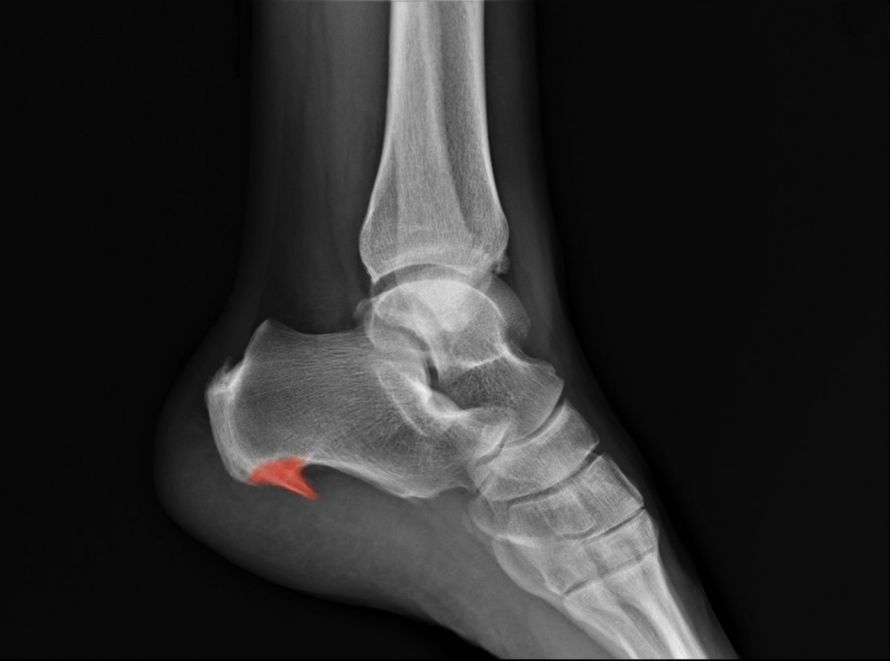
The diagnosis of a heel spur is usually made based on an X-ray and a clinical examination. The calcium deposit is not always clearly visible on the X-ray. In such cases, characteristic tender points on the sole of the foot or the heel help the doctor make an accurate diagnosis.
If the pain is very severe when walking, the patient’s gait often changes as well. Many patients then walk primarily on their toes to avoid putting further strain on the heel spur. The doctor identifies the subtle changes in gait during a gait analysis.

CC BY-SA 3.0 Heel Spur Anatomy
Treatment Options for Heel Spurs
The first priority is to relieve the pain. To do this, the affected foot must generally be immobilized and adequately cooled. Anti-inflammatory medications may also be necessary for a short time.
This is followed by the actual treatment of the heel spur. In addition to physical therapy, shockwave therapy and radiation therapy are particularly popular. In any case, the foot should be kept off for the duration of the therapy.
In most cases,
- special shoe inserts,
- more suitable footwear, or
- adequate stretching exercises before exercise
to alleviate the heel spur or prevent it from getting worse. If these measures do not provide relief, there are other treatment options. In most cases, surgery is not necessary.
Heel Spur Insoles
There are no special shoes designed specifically for heel spurs. However, many shoes can be adapted using special insoles.
For a lower heel spur—that is, one located under the sole of the foot—you can use, for example,
- perforated insoles,
- viscoelastic gel insoles, and
- widened cushioning heels
be used.
For heel spurs affecting the Achilles tendon, however, cushioning pads and glued-in felt wedges are recommended.
In addition to relieving current symptoms, these measures help prevent the heel spur from growing larger.
Shockwave Therapy
Shock waves are pressure waves that are transmitted from a device to the foot during shock wave therapy. The shock waves stimulate blood flow, which is intended to alleviate pain and reduce inflammation.
However, the therapeutic success of this procedure is controversial.
Radiation Therapy
The radiation dose used in heel spur therapy is much lower than, for example, in an X-ray. Within about five to six sessions, each lasting only a few minutes, many patients achieve the desired relief from pain.
Heel Spur Surgery
In fewer than 10% of cases, symptoms persist despite the aforementioned treatment options.
Surgery is then the last resort. The foot is anatomically very complex. Therefore, you should consult a specialist for surgical treatment of heel spurs.
Preventing Heel Spurs
Be sure to stretch your legs and feet before any physical activity. This helps prevent minor injuries caused by the strain of exercise. The Achilles tendon area is particularly vulnerable.
People who have to walk or stand a lot in their daily lives will also benefit from the following physical therapy exercises:
- Walking barefoot on uneven, sandy, or textured surfaces. This strengthens the foot muscles.
- Picking up and tearing paper with your toes. This improves coordination, strengthens the muscles and tendons of the foot, and is also a fun game to play with family and friends.
- A healthy diet and sufficient exercise. This helps prevent obesity and eliminates a risk factor for heel spurs.
Prognosis for Heel Spurs
A calcaneal spur does not resolve on its own. However, surgical removal of the spur in the heel area is very rarely necessary. Since the calcium deposits usually do not cause any symptoms, it is sufficient to manage the inflammation in the foot.
Physical therapy and appropriate anti-inflammatory medications can help with this.
FAQ: The 8 Most Important Questions About Heel Spurs and Plantar Fasciitis
What is the difference between a heel spur and plantar fasciitis?
The terms are often used interchangeably, but medically speaking, there is a difference. A heel spur is the bony change in the heel bone visible on an X-ray. Plantar fasciitis is the painful inflammation of the plantar fascia, the band of tissue on the sole of the foot. In most cases, it is the inflammation of the plantar fascia that causes the pain, not the spur itself. However, heel spurs and plantar fasciitis very often occur together, as the constant tension on the fascia promotes calcification.
How does a heel spur develop?
A heel spur develops as a result of chronic overuse and microtears at the attachment points of the tendons. When the plantar fascia or the Achilles tendon is under excessive tension over a long period, the body deposits calcium in the affected areas to increase stability. Over time, these calcium deposits form the bony spur. Common causes include being overweight, standing for long periods, foot misalignments such as flat feet, or wearing unsuitable footwear.
What are the typical symptoms?
The main symptom is a stabbing pain in the heel, which occurs particularly in the morning after getting out of bed or after prolonged periods of rest as “start-up pain.” The pain may improve somewhat as the day progresses but returns with activity. With a plantar heel spur, the pain is usually centered under the heel, while with an upper heel spur, it tends to be at the attachment of the Achilles tendon at the back of the shoe.
How can the pain be relieved?
To relieve acute pain, cooling the affected area and resting the foot often helps. Anti-inflammatory medications such as diclofenac or ibuprofen can be taken for a short time. In the long term, it is important to relieve pressure on the foot, for example by using soft heel cushions or orthopedic insoles that support the arch of the foot and reduce pressure on the heel.
What role does shock wave therapy play?
Extracorporeal shock wave therapy has proven to be an effective method, especially for chronic heel pain. In this procedure, high-energy sound waves (shock waves) are directed from outside the body onto the inflamed tissue. This promotes blood flow, stimulates metabolism, and can help reduce inflammation of the plantar fascia more quickly, allowing the patient to become pain-free again.
Do stretching exercises help with heel spurs?
Yes, stretching exercises are a key component of treatment. Since tight calf muscles increase the tension on the Achilles tendon and the plantar fascia, regular stretching is essential. Exercises that stretch the toes and the sole of the foot, as well as rolling the foot over a spiky ball, can reduce tension in the plantar fascia and thus alleviate symptoms.
When is surgery necessary?
Surgery is considered only in very rare cases, when all conservative treatment options have failed to produce improvement over an extended period (usually more than 6–12 months). During surgery, the tendon plate can be partially notched to relieve tension, or the heel spur can be removed. However, the risks of surgery must be weighed carefully.
Can heel spurs be prevented?
To prevent heel spurs from developing, it is important to wear good footwear with cushioning, especially for jobs that require a lot of walking and standing. Excess weight should be reduced to minimize the strain on the feet. Regularly walking barefoot on soft surfaces strengthens the foot muscles. If you have known foot misalignments, you should start wearing orthotics early on to prevent overloading the tendons.
Share this article

About the medical author
Dr Wolfram Wenz
Medical Author
Dr. med. Wolfram Wenz – medical author: expert articles, professional insights and medical knowledge in the Leading Medicine Guide.
View full expert profile →