Expert Interviews
Shoulder Surgery: Innovations for Mobility and Quality of Life — Expert Interview with Prof. Hoffmann

Alexandra Pfitzmann ·
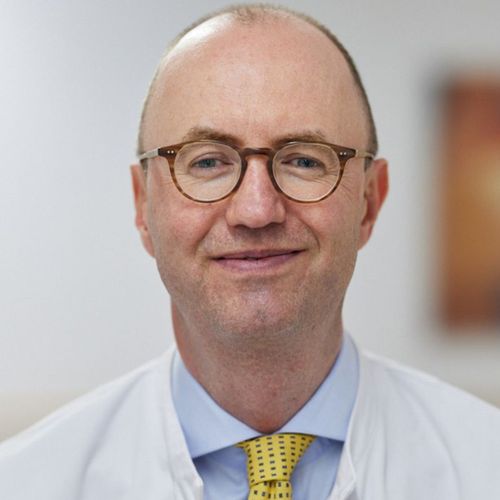
Prof. Dr. med. Michael Hoffmann, a renowned specialist in knee and shoulder surgery as well as sports orthopedics, is a leading figure in the medical field. His excellent professional knowledge and extensive expertise in the field of complex joint surgery have earned him an outstanding reputation. He practices at the Asklepios Klinik St. Georg in Hamburg and is one of the most respected physicians in his field.
Throughout his long career, Prof. Dr. Hoffmann has placed a special emphasis on the treatment of complex degenerative changes and acute injuries to the knee and shoulder joints. His expertise ranges from the treatment of complex bone fractures to revision and corrective surgeries following previous unsuccessful procedures. He has earned his reputation among elite athletes as the team physician for the 1st Bundesliga HSV Handball Team and as the association physician for the national beach volleyball team.
Prof. Dr. Hoffmann is distinguished by his innovative and minimally invasive approach, performing complex reconstructive procedures using arthroscopic techniques. He specializes in the repair of complex ligament injuries in the knee and the rotator cuff in the shoulder. His focus is on the surgical treatment of cartilage damage, correction of axial misalignments, and revision of complex fractures.
In addition to his outstanding surgical skills, Prof. Dr. Hoffmann is also recognized as a scientist. His numerous publications, presentations at national and international conferences, and his commitment to the development of modern surgical navigation methods have had a significant impact on the medical community. Prof. Dr. Hoffmann has been awarded certificates of excellence from various professional societies, underscoring his outstanding medical expertise.
The editorial team at Leading Medicine Guide wanted to learn more about shoulder surgery and spoke with Prof. Dr. Hoffmann about the various treatment options.

Shoulder surgery is a highly specialized field of medicine that deals with the diagnosis and treatment of injuries, diseases, and functional disorders of the shoulder. It is of crucial importance because the shoulder is an extremely complex joint that enables a wide range of movements. The variety of issues—ranging from acute injuries to degenerative diseases—requires a deep understanding of anatomy and a nuanced approach to treatment. Innovative techniques and a deep understanding of each patient’s individual needs have made shoulder surgery a key element in restoring mobility and quality of life.
Shoulder conditions can encompass a wide range of problems, from acute injuries to degenerative conditions.
Shoulder conditions can severely impair the shoulder’s mobility and function and absolutely require expert treatment. “Generally, degenerative conditions are distinguished from acute conditions. Conservative treatments are often used for less severe conditions, such as bursitis, tendinitis, minor rotator cuff injuries, or mild shoulder osteoarthritis. These problems can often be successfully treated with physical therapy, medication, injection therapy, or targeted exercises without the need for surgery. Only when the wear and tear—and thus the pain and physical limitations—become too severe should surgery be considered, and in the case of shoulder osteoarthritis, an implant may be necessary. “The findings must always be evaluated by an expert,” explains Prof. Dr. Hoffmann at the beginning of our conversation. The decision to pursue surgical or conservative treatment depends on the type and severity of the condition, the patient’s overall health, individual needs, and response to previous treatments.
Minimally invasive procedures in shoulder surgery have advanced significantly in recent years.
Initially, many shoulder procedures could only be performed via open surgery, which required large incisions and extensive tissue dissection. With advances in endoscopy and the development of specialized instruments, minimally invasive techniques such as arthroscopic shoulder surgery are now widely used. “Most shoulder surgeries can be performed using minimally invasive techniques—that is, arthroscopically and with the aid of a camera. These procedures allow for precise interventions through small skin incisions, through which an endoscope and specialized instruments are inserted into the joint. This makes it possible to visualize the interior of the shoulder and perform repairs or corrections on tendons, ligaments, or cartilage—all without large incisions. This is also feasible for rotator cuff tears, biceps tendon injuries, or tears of the labrum,” explains Prof. Dr. Hoffmann. The advantages of minimally invasive procedures in shoulder surgery lie in reduced trauma to soft tissues, which can lead to less pain, less blood loss, a faster recovery, and a shorter rehabilitation period. “Surgeries on the rotator cuff are even performed on an outpatient basis, and the patient can go home on the same day as the procedure. With other shoulder surgeries, the patient must first go through the ‘valley of tears’—because in the majority of patients, a so-called ‘frozen shoulder’ develops for a short time, which is a painful restriction of movement in the shoulder joint (adhesive capsulitis). This is normal, and it’s important to discuss this with the patient before surgery as part of effective expectation management. Because the outcome is ultimately a good one,” explains Prof. Dr. Hoffmann.
As team physician for the 1st Bundesliga HSV Handball team and association physician for the national beach volleyball team, Prof. Dr. Hoffmann is highly regarded among elite athletes due to his extensive expertise. “The shoulder is a major concern, especially in handball. For injuries that require surgical treatment, it is crucial to undergo highly professional physical therapy and rehabilitation measures in order to achieve good results quickly, although the same healing principles apply here as for non-athletes. However, it must be emphasized that, thanks to minimally invasive surgical methods, the recovery period is significantly shorter. And with targeted physical therapy, good results can be achieved in a very short time. For example, if a professional handball player is injured and the biceps tendon tears at the joint lip, it can be assumed that the athlete will be able to resume training approximately six weeks after treatment, and after about ten to twelve weeks, they will have reached the “return to competition” (back in competition). The better a person is physically conditioned, the faster they can make a full recovery. And the older a person is, the poorer their biological healing potential. Finally, it’s important to note that if someone has developed severe osteoarthritis in the shoulder but has a well-trained deltoid muscle, they simply have a better starting point for achieving good results quickly after surgery. “It’s also important to keep in mind that prolonged restriction of shoulder use always leads to muscle atrophy,” explains Prof. Dr. Hoffmann.
The deltoid muscle, also known as the Musculus deltoideus or simply the deltoid, is one of the most important muscles in the shoulder region. It forms the characteristic triangular shape on the side of the shoulder and is responsible for arm movement.
Shoulder surgery is a multifaceted field that encompasses various shoulder conditions and injuries.
Severe rotator cuff tears, serious fractures, or advanced osteoarthritis of the shoulder may require surgical repair or joint replacement. “Shoulder joint replacement used to have a rather poor reputation. However, with the modern prostheses used today, the risk of a frozen shoulder, for example, has been eliminated. Generally speaking, a shoulder prosthesis is more of an option for people aged 50 and older, since these are wear-and-tear components, and all other treatment options should be exhausted before a prosthesis is implanted,” explains Prof. Dr. Hoffmann. The course of treatment for shoulder replacement includes a thorough preoperative examination, the surgery itself, and subsequent rehabilitation to restore shoulder function.
“For patients with severe osteoarthritis, two different types of prostheses must be discussed. First, there is the anatomical prosthesis, which can be selected provided the rotator cuff is intact and functioning, with the goal of reconstructing the original anatomy. These prostheses achieve optimal results. They not only relieve pain in the shoulder but also restore full shoulder function—so effectively, in fact, that these joints become what are known as ‘forgotten joints’—the patient no longer even thinks about having a shoulder prosthesis. The situation is slightly different for patients who require a prosthesis due to an acute fracture. In such cases, inverse prostheses are often used. This means that the new prosthetic humeral head is placed where the glenoid cavity used to be, and vice versa. Essentially, the geometry of the shoulder is reconfigured. These prostheses yield better results than the use of a plate in cases of severely damaged joints, especially in older patients. “It is fundamentally important that the doctor brings the patient up to speed on the latest scientific findings, explains the current state of the literature, and also regularly exchanges information with fellow physicians,” says Prof. Dr. Hoffmann.
The course of rehabilitation following shoulder replacement surgery can vary depending on the patient’s individual health status and the type of prosthesis. In general, however, rehabilitation involves several phases. Professor Dr. Hoffmann emphasizes the importance of early mobilization: “The rehabilitation process following the implantation of an inverse prosthesis is very advanced. This is because there is no immobilization after the procedure, and the patient experiences no restrictions whatsoever in terms of movement. With anatomical prostheses, the rehabilitation period is different. In these cases, we have patients rest for two weeks (previously it was six weeks), and then follow the ‘fast-track concept’ to stabilize the muscle and prevent it from atrophying. Therefore, the patient is mobilized again as quickly as possible.”
Implant materials have a significant impact on the outcomes of shoulder surgeries.
In shoulder surgery, implants such as screws, plates, anchors, and prostheses are crucial for ensuring stable fixation during repairs of rotator cuff tears, shoulder instabilities, or endoprostheses. “The materials used for the prostheses are comparable to those used in hip and knee arthroplasty. There are titanium components, medical-grade steel components, and ceramic components. And since we don’t walk on our shoulders, these implants have better wear resistance and thus a longer lifespan. Anatomical prostheses can last about 15–20 years, and inverse prostheses typically last ten years without needing replacement,” explains Prof. Dr. Hoffmann encouragingly.
Ongoing research and the continued development of implant materials in shoulder surgery play a key role in improving long-term outcomes, patient satisfaction, and reducing complications following surgical procedures. The focus is on biological repair methods, including the use of stem cells or growth factors to promote the healing of soft tissue injuries such as ligament tears or rotator cuff tears. These approaches could enable even faster and more effective regeneration.
Revision shoulder surgery—that is, surgical procedures performed to correct or improve the results of a previous operation—presents particular challenges.
The biggest challenge lies in the previous surgery itself, which can leave behind anatomical changes and potential complications. “We see a great many patients who have previously undergone surgery elsewhere and have developed complications. We perform a large number of revision surgeries here. The first step is always to analyze exactly where and what the problem is. Why didn’t a previous surgery work? Why, for example, did a prosthesis become loose? One of the main difficulties lies in reconstructing or restoring the tissue, bone structure, and function of the shoulder after a previous surgery has already taken place. This can lead to changes in the normal anatomy and tissue structures, which makes the repeat surgery complex. Furthermore, in many cases, the ligaments, tendons, or muscle structures are already damaged or scarred, which complicates their repair or reconstruction during revision surgery. The primary goals are to restore the shoulder’s original function and minimize the risk of new complications. Another important consideration is selecting the appropriate surgical technique and the optimal implants, as existing surgical instruments or implants may need to be removed or readjusted. Careful planning and precise execution are crucial here to achieve the best possible results and to restore the shoulder’s mobility and function as fully as possible. “It is therefore imperative for patients to thoroughly research which surgeon possesses the necessary expertise before undergoing revision surgery,” says Prof. Dr. Hoffmann regarding the specific challenges of revision surgery, adding:
“We can’t make every patient happy, and it’s very important to investigate the underlying causes. Of course, it stands to reason that the patient would first return to the surgeon who performed the initial operation. However, it is entirely possible that the surgeon will say that while revision surgery is necessary, they do not wish to perform it themselves due to a lack of expertise in this specific area and will refer the patient to us, also because we have a large intensive care unit that allows us to respond immediately and effectively—especially for older patients who may have additional medical conditions—should complications arise. It’s also important to have a sufficient number of surgeries to gain the necessary experience—not just with revision surgeries, but in general. “Personally, I perform about 250 shoulder surgeries a year,” states Prof. Dr. Hoffmann.
A Look to the Future
“There will always be further developments. AI (artificial intelligence) will certainly play a role in the interpretation of MRI and X-ray images. Robotics also plays a major role in future developments, although it currently does not yet deliver what we had hoped for. At present, the robot requires a very experienced surgeon who is also skilled in using the technology. Navigation is a major issue. I developed a navigation system myself ten years ago—back then, there weren’t as many options as there are today—and there is certainly great potential for further development in this area. It’s also conceivable that lighting for arthroscopy could be further developed—for example, by using different light colors to detect cartilage damage earlier,” says Prof. Dr. Hoffmann, looking to the future, and with that, we conclude our conversation.
Thank you very much, Professor Dr. Hoffmann, for this fascinating insight into the world of shoulder surgery!
Share this article
Expert Interviews
Read next
- Expert interview
Expert interview with Professor Dr Elmar Herbst, PhD
Oct 15, 2026
Patient-centred and personalised knee surgery
Read more - Expert interview
Cardiogeriatrics: Significance and benefits in the context of hospital reform
Sep 21, 2026
Cardiogeriatrics: Significance and benefits in the context of hospital reform
Read more - Expert interview
Expert Interview with Professor Dr. Amadeus Hornemann, MPH
Sep 18, 2026
Prof. Amadeus Hornemann on Precision Medicine in Gynecology: Modern Surgery, New Techniques, Better Quality of Life
Read more