Expert Interviews
Partial Knee Replacement—It Doesn't Always Have to Be a Total Knee Replacement!—Expert Interview with Prof. Dr. K.P. Kutzner

Alexandra Pfitzmann ·
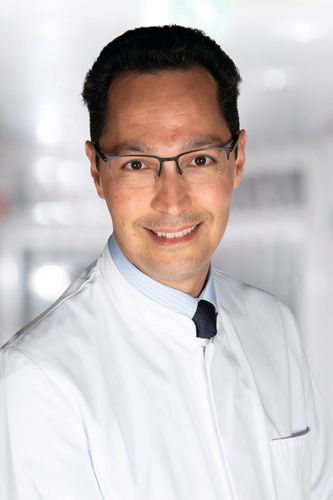
Professor Karl Philipp Kutzner, M.D., has developed remarkable expertise in the field of orthopedic surgery and is regarded as a specialist in hip and knee joint replacement. His many years of service as a senior physician in the Department of Orthopedics at St. Josef’s Hospital in Wiesbaden and his successful habilitation in orthopedics at Johannes Gutenberg University in Mainz underscore not only his professional competence but also his deep commitment to this medical discipline. As an expert in hip and knee joint replacement, Prof. Dr. Kutzner has earned an excellent reputation. With the opening of the Endoprotheticum Rhein-Main, he has established a practice that not only offers excellent medical care but also fosters a trusting atmosphere for personalized care. His specialization makes him a sought-after resource for patients with joint problems, and he guides them from consultation through treatment with great empathy and expertise.
Prof. Dr. Kutzner places great emphasis on conservative treatment methods, even given his focus on surgery. He stresses the importance of comprehensive care that extends beyond the surgical procedure itself. His range of treatments extends from minimally invasive procedures to partial joint replacement and revision surgeries, enabling him to offer a broad spectrum of treatment options. Prof. Dr. Kutzner has also specialized in partial knee replacement, which benefits many younger patients with osteoarthritis. His approach aims to provide individualized solutions that contribute to an active and pain-free life. With his practice at the Endoprotheticum Rhein-Main and the private Lilium Clinic in Wiesbaden, Prof. Dr. Kutzner offers first-class medical care in a modern setting.
He takes the time to listen to each patient and tailors treatment to their individual needs, ensuring not only durability and function but also freedom from pain and high patient satisfaction. Prof. Dr. Kutzner stands out not only for his medical expertise but also for his empathetic and dedicated commitment to his patients’ well-being, helping them achieve a better quality of life. The editorial team of the Leading Medicine Guide once again had the opportunity to speak with knee specialist Prof. Dr. Kutzner and wanted to learn more about partial knee replacement.

The knee joint is an impressive structure that is subjected to considerable stress on a daily basis. Osteoarthritis is a painful condition that attacks and wears down the joint cartilage, ultimately leading to pain, stiffness, and limited mobility. This condition affects a significant number of people worldwide and can significantly impair quality of life. In cases of advanced osteoarthritis, particularly when only certain areas of the knee are affected, partial knee replacement can be an effective solution. Unlike total joint replacement surgery, partial knee replacement replaces only the damaged or worn-out part of the knee with an implant, while preserving the healthy part of the joint. This surgical technique aims to relieve pain, restore range of motion, and improve mobility.
The first step is diagnosis.
The diagnosis of knee osteoarthritis and knee joint problems typically begins with a thorough examination by a doctor, who makes an initial assessment based on symptoms and a physical examination. Various diagnostic procedures are used for confirmation and precise evaluation. X-rays are often the first diagnostic tool used to detect bone changes, bone spurs, and the space between the bones. MRI scans provide detailed images of the soft tissues in the knee, including cartilage and ligaments, and help assess the condition of the joint more accurately. “Especially when considering a possible partial knee replacement, one should always take the time for a thorough diagnostic evaluation. In addition to standard X-rays and MRI, there are so-called weight-bearing X-rays, which clearly show and allow for the assessment of the progression of osteoarthritis in the individual knee compartments when they are under stress. This means the images are taken under load. This device for such a diagnostic procedure is essential for determining the best treatment. I’m glad to have had this option for several months now,” Prof. Dr. Kutzner says optimistically as he begins our conversation.
Blood tests can identify inflammatory markers or other factors that may be associated with osteoarthritis and provide additional information. Various methods complement one another to enable a precise diagnosis and determine the severity of knee osteoarthritis, which ultimately forms the basis for sound treatment decisions.
Partial knee replacement is not yet sufficiently established.
“Unfortunately, partial knee replacement is still sometimes given short shrift, and total knee replacements are generally preferred, even though this may not be necessary at all. Some colleagues also simply lack sufficient experience with partial knee replacements. Knee replacements often fail to achieve ideal results, and at least 10% of patients are dissatisfied with the outcome of the surgery. In my view, this is usually due to an incorrect indication. For example, if a 90-year-old woman receives a knee replacement, there is a very good chance she will be satisfied with it, since it can significantly alleviate her previous limitations and allow her, for instance, to move around her home pain-free once again. However, if we perform total knee replacement surgery on a 60-year-old working tradesman—who may also work on his knees—he may not be happy, since a total knee replacement will most likely prevent him from kneeling again, and he may perceive the prosthesis as a foreign body. Ultimately, we have a certain proportion of patients whom we must treat with great caution, particularly younger or very active and working patients. In these cases, it is essential to explain in detail exactly what activities will be limited with a knee prosthesis,” explains Prof. Dr. Kutzner. It is therefore very important that the treating physician make an accurate diagnosis and conduct a careful assessment to determine whether a partial knee replacement might not be the better option.
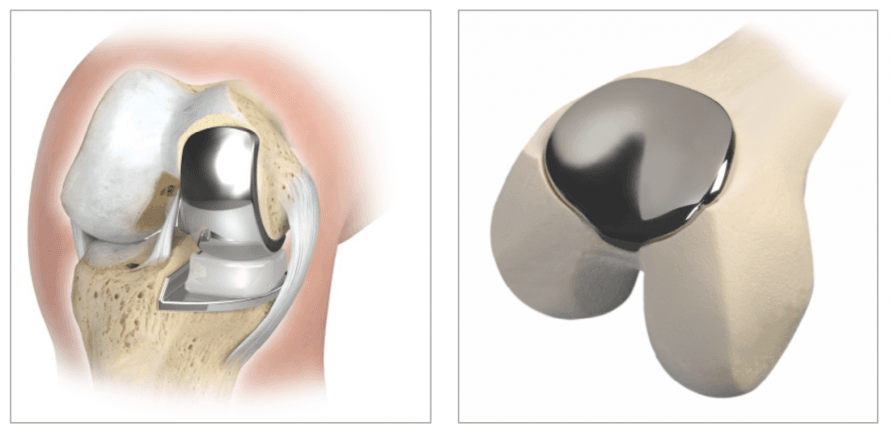
The primary indication for a partial knee replacement is degenerative joint disease.
“If there is no misalignment, age-related degenerative disease usually spreads throughout the entire knee over the years. However, it’s also the case that a young person—say, a 20-year-old—can injure the medial meniscus while playing soccer. If they undergo surgery for this, it’s not uncommon for part of the meniscus to be removed. In addition, the tear may have caused damage to the inner side of the knee. An injured meniscus is then considered a form of pre-osteoarthritis, which leads to signs of wear and tear developing at exactly this location later in life. However, this wear and tear occurs only on the inner side of the knee—that is, where the meniscus is located. The osteoarthritis is limited to one part of the knee joint. Even if people suffer from misalignments such as bowlegs, partial osteoarthritis can develop. For these individuals, a partial knee replacement may be an option. “After all, why use a total knee replacement if the rest of the knee is still fine?” argues Prof. Dr. Kutzner.
The knee and its three compartments:
The medial compartment encompasses the inner side of the knee and includes the inner portion of the thigh bone (femur) and the inner portion of the shin bone (tibia). Here, the medial collateral ligament and the meniscus are primarily responsible for ensuring stability. The lateral compartment encompasses the outer side of the knee and includes the outer portion of the thigh bone and the outer portion of the shinbone. Similar to the medial compartment, the lateral collateral ligament and the meniscus work to provide stability and protection. The patellofemoral compartment is the area between the kneecap (patella) and the front of the thigh bone (femur). This compartment is crucial for the function of the kneecap and its gliding along the femoral groove. Various ligaments, muscles, and the anatomy of the patella itself influence the stability and function of this compartment.
With a partial knee replacement, only the affected part of the knee is replaced.
“The most common partial knee replacement involves a so-called ‘sled prosthesis,’ also known as a unicondylar or unicompartmental prosthesis, which covers the affected area like a sled runner. The advantage of these ‘partial’ solutions is that all other healthy parts of the joint can be left intact. Another important point is the preservation of the knee’s natural biomechanics. Since the entire joint is not replaced and the ligament structures remain intact, the sled prosthesis can help the knee joint maintain more natural mobility and stability. This generally leads to improved function and increased comfort for patients, particularly during movements and activities of daily living. As a result, patients are often more satisfied. “The advantages and significant benefits of these partial knee replacements for isolated degenerative conditions are gradually being better understood today,” says Prof. Dr. Kutzner, commenting on the advantages of a partial knee replacement.
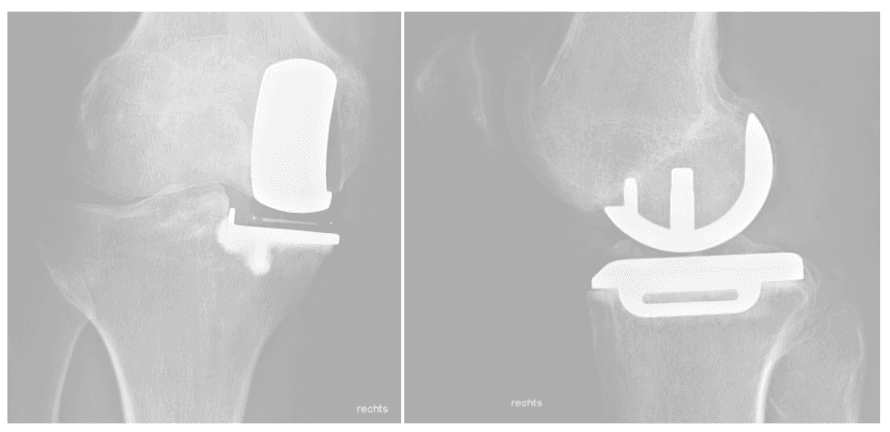
Partial knee replacement, particularly the sled prosthesis, offers a less invasive alternative to total knee replacement for selected patients with localized knee damage. Despite its advantages, there are potential drawbacks that must be taken into account.
“We cannot always predict with 100% certainty whether residual symptoms will persist after the implantation of a partial knee replacement, since a large portion of the knee remains untreated. This means that if, for example, we operate on a 50-year-old and he receives a partial knee replacement on the inner side of the knee, it is of course possible that by the time he is 70, he may gradually begin to experience symptoms on the outer side as well, since signs of wear and tear will also develop there. This presents the disadvantage that another surgery may eventually be necessary. On the other hand, switching from a partial knee replacement to a total knee replacement is generally quite straightforward. Of course, there are other reasons for revision surgery in partial knee replacements, such as loosening, wear and tear, or infections. I always recommend a partial knee replacement to younger patients when it’s an option. Even for older patients, a partial knee replacement may be the better option because it usually allows for a faster return to mobility. “The advantage of a partial knee replacement clearly lies in the greater range of motion it provides,” explains Prof. Dr. Kutzner.
Every kilogram of excess weight places significantly more stress on the knee joint and cartilage. This requires an in-depth discussion with the patient. Significant excess weight leads to an increased risk of complications, ranging from knee surgery through to rehabilitation.
If osteoarthritis is present beneath the kneecap, there are also options involving mini-implants.
In people with patellar dysplasia, the kneecap (patella) does not glide properly in the groove of the thighbone (femur), leading to instability of the kneecap. It is not uncommon for this to lead to isolated osteoarthritis of the patellofemoral joint over the course of a person’s life. Here, too, a partial knee replacement can help, explains Prof. Dr. Kutzner: “These patients—who are more often women—sometimes experience significant pain behind the kneecap, especially when walking down stairs. In some cases, certain surgeons may implant a total knee replacement—though there are actually excellent options available with so-called mini-implants. In this procedure as well, only the compartment behind the kneecap affected by wear and tear is covered with an implant. From a technical standpoint, partial knee replacement surgery is somewhat more challenging and is also covered much less frequently in medical training. In most cases, surgeons first learn to perform a total knee replacement before gaining experience with a partial knee replacement. This requires a bit more skill and theoretical knowledge. As a specialized knee surgeon, one should be well-prepared for this, because it’s simply a good way to gently help our patients regain mobility.”
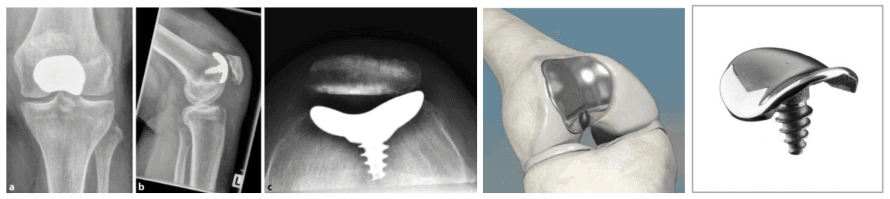
Postoperative rehabilitation following total knee replacement and partial knee replacement aims to restore the knee’s mobility, strength, and functionality.
After total knee replacement surgery, the rehabilitation phase often consists of physical therapy and exercises to strengthen the muscles around the knee. Exercises to improve flexibility and balance may also be performed. Rehabilitation lasts from several weeks to several months and is often divided into different phases, depending on the healing process and the patient’s individual response to treatment. With a partial knee replacement, the rehabilitation period is generally significantly shorter than with a total knee replacement, since less soft tissue and bone are involved. Nevertheless, a similar rehabilitation strategy is followed here as well, aimed at improving mobility and strengthening the surrounding muscles.
“With partial knee replacement surgery, a smaller incision is made during the procedure than when a total knee replacement is performed. Rehabilitation is similar in both cases. The most important thing, however, is that patients with a partial knee replacement generally still feel as though they are standing on their own bones. And if everything goes well, they can be back on the sports field after eight weeks. With a total knee replacement, that usually takes significantly longer,” says Prof. Dr. Kutzner, emphasizing: “By now, every other knee I treat is a ‘sled’!”
Exercise is good for natural knee health
“It’s never a good idea to lift heavy weights from a squatting position. Cycling is definitely a knee-friendly sport! Jogging on asphalt, on the other hand, is generally not recommended. However, the development of osteoarthritis always involves multiple factors. But the most important thing is to stay active,” recommends Prof. Dr. Kutzner, bringing our conversation to a close.
Dear Professor Dr. Kutzner, thank you very much for your time and for the insight into the complex structure of the knee joint and the individual options offered by partial knee replacements!
Share this article
About the medical author
Alexandra Pfitzmann
Editor
Alexandra Pfitzmann – medical author: expert knowledge, professional articles and medical insights in the Leading Medicine Guide.
More about the medical author →Expert Interviews
Read next
- Expert interview
Cardiogeriatrics: Significance and benefits in the context of hospital reform
Sep 21, 2026
Cardiogeriatrics: Significance and benefits in the context of hospital reform
Read more - Expert interview
Expert Interview with Professor Dr. Amadeus Hornemann, MPH
Sep 18, 2026
Prof. Amadeus Hornemann on Precision Medicine in Gynecology: Modern Surgery, New Techniques, Better Quality of Life
Read more - Expert interview
Expert Interview with Professor Dr. Konstantinos Anagnostakos
Sep 15, 2026
Prof. Anagnostakos on Painful Knee Replacements
Read more