News
PET/CT Scanner in Freiburg: A Pioneer in Technical Innovation

Sabine Schneider ·
Research is among the things that cancer patients most often pin their hopes on—whether it involves new therapies, alternative treatment approaches, or technological innovations. For medical professionals who work with cancer patients, it is therefore particularly important to always be at the forefront when it comes to technical equipment. This is especially true for PD Dr. med. Christian Weißenberger: His Center for Radiation Therapy in Freiburg plays a clear pioneering role throughout the German-speaking world—and, together with the neighboring WTZ-Ärztehaus Südbaden, has become a high-tech hub for cancer diagnostics.
It’s always a shock: for anyone confronted with a cancer diagnosis, everything changes. First and foremost, people who suddenly become patients often experience a great deal of uncertainty. The questions that arise then often race through their minds: Where exactly is my tumor located? What do these test results and findings actually mean? How active is the tumor? Has it perhaps already spread—and are there already metastases? Where? Patients would ideally like to have all their questions answered at once.
When cancer patients set out to find a doctor or a clinic, they want to be able to rely on a few things. Above all, the doctor should truly know their field—in other words, be a genuine specialist. They should be able to make precise diagnoses and then explain the situation to the patient in a way that’s easy to understand. And, of course, be honest. But what’s at least as important is that the specialist they’re looking for must have access to the best possible equipment. Not only to make a reliable diagnosis—but also to make successful treatment as likely as possible.
Center for Radiation Therapy: First-Class Equipment
 PD Dr. med. Christian Weißenberger is an experienced specialist who meets all of the above criteria—and does so exceptionally well. From the very beginning, patients at his Center for Radiation Therapy have been able to rely on receiving excellent care at an international level. In fact, the Freiburg facility has made headlines nationwide on several occasions: In 2016, for example, it became the first outpatient practice in Germany to install a radiation accelerator that combines dynamic rotational irradiation with breath-triggered irradiation in a single device. This “Gated Rapid Arc” technology enabled a level of precision in tumor treatment that was previously unheard of. It also minimizes damage to surrounding tissue, which greatly improved dose distribution. Lung and heart patients benefit from this the most.
The latest innovation is located in the building right next door, the WTZ Medical Center, with which the Center for Radiation Therapy is closely affiliated. This is where the device that provides the most precise answers to all the questions mentioned above—questions that concern cancer patients—is located: the innovative PET/CT system, a combined device consisting of a computed tomography (CT) scanner and a positron emission tomography (PET) scanner.
State-of-the-Art PET/CT Scanner
This state-of-the-art device offers many significant advantages. One of the most important is that it causes minimal discomfort to patients. It also operates very quickly, enabling highly precise diagnostics in a short amount of time. Incidentally, the PET/CT scanner isn’t used solely for cancer diagnoses: the procedure is equally suitable for inflammatory, orthopedic, or neurological conditions—and it can even be used to perform informative cardiological examinations.
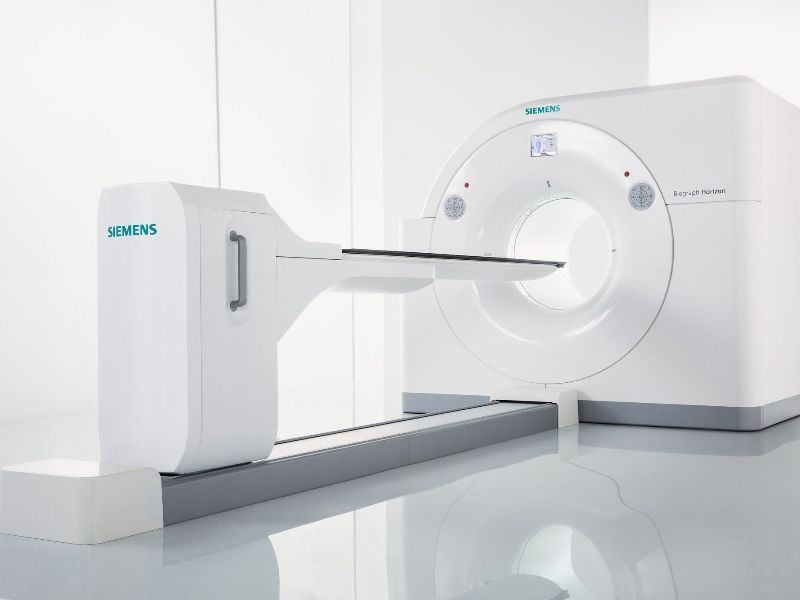
With the “Biograph HorizonTM” PET/CT scanner from Siemens—one of the most advanced in the entire German-speaking world—the entire network of private medical practices in the Freiburg area now has a tremendous asset for the delivery and planning of radiation therapy. As a key diagnostic component, the scanner supports the range of oncological services offered by cancer centers throughout the region. Although many other medical specialties benefit from the new installation—such as cardiologists, orthopedists, and neurologists—it primarily opens up a new dimension in first-class diagnostics and meaningful treatment monitoring—particularly for prostate cancer, breast cancer, and lung cancer, as well as lymphoma and malignant melanoma, i.e., malignant melanoma of the skin.
A Pioneering Innovation Not Just for Cancer Patients
Word of this groundbreaking innovation has now spread throughout the southern Baden region. Patients in the Breisgau and Black Forest regions will be delighted by the resulting benefits—as will those from neighboring France and nearby Switzerland. This is because the PET/CT scanner at the medical center will soon be used regularly for many other types of tumors as well—such as colorectal and anal cancers, pelvic tumors, breast cancer, and esophageal cancer. Patients with brain tumors or neuroendocrine tumors will also benefit from the fast, accurate diagnostics. The Siemens innovation is even suitable for diagnosing Parkinson’s disease and dementia.
However, anyone who thinks that an examination with the PET/CT system is comparable to a conventional CT scan will be surprised at first glance at the device: Its extremely compact design, featuring a wide yet surprisingly short tunnel and a comfortable patient table, ensures unexpected comfort. Since many patients have issues with the familiar long tubes—which can ultimately trigger anxiety—the specially developed “FlowMotionTM” technology is used: The table does not move in steps during the scan, but rather continuously—smoothly, as the name suggests. The highly sensitive sensors, which enable a significantly reduced radiation dose, ensure the best results—in a greatly shortened examination time of well under thirty minutes.
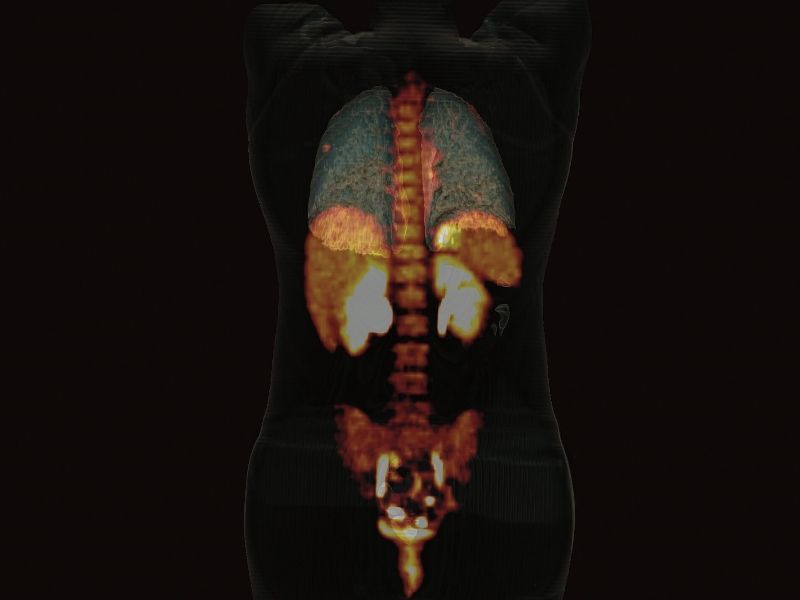
The morphological imaging is nothing short of remarkable: for example, when lymph nodes are affected by a certain type of cancer, this is not accompanied by lymph node enlargement until a later stage of the disease. A CT scan alone, therefore, cannot reveal that the lymph nodes are actually affected by the tumor.
Thanks to PET/CT, however, abnormal tumor metabolism can be identified and tumor metastasis detected. It is the fusion of these two techniques that allows the exact location of the affected lymph nodes to be visualized. This makes it possible—for example, in cases of prostate cancer or breast cancer—to target these lymph node metastases with radiation therapy.
Highly Informative Imaging
For PD Dr. med. Christian Weißenberger and all other physicians, this imaging provides an enormous amount of information—with multiple benefits. This allows the specialist to determine the exact stage of the cancer before treatment begins and to precisely determine which therapy is most appropriate for patients at the Center for Radiation Therapy. And after treatment, a PET/CT scan can be used to assess early on whether and how the treatment has been effective. This provides the specialist with information that enables individualized treatment of the highest standard. Patients thus receive the best possible, most tolerable treatment—whether it be surgery, radiation therapy, or chemotherapy.
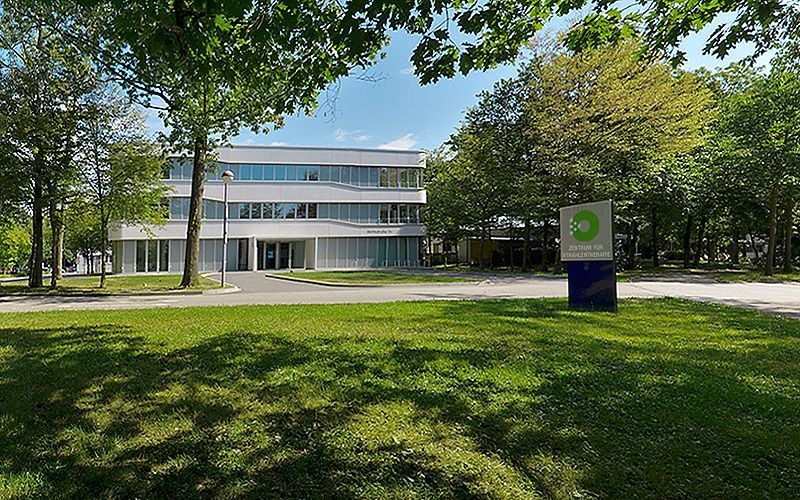
Incidentally, patients in Freiburg have responded very positively to the new machine. No wonder—after all, there are only advantages: The scan is guaranteed to be anxiety-free, using a fraction of the conventional radiation dose—and it’s completed in an astonishingly short time. In addition, the machine is located right next to the Center for Radiation Therapy in a pleasant setting. Even though patients of PD Dr. med. Christian Weißenberger and his skilled team are accustomed to the highest standards of patient care, the light-filled room housing the device offers a view of the treetops of the Mooswald.
This state-of-the-art device at the WTZ Medical Center in Freiburg represents a forward-looking turning point not only for the Center for Radiation Therapy but also for radiologists, nuclear medicine specialists, and other medical specialists in southern Germany. Through shared use, the costs of this expensive device are sensibly spread across multiple institutions. This ensures that the state-of-the-art, medically vital PET/CT combination can be sustained in the long term—and that patients are guaranteed care from their treating physician and their team. Thus, future cancer patients, too, can at least hold on to this hope: At the Center for Radiation Therapy and throughout the Freiburg area, the best possible care is provided during treatment and therapy—based on technically advanced equipment.
Share this article
Verified expertise
Recommended specialists
4 specialists
4 results

Thoraxklinik-Heidelberg gGmbH
Heidelberg



Prof. Dr. Detlev Uhlenbrock
Dortmund


News
Read next
- News
Heat Rash: What's Behind the Itchy Blisters
Oct 23, 2026
Heat Rash: Heat and Sweat Can Disrupt the Skin's Balance
Read more - News
Enlarged Prostate – When Medication Is Sufficient and When Surgery Is Recommended
Oct 21, 2026
Why Many Men Ignore Urinary Problems for Too Long
Read more - News
Daraxonrasib as a treatment for metastatic pancreatic cancer
Oct 21, 2026
Daraxonrasib: Survival time almost doubled in the study
Read more