News
Meniere's Disease: Sudden Vertigo Originating in the Inner Ear

Melanie Al Tikriti, BSc ·
Episodes of dizziness usually occur without warning.
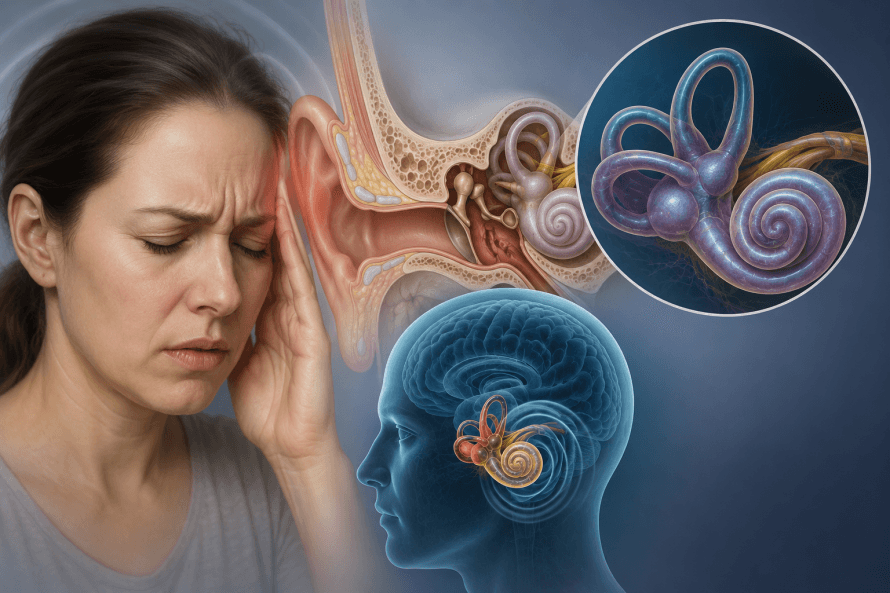
Suddenly, everything around you starts spinning. This is accompanied by nausea, a sensation of pressure in the ear, and a feeling that your hearing has worsened. These symptoms may indicate Meniere’s disease—a chronic disorder of the inner ear characterized by recurring episodes of vertigo. The attacks often occur unexpectedly and can significantly disrupt daily life. Many people affected feel completely helpless during an attack and must stop what they’re doing immediately.
Although Meniere’s disease is incurable, the symptoms can often be effectively managed. An early diagnosis and a personalized treatment plan can help reduce the frequency of attacks and improve quality of life.
What Lies Behind the Condition
The inner ear contains both the organ of hearing and the organ of balance. Both are filled with a special fluid that is necessary for their normal function. In Meniere’s disease, this fluid balance becomes disrupted. As a result, pressure in the inner ear increases, and the sensitive sensory cells are temporarily disrupted.
Why these changes occur is not yet fully understood. It is believed that several factors interact. Among other things, genetic influences, disturbances in fluid regulation, or changes in the immune system are being discussed.
Symptoms usually occur in episodes
The typical characteristic of Meniere’s disease is the simultaneous occurrence of multiple symptoms. Vertigo attacks usually begin suddenly and can last anywhere from 20 minutes to several hours.
The most common symptoms include:
- severe rotational vertigo
- Nausea and vomiting
- Hearing loss in one ear
- ringing in the ears (tinnitus)
- A feeling of pressure in the affected ear
- Balance problems
- Unsteadiness when walking
Between episodes, many people affected initially feel completely healthy again. However, as the disease progresses, hearing may deteriorate permanently.
Why daily life is often severely limited
The symptoms do not affect only the vestibular system. Over time, many people develop a sense of insecurity and fear of the next vertigo attack, as it can occur at any time.
Simple everyday activities such as driving, shopping, or exercising often become a challenge as a result. Some people increasingly withdraw from their social lives out of fear of another episode. This makes good medical care and an open approach to the condition all the more important.
Other causes must be ruled out
Not every episode of dizziness is caused by Meniere’s disease. Benign positional vertigo, inflammation of the vestibular system, migraines, or neurological disorders can also cause similar symptoms. Therefore, the first step is a detailed discussion of the symptoms and their progression. Various hearing and balance tests are then performed.
Depending on the findings, additional blood tests or an MRI may be necessary to rule out other conditions.
What Treatment Options Are Available
Treatment depends on whether an acute attack is currently occurring or whether the goal is to prevent further episodes of dizziness. During an attack, medications for dizziness and nausea are often used. They can help alleviate symptoms and stabilize circulation.
In the long term, various medications are available that are designed to reduce the frequency of attacks. If these measures are not sufficient, special injections or surgical procedures may be considered in certain cases. The appropriate treatment depends on the individual situation of the person affected.
What People with Meniere’s Disease Can Do Themselves
Even though Meniere’s disease cannot be completely prevented, certain measures can make daily life easier.
The following are helpful, among other things:
- Reducing stress as much as possible
- getting enough sleep
- Avoiding alcohol and nicotine as much as possible
- Eating and drinking regularly
- Be aware of your personal triggers
- Take prescribed medications consistently
Keeping a symptom diary can also help you better identify potential triggers or patterns and tailor your treatment accordingly.
How the condition may progress
The course of Meniere’s disease varies greatly. Some people experience only a few episodes of vertigo, while others suffer from them for years. Over time, these episodes become less frequent for many people with the condition. At the same time, hearing in the affected ear may deteriorate permanently.
Conclusion: With the right treatment, it is often possible to better manage daily life again.
Meniere’s disease can significantly impair quality of life due to sudden episodes of vertigo. However, modern treatment options and a proactive approach to managing the condition can help alleviate symptoms and make daily life safer again. Close collaboration with your treating physician helps tailor the treatment plan to your individual needs.
Share this article
Verified expertise
Recommended specialists
7 specialists
7 results

GASSMANN MEDICAL
Münstertal (Black Forest)


Dr. med. Regina Becker
Munich





News
Read next
- News
Scabies: A contagious skin disease that is easily treatable
Oct 26, 2026
Severe itching and minor skin changes should be taken seriously
Read more - News
Heat Rash: What's Behind the Itchy Blisters
Oct 23, 2026
Heat Rash: Heat and Sweat Can Disrupt the Skin's Balance
Read more - News
Enlarged Prostate – When Medication Is Sufficient and When Surgery Is Recommended
Oct 21, 2026
Why Many Men Ignore Urinary Problems for Too Long
Read more