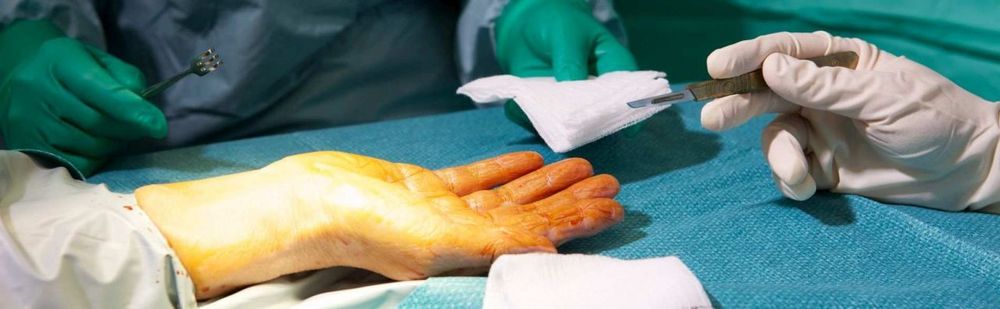
Hand surgery is a medical specialty that deals with injuries, diseases, and congenital abnormalities of the hand. In addition, the upper arm, forearm, and shoulder also fall within the scope of a hand surgeon's practice.
Although the term “hand surgery” might suggest otherwise, non-surgical, conservative treatment is also part of hand surgery. It is used whenever the patient’s impairment is not yet too severe. However, if the patient can no longer move their fingers or hand properly and/or has been experiencing severe pain over an extended period, surgical intervention is necessary.
What conditions are treated in hand surgery?
The field of hand surgery is extremely broad. Hand surgeons treat
- burns,
- injuries,
- malformations,
- malalignments,
- inflammation,
- chronic degenerative diseases,
- chronic pain, and tumors of the hands, fingers, and arms.
In addition, due to their specialized training, they are able to amputate finger joints and parts of the hand and replace them with appropriate prostheses.
Injuries and Malformations of the Hand
Injuries caused by accidents result in damage not only to bones but also to soft tissues (muscles, tendons, nerves, and blood vessels). In addition to limited mobility of the structures and pain, these injuries can also lead to numbness and paralysis. These conditions must always be treated by a specialist in hand surgery.
Overuse can also cause pain and changes in the position of structures in the arms and hand. This can lead, for example, to tendon insertion problems (golfer’s elbow, tennis elbow).
Sometimes, the hand surgeon also deals with congenital malformations such as polydactyly: Patients—usually young children—have too many fingers on their hands. Over the course of their lives, the extra fingers can become a nuisance, so one or more fingers may be surgically removed.
A very common condition treated at the clinic or medical center is a ganglion cyst. In this condition, a joint or tendon protrudes outward. This protrusion contains an accumulation of tissue fluid. Since a ganglion cannot be treated conservatively, surgery is necessary.
Dupuytren’s contracture, which affects 6 to 9 times more men than women in older age groups, is also one of the more common conditions encountered in hand surgery. The patient suffers from a curvature of several fingers that becomes increasingly severe over the course of their life, progressively limiting the hand’s mobility. In this condition, the cause of which has not yet been scientifically clarified, there is a significant proliferation of subcutaneous connective tissue on the palm side of the hand. If conservative treatment using the enzyme collagenase is ineffective, the hand surgeon surgically removes the excess tissue. Collagenase is produced biotechnologically from a species of bacteria (Clostridium).

By Efstathios Chronopoulos, Nikolaos Ptohis, Christos Karanikas, Alkis Kalliakmanis, Spyros Plessas, Ioannis Neofytou, Fotios Laspas, Ioanna Tzovara, and Athanasios Chalazonitis - Efstathios Chronopoulos, Nikolaos Ptohis, Christos Karanikas, Alkis Kalliakmanis, Spyros Plessas, Ioannis Neofytou, Fotios Laspas, Ioanna Tzovara, and Athanasios Chalazonitis: Patient presenting with a lipoma of the index finger: a case report. In: Cases Journal 3, 2010, 20. doi:10.1186/1757-1626-3-20 PMID 20205806 (Open Access), CC BY-SA 2.0, Link
Inflammatory Conditions
Tendinitis is one of the inflammatory conditions treated by hand surgeons. It results from an infection of the soft tissues, overuse, or injuries (strains) to the hand or wrist. Chronic cases of tenosynovitis require surgical treatment to prevent the tendons from becoming pinched later on.
If the patient suffers from polyarthritis (rheumatic inflammation of the joints affecting the entire body), the joint inflammation will, as the disease progresses, destroy the entire joint and require treatment by a hand surgeon.
Signs of Wear and Tear in Hand Surgery
Thumb osteoarthritis often occurs following accidents or due to naturally loose joint ligaments. Signs of wear and tear in the thumb saddle joint are more common in patients aged 40 and older and cause pain and limited thumb function. If pain-relieving medications are no longer effective, the thumb saddle joint is surgically removed.
Nerve Compression Syndromes
Trapped nerves are also part of the hand surgeon’s area of expertise. For example, if the median nerve runs through a narrowed bony canal, the canal compresses the nerve, causing pain, numbness, and sometimes even paralysis.
Carpal tunnel syndrome occurs in women in connection with hormonal changes (menopause, pregnancy) and can also be congenital. If conservative treatment is unsuccessful, a carpal ligament release is performed at the clinic.
If the other two nerves in the hand are affected, the condition is referred to as Guyon’s canal syndrome or supinator syndrome. To prevent permanent nerve damage, surgery is performed if corticosteroid therapy is unsuccessful.
Treatment of Circulatory Disorders
Circulatory disorders affecting bones and soft tissues, such as lunate osteonecrosis, also fall within the scope of hand surgery.
Tumors of the Hand
Occasionally, the hand surgeon must even remove benign or malignant tumors in the hand, arm, and shoulder region. An enchondroma, for example, is a benign growth of cartilage tissue located on the hand bones. It often occurs in large numbers.
If too much tissue has been destroyed, amputation is often the only option. In the hospital, a finger joint, the entire finger, or the entire hand is amputated. Other patients receive a finger joint implant or an endoprosthesis to replace the damaged joint that was removed.
Which medical specialists focus on hand surgery?
The specialty of hand surgery initially emerged from the fields of general surgery and orthopedics. In Germany, hand surgeons are board-certified specialists in
- orthopedics
- Orthopedics and Trauma Surgery
- Surgery
- Plastic Surgery / Aesthetic Surgery
After passing their board certification exam, they complete an additional 36 months of specialized training in hand surgery.