Small toe deformities are misalignments that occur in the small toes—that is, not in the big toe. Rarely are they isolated forefoot deformities occurring on their own. Most often, these misalignments are part of a more complex forefoot deformity that usually involves the big toe as well. Nevertheless, misalignments of the smaller toes must be considered a separate entity within the treatment plan.
Here you will find further information as well as a selection of specialists and centers for deformities of the lesser toes.
Definitions of Small Toe Deformities
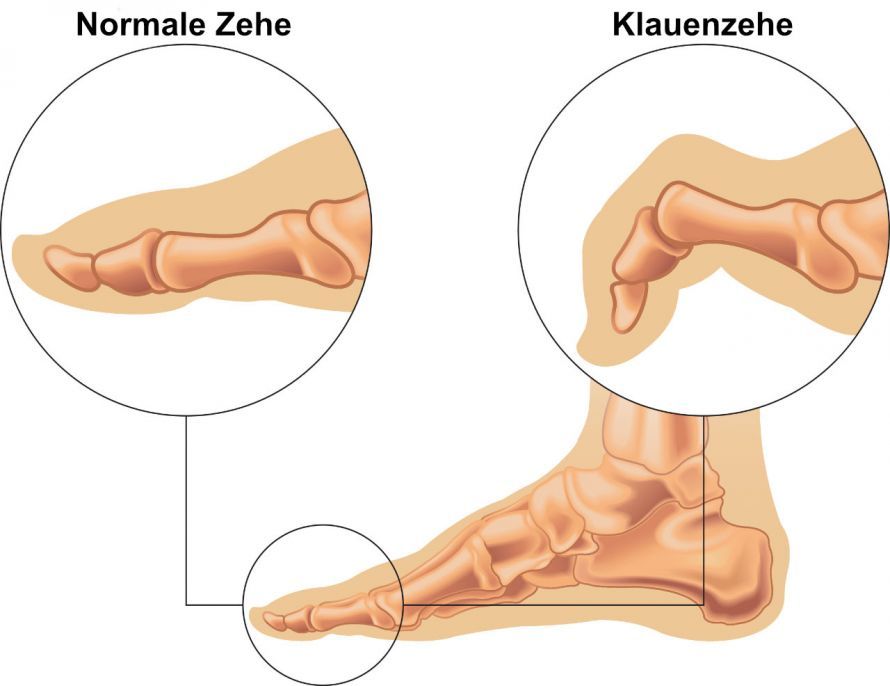
Minor toe deformities often consist of misalignments at multiple toe joints. The definition of the various minor toe deformities is generally based on the deformity closest to the body:
- In the case of a claw toe, there is always a (sub)luxation directed toward the top of the foot in the metatarsophalangeal joint. Luxation refers to a dislocation. A subluxation is an incomplete, i.e., partial, dislocation. In most cases, a claw toe is accompanied by a flexion deformity in the middle joint, and the tip of the toe has lost contact with the ground.
- In a claw toe, the flexion deformity is present in the middle joint. In this case, the tip of the toe may still be in contact with the ground. Sometimes, other toe deformities are present as well.
- A hammer toe is characterized by an isolated flexion deformity at the distal joint. In this case, the tip of the toe remains in contact with the ground.
- In addition, there are other minor toe deformities, such as “mallet toe,” “curly toe,” or “Taylor’s bunion.”
Intact, mobile little toes are necessary for balancing the foot, and they play an important dynamic role in the foot’s push-off phase. Little toe deformities can therefore significantly impair the function and stability of the foot.
What are the causes of small toe deformities?
One cause of small toe deformities can be increasing tension in the long flexor tendons of the small toes. This is often caused by
- often external factors, such as shoes that are too tight or accidents,
- less commonly physical factors, such as excessively long little toes (so-called “Greek foot” shape), or
- neurological disorders.
In most cases, misalignments of the small toes occur alongside other foot deformities, such as hallux valgus. Misalignments of the small toes are also often seen in conjunction with pes cavus deformities.
What are the symptoms of little toe deformities?
If ill-fitting shoes are the cause of a deformity, calluses form over the middle joint of the toe. In cases of impaired (pathological) weight-bearing during walking, calluses appear under the metatarsophalangeal joint.
Often, those affected cannot touch the ground with the tip of their toe. Sometimes, abnormalities in toenail growth also occur.
Over time, pain develops, even in adjacent toes that are not affected. Because of the pain, those affected will sooner or later see a doctor.
What does the diagnostic process for small toe deformities involve?
The doctor examines the joints for the aforementioned externally visible signs and misalignments. In doing so, the doctor also assesses the stability of the joints as well as their remaining range of motion.
An X-ray of the foot taken while the patient is standing then confirms the diagnosis.
In some cases, additional tests, such as a foot pressure measurement, may be necessary. Foot pressure measurement is often used in preparation for revision surgery. Revision surgery refers to procedures used to correct an initial surgery that was not sufficiently successful.
Magnetic resonance imaging (MRI) also does not play a significant role in the diagnostic process. It is used only to rule out other conditions. This is necessary when the present symptoms are not clear enough to make a definitive diagnosis.
What is the treatment for misalignments of the small toes?
In general, both conservative (non-surgical) and surgical measures are available to correct toe deformities.
However, conservative methods can only correct a toe deformity during the growth phase. In adults, only surgical intervention can correct a toe deformity.
In some cases, conservative measures may be used in adults to prevent the condition from worsening. While commercially available devices (“toe correctors”) suggest correction without surgery, they do not guarantee success.
Conservative Treatment of Small Toe Deformities
Useful conservative measures include proper shoe modification to adapt the shoe to the deformity. Care should be taken to ensure a sufficiently spacious toe box with soft upper leather.
Orthotic insoles for shoes are also a common measure. They are designed to support the metatarsal bones behind their “heads.” Soft foam padding is helpful for the ball of the foot.
In addition, many patients also find small interdigital pads useful.
Surgical Treatment of Small Toe Deformities
The choice of surgical procedure depends on
- whether the toe joints are stable or unstable and
- whether the resulting flexion deformity is flexible or contracted.
In cases of flexible flexion contracture at the middle joint, flexor tendon transfer is a viable surgical option. A prerequisite is that the proximal joint is stable. This is known as the Girdlestone-Taylor technique.
In this procedure, the excessive flexor tendon tension is redirected to the extensor side of the toe. This results in extension at the metatarsophalangeal and middle joints. The result is secured with a tape bandage for 3 weeks.
If the metatarsophalangeal joint is stable and there is a contracture with flexion deformity in the middle joint, “resection arthroplasty” of the metatarsal head is possible (Hohmann technique).
In this procedure, the proximal phalanx is shortened by about one-third so that the middle joint can be brought into extension. The result is stabilized with a wire for 3 weeks.
In cases of an unstable proximal joint with (sub)luxation of the proximal phalanx, this malalignment must first be corrected. The “translational osteotomy of the metatarsal head” (Weil technique) is suitable for this purpose. In this procedure, the metatarsal head is shortened to the extent necessary to achieve a stable joint position. The osteotomy is secured with a screw.
What does follow-up care for small toe deformities involve?
A special cast shoe is often recommended until the injury has fully healed. A so-called “forefoot-relief shoe” is also an option. Depending on the extent of the procedure, you should wear this shoe for 4 to 6 weeks.
Thrombosis prophylaxis—that is, measures to prevent blood clots—is often recommended during this time. This is particularly necessary if the affected foot cannot bear full weight.
Shortly after surgery, measures to reduce swelling are also implemented, such as
- elevation,
- initial ice application,
- and, if necessary, lymphatic drainage.
In addition, physical therapy is provided. Particular attention is paid to
- flexibility in the metacarpophalangeal joint,
- extension in the midfoot joint, and
- strengthening the so-called intrinsic foot muscles.
These exercises can then be quickly performed independently at home.
Prognosis for Small Toe Deformities
Provided the indication is clearly established and the surgical technique is correctly applied, a significant improvement in the original foot deformity can be expected. As a rule, the accompanying pain has subsided by the end of the healing phase.
In isolated cases, despite the most meticulous approach, a slight limitation of motion may remain in the metatarsophalangeal and midfoot joints. However, this has no functional significance, or at most only a minor one. It also does not lead to any noticeable or visible impairment of gait.
For many of these surgeries, an outpatient procedure is entirely feasible. This means the patient does not need to stay in the hospital but can return home on the day of the surgery.
However, the patient should expect the healing process to take 4 to 8 weeks. This depends on the treatment and surgical method used.
Afterward, the patient can gradually resume athletic activities. Full athletic capacity should be restored after 12 weeks (for “stop-and-go” sports).
Share this article