News
Shockwave Therapy: How High-Energy Sound Waves Can Relieve Chronic Pain and Prevent Surgery

Sabine Schneider ·
Chronic pain in tendons, ligaments, and muscles can severely impair quality of life. Patients have often gone through a long ordeal of trying various ointments, pills, and physical therapy without experiencing lasting relief. When conservative treatments no longer work and surgery is being considered, modern orthopedics offers an effective interim solution: extracorporeal shock wave therapy (ESWT).
Detailed information on the physical principles, areas of application, and risks can be found in our comprehensive technical article: Shock Wave Therapy
From Kidney Stone Crusher to Orthopedic Standard
The technique was originally developed in urology to break up kidney stones without surgery. In the 1990s, however, physicians discovered that the high-energy sound waves also had remarkable effects on orthopedic conditions. Today, shock wave therapy has become an indispensable part of treating sports injuries and degenerative diseases.
The principle is physically simple but biologically highly effective: A device generates pressure waves outside the body (“extracorporeal”) that are transmitted through the skin into the tissue. There, they release their energy specifically at the painful area.
How does the shock wave work in the body?
Contrary to popular belief, in orthopedic applications (such as calcific tendinitis of the shoulder), the shock wave does not simply “shatter” the deposits mechanically like a stone. Rather, it triggers a complex biological response:
-
Promotion of blood circulation: The waves stimulate the formation of new, fine blood vessels.
-
Metabolic activation: Anti-inflammatory processes are initiated.
-
Cell regeneration: The body is stimulated to repair damaged tissue.
-
Pain reduction: The transmission of pain signals through the nerves is inhibited.
Simply put: The shock wave awakens the body’s self-healing powers in areas where the healing process has chronically “fallen asleep.”
Radial or Focused: The Two Variants
Depending on the condition, doctors use different types of shock waves:
-
Radial shock waves: These spread spherically and tend to act more superficially. They are ideal for treating widespread muscle tension or tendon insertion issues (e.g., tennis elbow).
-
Focused shock waves: These waves are precisely focused on a tiny deep-seated area. They are used for deeper-seated problems, such as calcific tendinitis of the shoulder or poorly healing bone fractures (pseudoarthrosis).
When is shock wave therapy helpful?
The list of indications is long. The method has proven particularly effective for the classic “common musculoskeletal conditions”:
-
Heel spurs (plantar fasciitis): Stabbing pain on the sole of the foot is one of the most common reasons for treatment.
-
Calcific tendinitis (tendinosis calcarea): The waves help dissolve the painful calcium deposits in the tendon so that the body can eliminate them.
-
Tennis or golfer’s elbow: Chronic inflammation of the tendon insertions often responds very well to stimulation by sound waves.
-
Achilles tendon issues: Pain in the heel or thickening of the tendon.
-
Delayed bone healing: When bones do not fuse after fractures, shockwave therapy can stimulate bone growth again.
Treatment Procedure: Short and Efficient
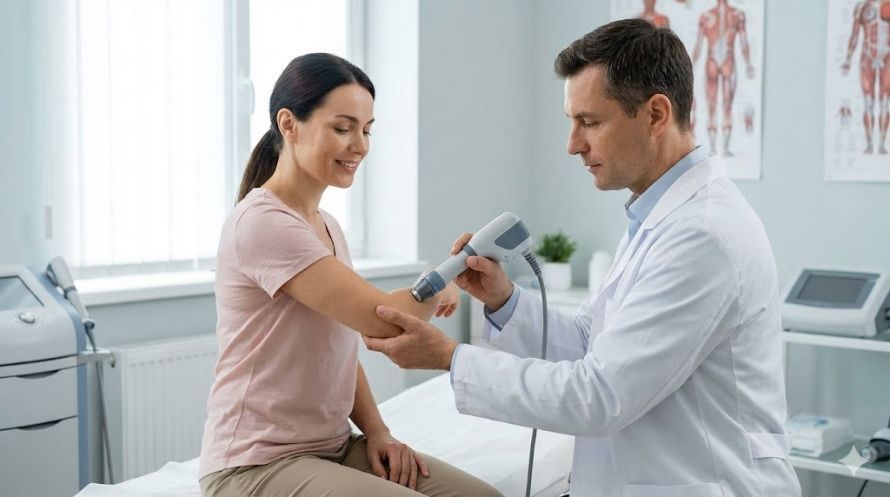
A session usually lasts only 5 to 15 minutes. The doctor locates the pain site (often using ultrasound), applies a contact gel, and places the transducer on the skin. The treatment is not entirely pain-free—patients clearly feel the pressure pulses—but it is usually well tolerated. Typically, 3 to 5 sessions, spaced one week apart, are necessary to achieve lasting results.
Conclusion: A Real Alternative to Surgery
Shock wave therapy is a low-risk procedure that can spare many patients the need for surgery or long-term use of pain medication. Since it is a non-covered medical service (IGeL) that is not always covered by public health insurance, it is worth consulting a specialist in orthopedics or trauma surgery to assess the chances of success in your specific case.
Share this article
Verified expertise
Recommended specialists
11 specialists
11 results
GASSMANN MEDICAL
Münstertal (Black Forest)




Dr. med. Dipl. Psych. Simone Heymann
PracticeProprietor



PD Dr. med. Dariusch Arbab
Herten, Westphalia

Professor Dr med. Christoph Wiese
Braunschweig

1 / 2
News
Read next
- News
Scabies: A contagious skin disease that is easily treatable
Oct 26, 2026
Severe itching and minor skin changes should be taken seriously
Read more - News
Heat Rash: What's Behind the Itchy Blisters
Oct 23, 2026
Heat Rash: Heat and Sweat Can Disrupt the Skin's Balance
Read more - News
Enlarged Prostate – When Medication Is Sufficient and When Surgery Is Recommended
Oct 21, 2026
Why Many Men Ignore Urinary Problems for Too Long
Read more