News
Stent Implantation – Explained in Terms Easy to Understand for Laypeople, Patients, and Doctors

Sabine Schneider ·
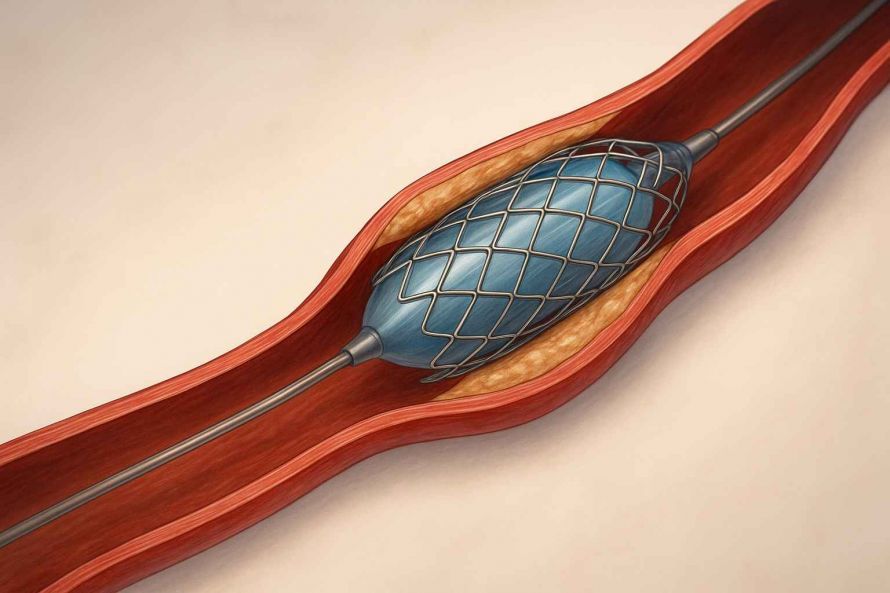
Stent implantation is a minimally invasive procedure in which a small mesh tube (“stent”) is inserted into a narrowed or blocked blood vessel to ensure a permanent flow of blood. This procedure is frequently used to treat narrowing of the coronary arteries or peripheral vascular disease.
Causes & Indications
Stent implantation is particularly indicated when:
- there is a narrowing of the vessel (stenosis) caused by atherosclerotic deposits that impedes blood flow.
Symptoms such as chest pain (angina pectoris), shortness of breath on exertion, or a heart attack indicate a significant circulatory disturbance in the coronary arteries. - there is a circulatory disorder (“peripheral arterial disease,” or PAD) or a narrowing in the peripheral arteries that conservative therapy has been unable to sufficiently improve.
Procedure
- Access & Preparation
The physician inserts a catheter via the groin or wrist (often the femoral artery or radial artery). - Visualization of the Narrowing
A guidewire guides the catheter to the affected area. Contrast dye aids in visualizing the vascular narrowing on X-ray. - Dilation & Stent
Placement An attached balloon is inflated to open the vessel, and the stent is positioned and deployed accordingly. - Completion & Follow-up
After successful placement, the catheter is removed, and the stent remains in place permanently to support the vessel.
Follow-up Care & Important Information
- Medications: Antiplatelet agents are often required immediately after implantation to prevent blood clot formation within the stent.
- Monitoring: An overnight stay or observation following the procedure is common; in uncomplicated cases, the patient can usually resume mobility relatively quickly.
- Lifestyle & Follow-Up: Exercise, a healthy diet, smoking cessation, and management of risk factors such as high blood pressure or diabetes are important.
- Access Site: Small hematomas or a feeling of pressure at the puncture site are normal; if you experience unexpected pain, swelling, or bleeding, you should notify the treatment team.
Benefits & Risks
Benefits:
- Minimally invasive—no major surgery required.
- Rapid restoration of blood flow and often rapid improvement in symptoms.
- A widely used standard procedure with high safety and success rates in experienced centers.
Risks:
- As with all procedures, there is a risk of bleeding, infection, or a reaction to the contrast agent.
- Restenosis may occur—that is, a new narrowing in or around the stent.
- Stent thrombosis (acute occlusion within the stent) is rare but potentially life-threatening.
Prognosis – What Can Patients and Doctors Expect?
With modern technology and good follow-up care, long-term outcomes are generally very good: Most patients can return to a normal quality of life, resume physical activities, and experience a significant reduction in symptoms. However, the following factors are crucial:
- careful selection of the procedure and stent type (e.g., drug-eluting stent vs. bare-metal stent)
- consistent follow-up care and management of risk factors
Share this article
Verified expertise
Recommended specialists
12 specialists
12 results




Dr. med. Konstantinos Verginis
Duisburg



Dr. med. (syr) Amer Jomha
Bad Hersfeld

Dr Thomas Riester
Karlsbad







1 / 2
News
Read next
- News
Scabies: A contagious skin disease that is easily treatable
Oct 26, 2026
Severe itching and minor skin changes should be taken seriously
Read more - News
Heat Rash: What's Behind the Itchy Blisters
Oct 23, 2026
Heat Rash: Heat and Sweat Can Disrupt the Skin's Balance
Read more - News
Enlarged Prostate – When Medication Is Sufficient and When Surgery Is Recommended
Oct 21, 2026
Why Many Men Ignore Urinary Problems for Too Long
Read more