News
Early Detection: What Are the Signs of Lung Cancer?

Sabine Schneider ·
The mortality rate for lung cancer remains high because the disease is often diagnosed at a late stage, when it has already metastasized. On average, about 45,000 patients die from this type of cancer each year. Approximately 57,000 people are newly diagnosed with the disease each year. What are the signs?
Heavy (former) smokers and passive smokers have emerged as a clear risk group. In addition, other pollutants such as asbestos and diesel soot in industrial settings can contribute to lung cancer.
Until now, there have been no early detection programs in this country for known risk groups. As of July 1, 2024, the regulation issued by the Federal Ministry for the Environment, Nature Conservation, and Nuclear Safety has taken effect, allowing low-dose CT scans to be provided as an individual health service (IGeL). The Joint Federal Committee (G-BA) is currently reviewing its inclusion in the catalog of guidelines and, accordingly, whether statutory health insurance plans will cover the costs.
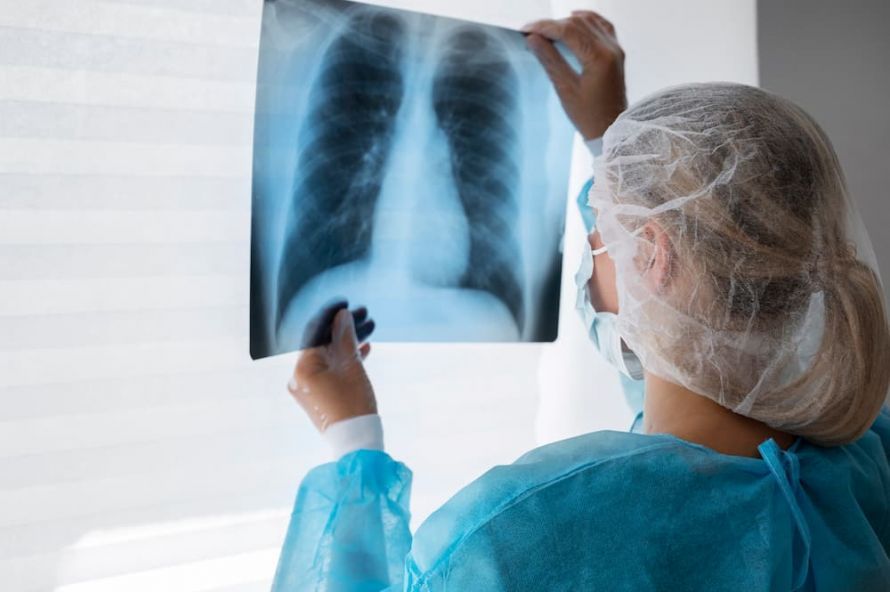
What symptoms indicate lung cancer?
One of the biggest problems with lung cancer is that symptoms do not appear until very late in the disease’s progression. As a result, bronchial carcinoma is often not detected until the disease is already at an advanced stage. The following is a list of typical signs of lung cancer, although these symptoms may also be associated with other illnesses. Therefore, a diagnosis by a specialist should always be sought:
- persistent cough
- bloody sputum
- shortness of breath
- chest pain and/or bone pain
- sudden weight loss
- Fever spikes
- Hoarseness
- Difficulty swallowing
- Clubbing of the fingers (thickening of the soft tissue at the fingertips)
- Swollen lymph nodes above the collarbone
- Wheezing
- Fatigue and reduced performance
Risk groups for bronchial carcinoma
Few other types of cancer have such clearly defined risk groups as lung cancer. Heavy smokers, former smokers, and secondhand smokers make up the majority. In addition, workers who are regularly exposed to asbestos, diesel soot, and other pollutants such as arsenic, chromium, nickel, etc., have an increased risk of developing lung cancer. Genetic factors may also play a role, albeit a minor one.
Since tobacco use is the primary cause, an early detection program was developed for heavy smokers between the ages of 50 and 75. Experts and policymakers were involved in its development. The Federal Ministry for the Environment, Nature Conservation, and Nuclear Safety gave its approval as early as last summer; however, the Joint Federal Committee has yet to make a decision regarding the adjusted implementation and coverage of costs.
How does lung cancer screening work?
The screening is to consist of a low-dose CT scan, which produces X-ray images of the lungs to detect changes such as tumors. Eligibility criteria for the screening: Participants must be heavy smokers who are currently asymptomatic and fall within the specified age range. In order to offer this service—which is currently still classified as an IGeL—special requirements also apply to medical practices.
HANSE Lung Check in Hanover, Lübeck, and Großhansdorf as a Pilot Program
From July 2021 through the summer of 2023, participants were invited to take part in the HANSE Lung Check. Led by the Hannover Medical School (MHH), the program was designed to demonstrate how a lung cancer early detection program for high-risk groups can be effectively implemented and carried out.
DZL Breath Test
Since 2017, a breath test developed by the DZL (German Center for Lung Research) has also been in the development phase; it is designed to detect lung cancer with a high degree of accuracy based on exhaled air. However, the current status of this early-diagnosis method is unknown.
Risks of the Lung Cancer Early Detection Method
CT scans do not always yield a correct diagnosis. In some cases, suspicious changes are classified as lung cancer, leading to further, often stressful examinations that would not have been necessary at all.
Even with a low-dose CT scan, there is still radiation exposure, which in turn can increase the risk of cancer.
Nevertheless, according to experts, the benefits of screening for the identified risk group outweigh the risks, as treatment can be initiated more quickly and successfully in the event of a serious diagnosis.
Sources:
- https://www.gesundheitsforschung-bmbf.de/de/atemtest-zur-fruherkennung-von-lungenkrebs-6999.php
- https://dzl.de/news/lungenkrebs-eine-offizielle-forschungserklaerung-der-american-thoracic-society-ats/
- https://www.krebsinformationsdienst.de/fileadmin/pdf-dateien/informationsblaetter/iblatt-lungenkrebs-frueherkennung.pdf
- https://www.bvmed.de/verband/presse/pressemeldungen/meilenstein-bei-der-frueherkennung-weg-frei-fuer-lungenkrebs-screening-mittels-low-dose-ct
- https://www.krebsgesellschaft.de/onko-internetportal/basis-informationen-krebs/krebsarten/definition/frueherkennung.html
- https://www.krebsinformationsdienst.de/lungenkrebs/symptome-und-frueherkennung
- https://www.krebsgesellschaft.de/onko-internetportal/basis-informationen-krebs/krebsarten/definition/ursachen-und-risikofaktoren.html
- https://dzl.de/news/frueherkennung-von-lungenkrebs-mediziner-stellen-erstmals-eckpunkte-eines-nationalen-screening-programms-vor/
- https://www.bmuv.de/pressemitteilung/bundesumweltministerium-laesst-kuenftig-lungenkrebsfrueherkennung-mittels-niedrigdosis-computertomographie-zu
- IGeL-Monitor: Information on Computed Tomography for Early Detection Updated
Share this article




News
Read next
- News
Scabies: A contagious skin disease that is easily treatable
Oct 26, 2026
Severe itching and minor skin changes should be taken seriously
Read more - News
Heat Rash: What's Behind the Itchy Blisters
Oct 23, 2026
Heat Rash: Heat and Sweat Can Disrupt the Skin's Balance
Read more - News
Enlarged Prostate – When Medication Is Sufficient and When Surgery Is Recommended
Oct 21, 2026
Why Many Men Ignore Urinary Problems for Too Long
Read more