When walking becomes a struggle and every movement is painful, the cause is often advanced osteoarthritis (joint wear). Once conservative treatment options have been exhausted, joint replacement is usually the only remaining option. But not all hip replacements are the same. Every person has a unique anatomy. While standard implants deliver good results for many patients, a customized hip prosthesis (also known as a made-to-measure prosthesis) provides an exact replica of the body’s natural geometry. In modern orthopedics and trauma surgery, this procedure enables the restoration of mobility at the highest level.
Why Choose a Custom Hip Replacement?
An artificial hip joint (total hip replacement, THR) must fit perfectly. Although standardized hip replacements come in many sizes, they do not account for every anatomical variation. For patients with congenital abnormalities (dysplasia), those who have undergone previous surgeries, or those with very narrow medullary canals in the femur, the “off-the-shelf” prosthesis reaches its limits. This is where the customized hip prosthesis truly shines. It is precisely tailored to the shape of the pelvic bone and the femoral neck. This reduces the risk of the implant becoming loose or causing pain. A custom-made prosthesis may also be necessary during a later revision (replacement surgery) if there is little bone mass remaining.
Planning and Manufacturing: The Digital Twin
The manufacturing process begins long before implantation. A three-dimensional image of the hip joint is created using computed tomography (CT). Based on this data, the surgeon plans the prosthesis using a virtual 3D model. The prosthetic stem and hip cup are shaped to fit seamlessly into the existing bone structure. They are often manufactured using 3D printing technology from high-quality titanium. These modern implants guarantee a high degree of stability.
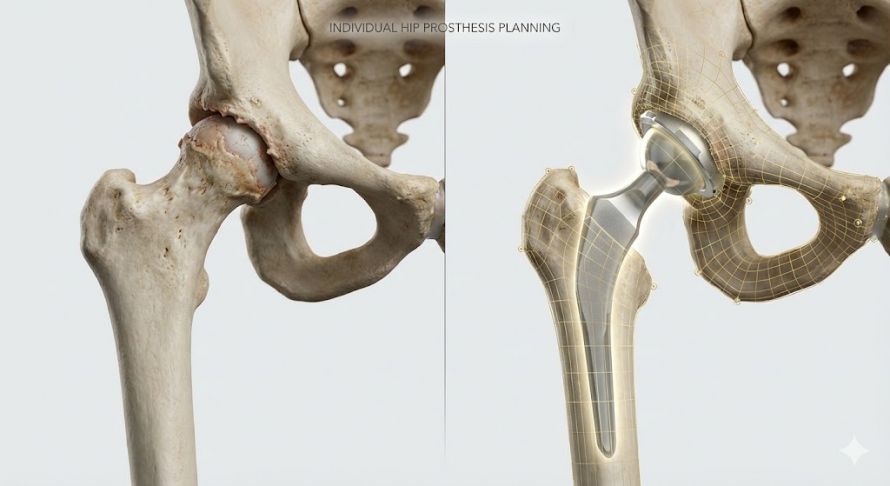
Based on CT data, the custom hip prosthesis is precisely tailored to the patient’s anatomy to ensure optimal stability and mobility.
The Procedure at the Endoprosthetics Center
The implantation of an artificial hip joint is a routine procedure, but it should be performed at a certified endoprosthetics center. There, doctors have the necessary experience. A crucial factor for success is access to the hip joint. Today, surgery is almost always performed using minimally invasive techniques. This surgical method is particularly gentle on the muscles: the muscles are not cut, but simply moved aside. This results in less blood loss, better wound healing, and less pain immediately after surgery.
Cemented or cementless? The fixation
A common question at the clinic concerns the type of fixation. Hip prostheses generally consist of several components: the stem, the prosthetic head, the inlay (gliding surface), and the cup. Whether the prosthesis is cemented or cementless depends on bone quality:
-
Cementless: The prosthesis is “pressed” into the bone (press-fit). The rough surface fuses with the bone. This is typically done today for younger patients with good bone density.
-
Cemented: In this case, the surgeon uses bone cement to immediately and securely fix the stem in place. With cemented prostheses, the artificial joint can bear a full load immediately. This is often advisable for older people with osteoporosis.
Hybrid solutions are also possible. Thanks to the precise fit of a custom prosthesis, excellent fixation is often achieved even without cement.
Articulating Surfaces and Durability
The bearing surfaces are crucial for ensuring that the new joint moves smoothly. In most cases, a ceramic head is combined with an inlay made of highly cross-linked polyethylene. This proven combination minimizes wear. This is because when particles are worn away, it can lead to inflammation and loosening (prosthesis loosening). A perfectly fitting custom prosthesis results in fewer micro-movements, which can potentially extend the implant’s lifespan.
After Surgery: Rehabilitation and Mobility
Thanks to minimally invasive techniques, mobilization often begins on the very day of surgery. Rapid mobilization is important to prevent blood clots and regain mobility. Rehabilitation (outpatient or inpatient) helps restore a normal gait. Because the individual anatomy has been respected, the artificial hip joint feels “natural” more quickly for many patients (“Forgotten Joint”). The patient’s mobility and return to daily life are accelerated by the precise fit.
Conclusion
The customized hip prosthesis is the high-end solution in hip replacement surgery. It is particularly beneficial in cases of complex anatomy or special requirements. When combined with a minimally invasive surgical technique performed by an experienced surgeon, it offers the opportunity to live a pain-free and active life. Whether cemented or cementless: the treatment plan individually selected by the physician determines long-term success.
FAQ: Frequently Asked Questions About Custom Hip Replacements
What is the difference from a standard prosthesis?
Standard prostheses are manufactured in fixed sizes. The customized hip prosthesis is precisely tailored to the patient based on CT data.
When is a custom prosthesis recommended?
It is particularly beneficial in cases of severely deformed bones, following accidents, in cases of congenital malformations (dysplasia), or when standard implants would not fit anatomically.
How long does a custom hip replacement last?
As with standard prostheses, the expected lifespan today is 15 to 20 years or more. The precise fit can minimize the risk of premature loosening.

About the medical author
Sabine Schneider
Editor-in-Chief
Sabine Schneider – medical author: Explore expert articles and medical expertise in the Leading Medicine Guide.
More about the medical author →