
This pattern is classic—and it’s one of the reasons why pneumonia is so often fatal in older adults. Not because the pathogens are more aggressive, but because it takes longer to diagnose.
As a geriatrician, I regularly see patients who are admitted with “acute confusion,” “a fall,” or “a sudden bout of weakness”—and in whom pneumonia is only detected through imaging. The lesson here: For every older adult with an acute change in behavior, screening for an infection should be part of the initial evaluation.
Why Pneumonia Is So Serious in Older Adults
- The most common fatal infection among older adults in Germany
- Hospital mortality rate of 10 to 25 percent, depending on age and frailty status
- Three to four times higher risk in nursing homes compared to the general population
- The most common cause of death in older adults with advanced dementia
- If the patient survives: often months of functional impairment
The atypical presentation: What to really look out for
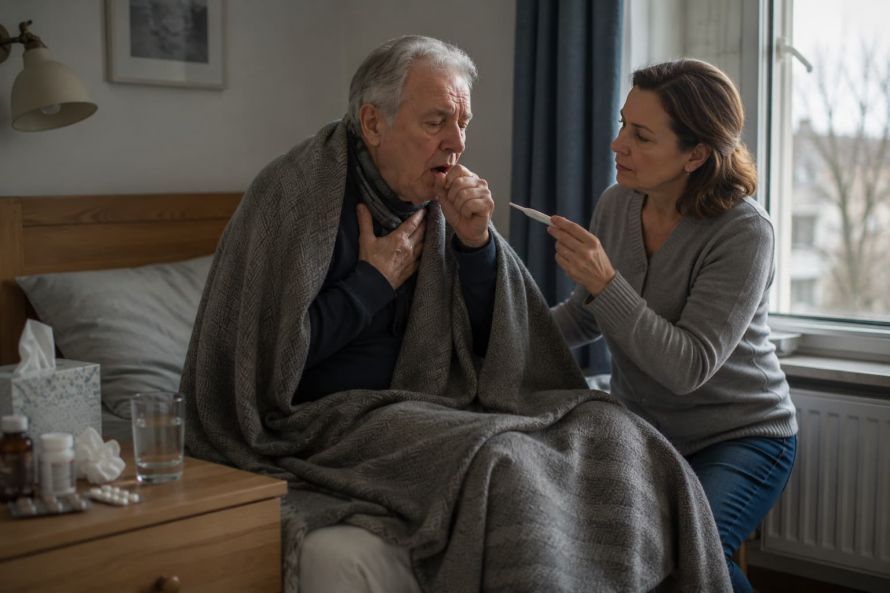
In older patients, the classic triad of fever, cough, and shortness of breath is absent in 30 to 60 percent of cases. Instead, the following are often the primary symptoms:
- Acute confusion (delirium): The most common leading symptom in people over 80 with pneumonia.
- Falls: Often the first sign of an infection. More on falls in older adults.
- Loss of appetite and fluid intake: Nonspecific, but an important warning sign in older patients.
- General weakness: “She’s suddenly not herself anymore.”
- Tachypnea: A respiratory rate above 20 per minute is often the most sensitive single parameter—even if the patient does not report shortness of breath.
- Mild or absent fever: Older adults often respond to infections with a normal or even lower body temperature.
- Cough is absent or minimal: Especially in bedridden or dementia patients.
The most sensitive single symptom of pneumonia in the elderly is not fever or cough—it is a respiratory rate above 20 per minute. Count for one minute. It’s simple, costs nothing, and can save lives.
→ On the frequent confusion of infection symptoms with the onset of dementia: Delirium in older adults and delirium prevention.
What forms are there?
Community-acquired pneumonia (CAP)
Pneumonia that develops at home or in the community. Most common pathogens: Streptococcus pneumoniae (pneumococci), Haemophilus influenzae, Mycoplasma pneumoniae, respiratory viruses (influenza, RSV, coronavirus).
Hospital-acquired pneumonia (HAP)
Acquired in the hospital, at least 48 hours after admission. Different spectrum of pathogens, often multidrug-resistant bacteria, requiring a broader range of antibiotics.
Aspiration pneumonia
Particularly important in the elderly. Caused by the inhalation of saliva, food, or stomach contents into the lungs. Primarily affects patients with:
- Swallowing difficulties following a stroke
- Advanced-stage dementia
- Parkinson’s syndromes
- Alcohol abuse
- Sedative medications
- Poor oral hygiene and dental health
→ On the role of swallowing disorders that promote aspiration: Early geriatric rehabilitation.
Diagnosis
Diagnosis involves a combination of:
- A detailed medical history and physical examination — respiratory rate, auscultation, oxygen saturation
- Chest X-ray or low-dose CT as the gold standard
- Laboratory tests: Complete blood count, CRP, procalcitonin, electrolytes, renal function, blood gases
- Microbiology: Sputum, blood cultures prior to antibiotic administration, pneumococcal and Legionella antigens in urine
- Pulmonary ultrasound as a bedside adjunct
In older patients with atypical presentations, a low diagnostic threshold is warranted: better to order one too many X-rays than to diagnose pneumonia too late. The geriatric assessment helps to systematically evaluate the patient’s overall condition.
Treatment
Antibiotics
The choice depends on severity, preexisting conditions, local resistance patterns, and the patient’s age. Standard options for community-acquired pneumonia:
- Amoxicillin (oral, for mild pneumonia without complications)
- Amoxicillin/clavulanic acid (for patients with comorbidities)
- If the patient is allergic to penicillin: macrolides or doxycycline
- If hospitalization is required: broader-spectrum antibiotics (ceftriaxone, possibly plus a macrolide)
- For aspiration pneumonia: antibiotics effective against anaerobes (ampicillin/sulbactam, clindamycin)
The duration of treatment is usually 5 to 7 days, or longer in more severe cases. In elderly patients taking multiple medications, interactions with antibiotics must be assessed with particular care.
Supportive therapy
- Oxygen if oxygen saturation is below 90 percent
- Adequate hydration
- Reduce fever if it is causing significant distress
- Respiratory therapy to mobilize secretions
- Early mobilization—even in bed—to prevent immobility in older adults
- Ensure adequate nutrition; adjust food consistency in cases of dysphagia — to prevent malnutrition in older adults
Severe pneumonia
For severe pneumonia with sepsis, respiratory failure, or circulatory instability, provide intensive care. The decision to admit to the intensive care unit (ICU) for older, multimorbid patients should be made by considering frailty, life expectancy, and the patient’s wishes—not solely based on the clinical presentation.
→ On the role of frailty in intensive care decision-making: Frailty syndrome.
→ On treatment limits at the end of life: Palliative care in older adults.
Prevention: Where It Really Works
Vaccinations
- Pneumococcal: Recommended for everyone over 60 years of age. The currently recommended conjugate vaccines offer good protection and have been shown to reduce invasive pneumococcal disease.
- Influenza: Annually, ideally in the fall. High-dose or adjuvanted vaccines are preferred for older adults.
- RSV: Vaccines approved for older adults since 2024, increasingly recommended in guidelines.
- COVID-19: Updated vaccination in accordance with STIKO recommendations, especially for high-risk patients such as those with heart failure or diabetes in older adults.
Oral Hygiene
An often underestimated component. The bacterial load in the mouth is one of the main drivers of aspiration pneumonia. Regular dental cleanings, dental checkups, and assisted oral care for patients requiring nursing care measurably reduce the risk of pneumonia.
Swallowing Therapy
For known swallowing disorders following a stroke, Parkinson’s disease, or dementia: speech-language pathology assessment, adjusting food consistency, and targeted swallowing techniques. More on rehabilitation: Early geriatric rehabilitation.
Additional Measures
- Smoking cessation — always advisable, even in old age
- Treatment of chronic underlying conditions (heart failure, COPD, diabetes)
- Avoidance of unnecessary sedatives and PPIs (which increase the risk of aspiration and susceptibility to pneumonia)
- Early mobilization for bedridden patients
→ On reducing medication as a preventive measure: Polypharmacy in older adults and deprescribing.
What Family Members Should Know
- Count the respiratory rate: Do this whenever there is an acute change. A rate of more than 20 per minute is cause for concern.
- Take confusion seriously: Acute confusion is a medical emergency in older adults, not a normal part of aging. More on this: Delirium.
- Keep vaccination status up to date: Pneumococcal, influenza, RSV, COVID-19.
- Ensure oral hygiene: Especially for family members who require care. An underrated lifesaver.
- Do not force food if there are swallowing problems: Request swallowing therapy; adjust food consistency.
- Seek medical help early: If you’re unsure, it’s better to have one too many doctor visits than one too late.
When should you see a doctor or go to the hospital?
Urgency levels:
- Emergency: Severe shortness of breath, blue-tinged lips, confusion, very high or very low body temperature with signs of circulatory distress—call an emergency doctor immediately.
- Urgent: New-onset confusion, a fall with no clear cause, respiratory rate over 20, persistently poor general condition—see your primary care physician or go to the emergency room the same day. More on the consequences of falls: Falls in older adults.
- Prompt: Mild cough lasting several days, slightly elevated temperature, loss of appetite — see your primary care physician within the next two to three days.
→ For broader classification within geriatric care: Geriatric Assessment.
Share this article
Sources
- S3 Guideline “Treatment of adult patients with community-acquired pneumonia”. AWMF Register 020-020, current version.
- Standing Committee on Vaccination (STIKO): Recommendations on pneumococcal, influenza, RSV and COVID-19 vaccination. Current version.
- Welte T, Torres A, Nathwani D (2012): Clinical and economic burden of community-acquired pneumonia among adults in Europe. Thorax.
- Teramoto S, Fukuchi Y, Sasaki H et al. (2008): High incidence of aspiration pneumonia in community- and hospital-acquired pneumonia in hospitalized patients: a multicenter, prospective study in Japan. JAGS.
