
Every day without mobility costs an older person up to five percent of their muscle strength. After a week of being bedridden, it takes two weeks to regain that strength—if they regain it at all. Breaking this cycle before it becomes irreversible is the core mission of geriatric early rehabilitation—and the key to successful rehabilitation for seniors.
As a geriatrician, I see every day what happens when rehabilitation starts too late—and what is possible when it begins on the very first day after acute treatment. The difference is often dramatic.
What is early geriatric rehabilitation?
Geriatric early rehabilitation (early rehab or acute geriatrics) is a treatment approach in which acute medical care and rehabilitation take place simultaneously in an acute care hospital—not one after the other. The patient is still in the hospital and is still receiving medical treatment, but is already participating in a structured therapy program at the same time.
What makes it unique: This model exists in this form only in Germany. It is anchored in the billing system (OPS 8-550) and is subject to clear quality criteria:
- At least 20 therapy sessions per week (30 minutes each) from at least two therapeutic disciplines.
- Treatment by an interdisciplinary team led by a geriatrician.
- An individualized treatment plan within the first 24 hours after admission.
- Weekly team conference to review and adjust treatment goals.
In practice, this means: No patient lies idle in bed waiting for a rehabilitation spot. Rehabilitation begins immediately.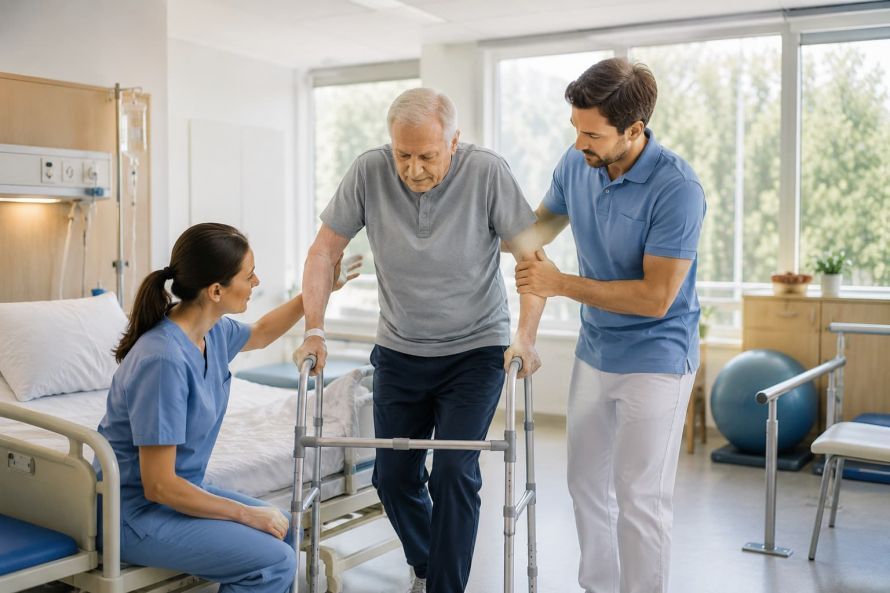
What distinguishes early rehabilitation from standard rehabilitation?
Many patients and their families confuse geriatric early rehabilitation—often also called geriatric rehab—with follow-up rehabilitation (AHB) or outpatient rehab. The differences, however, are fundamental:
|
Geriatric Early Rehabilitation |
Follow-up Rehabilitation (AHB) |
Outpatient Rehabilitation |
|
|
Timing |
During acute care |
After completion of the acute phase |
After discharge |
|
The patient is... |
Still acutely ill |
Medically stable and independent |
Largely stable |
|
Where? |
In an acute care hospital |
In a rehabilitation clinic |
Outpatient / at home |
|
Duration |
14–21 days |
3–4 weeks |
Weeks to months |
|
Team |
Geriatrician + interdisciplinary team |
Rehabilitation physician + team |
Therapists + primary care physician |
|
OPS code |
OPS 8-550 |
— |
— |
The key point: In early rehabilitation, the patient is still acutely ill. They require both acute medical treatment and rehabilitation at the same time. It is precisely this combination that makes the German model unique—and particularly effective for older, multimorbid patients.
Who is eligible for geriatric early rehabilitation?
Geriatric early rehabilitation is intended for older patients who have suffered a significant loss of function following an acute event and require intensive care. Typical situations:
- After a femoral neck fracture—the most common reason for admission to geriatric early rehabilitation
- After a stroke in older adults—when neurological rehabilitation is insufficient or comorbidities limit the patient’s tolerance
- After hip or knee replacement surgery—especially in patients over 80 with comorbidities
- Following severe pneumonia in older adults with subsequent immobility
- Following a worsening of heart failure in older adults with loss of function
- After any hospital stay resulting in a significant loss of activities of daily living — particularly in the presence of frailty syndrome
→ For more information on the treatment of bone fractures in older adults, see our article on geriatric traumatology.
→ Specifically regarding femoral neck fractures: causes, surgery, and rehabilitation.
The interdisciplinary team—who will treat you?
The strength of early rehabilitation lies not in a single person, but in the team. Each team member contributes their own perspective:
- Geriatrician (team leader): Coordinates the overall treatment, manages medication and medical therapy—including consistent deprescribing—and leads team meetings.
- Physical therapy: Mobilization, gait training, balance exercises, fall prevention.
- Occupational therapy: Training in activities of daily living—getting dressed, washing, eating, cooking. Advice on assistive devices.
- Speech-language pathology: Treatment of swallowing disorders (dysphagia) and speech or communication disorders.
- Neuropsychology: Cognitive assessment, memory training, delirium monitoring.
- Social Work: Discharge planning, organizing care services, applying for a care level, and arranging assistive devices.
- Nursing: Activating care—this means helping patients help themselves, rather than taking over all tasks.
How does treatment work? A typical course of treatment
To give you a realistic idea, I’ll describe a typical early rehabilitation course following a femoral neck fracture in an 82-year-old female patient:
Day 1 — Assessment and initial mobilization: Comprehensive geriatric assessment (Barthel, Tinetti, MMSE, GDS, MNA). Initial mobilization to the edge of the bed. Medication review. An individualized therapy plan is developed.
Days 2–3 — Standing with support: Initial attempts at standing by the bed with physical therapy assistance. Occupational therapy begins with self-care training (washing, dressing). Speech therapy for swallowing difficulties.
Days 4–7 — Walking with a walker: Initial walking exercises in the hallway. Balance training. Cognitive stimulation. Team meeting: Review and adjust therapy goals.
Days 8–14 — Activities of daily living training: Practicing climbing stairs. Independent washing and dressing. Planning home modifications. Social work prepares for discharge.
Days 14–21 — Discharge preparation: Final assessment: Compare Barthel Index scores (admission vs. discharge). Organize assistive devices. Brief the home care service. Notify the primary care physician. Provide a rehabilitation recommendation.
???? The measurable difference: Upon admission, our example patient’s Barthel Index was 35 (high need for assistance). Upon discharge after two weeks of early rehabilitation, it was 60 (largely independent in daily life). This gain of 25 points means the difference between a nursing home and home.
How is success measured?
In geriatrics, we measure success not by lab values, but by function. The most important tool:
The Barthel Index—measured at admission and at discharge. The difference indicates the improvement in functional ability. In simple terms:
- Barthel 0–30: The patient needs help with almost everything.
- Barthel 35–60: Partially independent, but needs regular support.
- Barthel 65–95: Largely independent in daily life.
- Barthel 100: Completely independent.
→ To find out exactly which tests are performed as part of a geriatric assessment, read our article on Geriatric Assessment.
What happens after early rehabilitation?
Discharge from early rehabilitation is not the end, but a transition. Where the journey leads depends on the level of functioning achieved:
- Barthel 70 or higher: Discharge home, possibly with outpatient physical therapy and home care assistance.
- Barthel 40–70: Outpatient physical therapy and home care assistance, or short-term care with continued therapy.
- Barthel score below 40: Continued inpatient care, a long-term care facility, or intensive home care.
In every case, a discharge summary is prepared that summarizes all findings, therapy recommendations, and follow-up measures for the primary care physician.
When should you ask about early geriatric rehabilitation?
If your loved one can no longer get up on their own after a hip fracture, a stroke, or a serious illness—ask the treating physician specifically about geriatric early rehabilitation. Even if there are already limitations in mobility, cognition, or self-care prior to a planned surgery, you should request a geriatric assessment. The earlier early rehabilitation begins, the greater the chances of returning home. Also watch for signs of frailty syndrome, as these patients benefit particularly from early intervention.
How can family members help?
Early rehabilitation is a team effort—and you, as a family member, are part of that team:
- Bring comfortable shoes, glasses, and a hearing aid. Without them, your loved one cannot move around safely—and the risk of delirium increases.
- Visit regularly. Familiar faces reduce the risk of delirium and boost motivation.
- Ask about the treatment plan. You have the right to know what goals have been set and how progress is going.
- Be involved in discharge planning. The sooner you’re included, the smoother the transition home will be. A living will prepared in advance can also provide important guidance in this process.
- Encourage them, but don’t overwhelm them. Progress takes time. Celebrate small successes: getting up on their own for the first time, or taking their first steps to the sink.
→ To learn why falls are so common among older adults and how to prevent them, read our article on falls in older adults as well as our article on fall prevention.

About the medical author
Naumche Matoski
Medical writer
Sources
- Ellis G et al. (2017): Comprehensive geriatric assessment for older adults admitted to hospital. Cochrane Database of Systematic Reviews. DOI: 10.1002/14651858.CD006211.pub3
- Veronese N et al. (2022): Comprehensive geriatric assessment in older people: an umbrella review of health outcomes. Age and Aging. DOI: 10.1093/aging/afac104
- OPS 8-550: Geriatric early rehabilitative complex treatment. Federal Institute for Drugs and Medical Devices (BfArM).
