
This outcome is possible today—and it depends on a single factor: time. Those who recognize the signs and act immediately double the chance of a good outcome. Those who hesitate lose nerve cells that will never return.
As a geriatrician, I see both sides: the patients for whom everything turned out well—and those for whom the call came too late because the family wanted to “wait and see” first. This article is intended to help ensure that the first scenario occurs more often.
What is a stroke?
A stroke in older adults is an acute disruption of blood flow to the brain. There are two main types:
- Ischemic stroke (about 85 percent): A blood clot blocks a cerebral artery. The affected brain tissue is no longer supplied with blood and dies within minutes to hours—unless blood flow is restored.
- Hemorrhagic stroke (about 15 percent): A cerebral artery ruptures, causing blood to leak into the brain tissue, where it puts pressure on surrounding structures and destroys them.
A special variant: the transient ischemic attack (TIA)—a brief disruption of blood flow that resolves within 24 hours. It is a warning sign: About 10 percent of patients with a TIA will suffer a full-blown stroke within 90 days if they are not quickly evaluated and treated.
The FAST Rule: The Most Important Minutes of Your Life
The FAST rule detects over 80 percent of all strokes. Four steps:
- F — Face: Ask the person to smile. Is one corner of the mouth drooping?
- A — Arms: The arms. Have them extend both arms, palms facing up. Does one arm drop or fail to lift?
- S — Speech: Speech. Have the person repeat a simple sentence. Is their speech slurred, halting, or incomprehensible?
- T — Time: Time. If any of these signs are present, dial 112 immediately. Don’t wait, don’t call your family doctor, and don’t go to the hospital first. Dial 112.
???? The most important phrase regarding a stroke is: “Time is brain.” Every minute without blood flow costs about 2 million nerve cells. The minutes until emergency medical help arrives are the most critical minutes in the patient’s life—even if the symptoms seem “not that bad.”
Other warning signs
- Sudden onset of a headache, often the most intense pain of one’s life (in the case of a brain hemorrhage)
- Sudden numbness or weakness on one side of the body, affecting an arm or leg
- Sudden vision problems—double vision, hemianopia, blurred vision
- Sudden severe dizziness with unsteadiness when walking or standing
- Sudden loss of consciousness or confusion
- Sudden difficulty swallowing
The key word is always “sudden.” Unlike many other conditions, a stroke sets in abruptly—often within seconds.
Why the Minutes Until You Reach the Hospital Are Critical
In an ischemic stroke, the central area of the brain (core) dies within a few minutes. It is surrounded by a zone of reduced blood flow (penumbra) where the cells can still survive—but only if blood flow is restored in time. Modern acute treatment targets this penumbra:
- Systemic thrombolytic therapy (rtPA, alteplase): Dissolves the clot with medication. Standard treatment window is 4.5 hours from symptom onset; longer in specific cases.
- Mechanical thrombectomy: Catheter-assisted mechanical removal of the clot from large cerebral vessels. Treatment window of up to 24 hours for suitable patients.
Both procedures are highly effective—the number of patients who can live independently again after thrombectomy has multiplied over the past ten years. A prerequisite is timely access to a specialized stroke unit.
The Stroke Unit — The Right Place
A stroke unit is a specialized stroke care unit staffed by an interdisciplinary team comprising neurologists, nurses, physical therapists, occupational therapists, speech-language pathologists, and social workers. There are over 300 certified stroke units in Germany—including regional, supraregional, and those connected via teleneurology networks. Studies show that treatment in a stroke unit reduces mortality and the need for long-term care compared to standard inpatient care.
In an emergency: The 112 emergency dispatch center knows which stroke units are responsible and transports patients directly there. Family members do not have to organize this.
Acute Care
Upon arrival at the hospital, several processes run concurrently:
- CT or MRI of the head — distinguishing between ischemia and hemorrhage, locating the occluded vessel
- Vascular imaging (CT angiography, MR angiography) — identification of the occlusion
- Neurological examination using a standardized scale (NIHSS)
- Laboratory tests, ECG, blood pressure and heart rhythm monitoring
- Decision regarding thrombolysis and/or thrombectomy
- Initiation of acute treatment
Causes and Prevention
The most important causes and risk factors for stroke:
- Hypertension: By far the most important modifiable risk factor. Good blood pressure control reduces the risk of stroke by about 30 percent.
- Atrial fibrillation: Responsible for about 20 percent of all ischemic strokes. Consistent anticoagulation reduces the risk by 60 to 70 percent.
- Diabetes mellitus: Doubles the risk of stroke.
- Dyslipidemia: Elevated LDL cholesterol levels. Statin therapy reduces the risk.
- Smoking: Doubles the risk. Quitting smoking has a rapid effect.
- Obesity and physical inactivity: Important modifiable risk factors.
- Carotid stenosis: Narrowing of the carotid artery—surgical or interventional treatment is indicated for severe symptomatic stenosis.
- Previous TIA: A strong warning sign that requires a structured evaluation.
→ On the independent significance of atrial fibrillation: Atrial fibrillation in older adults.
→ On the role of diabetes as a stroke risk factor: Diabetes in older adults.
Rehabilitation After a Stroke
The acute phase is only the beginning. The course of recovery depends crucially on the subsequent rehabilitation. Typical course:
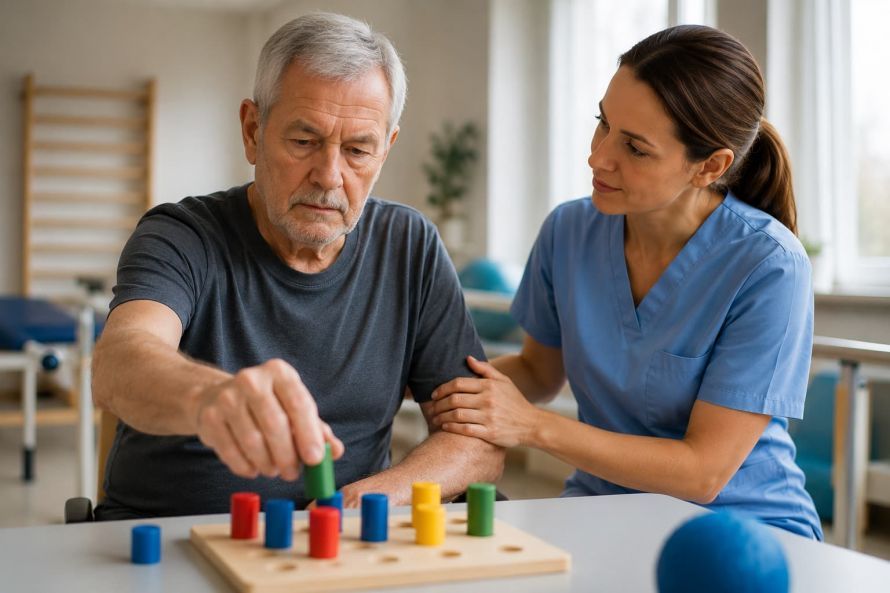
- Acute phase (first few days): Stroke unit—stabilization, initial mobilization, and the start of physical therapy, occupational therapy, and speech therapy within 24 to 72 hours.
- Early neurological rehabilitation: Phase B — intensive, often involving mechanical ventilation or a high level of nursing care. Specialized rehabilitation clinics.
- Follow-up rehabilitation: Phases C and D — continuous restoration of function and independence. Duration: 3 to 12 weeks or longer, depending on severity.
- Geriatric Early Rehabilitation: Often beneficial for older patients with multiple health issues (stroke plus comorbidities) to be conducted in parallel with neurological rehabilitation.
- Outpatient follow-up: Physical therapy, occupational therapy, and speech therapy over weeks to months—functional improvement continues for up to one year.
→ For more on geriatric early rehabilitation: Geriatric Early Rehabilitation.
The geriatric perspective following a stroke
For older patients after a stroke, holistic geriatric care is provided in addition to neurological treatment:
- Fall assessment (hemiparesis, unsteady gait)
- Medication review with secondary prevention — see also deprescribing and polypharmacy in older adults
- Nutritional assessment for swallowing disorders — preventing malnutrition in older adults
- Cognitive assessment — stroke-related deficits versus coexisting dementia
- Depression following a stroke (post-stroke depression, common, often overlooked)
- Social and residential adaptation
- Advance directive, power of attorney — often urgently needed
→ On post-stroke depression and related topics: Depression in older adults.
→ On establishing one’s wishes in a timely manner: Living will.
Secondary prevention — preventing the next stroke
After a stroke, the risk of another one is significantly increased. Secondary prevention includes:
- Antiplatelet agents (usually acetylsalicylic acid plus clopidogrel initially, followed by monotherapy)
- In cases of atrial fibrillation: oral anticoagulation (direct oral anticoagulants preferred)
- Statins to lower LDL
- Blood pressure control with target values based on the individual’s situation
- Diabetes management
- Smoking cessation
- Regular exercise
- For carotid stenosis: Evaluation for surgery or stenting
What family members should know and do
- Know the FAST rule: And apply it in an emergency. Dial 112.
- Do not initiate treatment on your own: Do not give aspirin, do not insist on lowering blood pressure—the hospital must first determine the type of stroke.
- Document the time symptoms began: The exact time when symptoms started—this is crucial for the treatment window.
- Have a list of medications ready: Especially important: Is the patient taking anticoagulants?
- Be present during rehabilitation: Familiar faces measurably promote neurological recovery.
- Watch for signs of depression: Post-stroke depression is common, treatable, and often overlooked.
- Call 112 even for a TIA or “transient” symptoms: A TIA is not a “all-clear” signal, but a warning.
When should you see a doctor?
- Emergency: FAST signs or other acute neurological symptoms—call 112 immediately.
- TIA in the last 24 hours: Even if symptoms have disappeared—go to the hospital the same day.
- After discharge: Structured monitoring of blood pressure, blood sugar, lipids, medication, and functional status every three to six months.
- If there are signs of depression: Often in the weeks and months following a stroke—have dementia or depression carefully evaluated.
- If cognitive changes are present: Distinguish between stroke sequelae and concomitant dementia—initiate dementia evaluation if necessary.
→ For a comprehensive post-stroke evaluation: Geriatric assessment.
Share this article
Sources
- S3 Guideline “Stroke”, German Stroke Society (DSG) and German Society of Neurology (DGN). AWMF Register 030-140, current version.
- Powers WJ, Rabinstein AA, Ackerson T et al. (2019): Guidelines for the Early Management of Patients With Acute Ischemic Stroke. Stroke. DOI: 10.1161/STR.0000000000000211
- Goyal M, Menon BK, van Zwam WH et al. (2016): Endovascular thrombectomy after large-vessel ischemic stroke: a meta-analysis. The Lancet.
- Stroke Unit Trialists’ Collaboration (2013): Organized inpatient (stroke unit) care for stroke. Cochrane Database of Systematic Reviews.
