A birth that occurs before the 37th week of pregnancy is considered a preterm birth. In Germany, about 9 out of every 100 live births are preterm. Depending on their stage of development, these preterm infants are unable to breathe on their own, feed, or regulate their body temperature. Premature babies today have significantly higher chances of survival than they did just a few decades ago. As a result, the mortality rate for premature babies is declining in most countries.
Here you will find further information as well as a selection of specialists and centers for premature births.
Signs of Premature Birth
Various signs can indicate a preterm birth, such as
- premature rupture of the membranes,
- premature contractions accompanied by cramping pain, as well as
- bright red bleeding.
An important indicator is the regularity of the contractions. The uterus occasionally contracts during pregnancy, which causes pain. However, if these contractions occur regularly, this could be a sign that labor has begun.
If premature labor is suspected, the expectant mother should contact her doctor, midwife, or the hospital immediately. The sooner medical care begins, the better the child can be helped.
Causes and Risk Factors for Preterm Birth
There are several risk factors associated with preterm birth. However, the exact causes of preterm birth remain unclear.
Each pregnant woman’s personal risk factors are assessed. These serve as the basis for planning medical care during pregnancy. The goal is to allow the baby to develop as fully as possible in the womb for as long as possible.
The most important risk factor for preterm birth is a history of preterm birth (i.e., when the pregnant woman has previously experienced preterm births). Depending on the number of previous preterm births and the timing of their occurrence, the absolute risk of recurrence is 20–30%.
Other possible risk factors for preterm birth include pre-existing medical conditions
- in the mother (e.g., diabetes mellitus, high blood pressure, and anemia) or
- the child (e.g., congenital anomalies).
Pregnancy-related conditions, such as preeclampsia, are also significant individual risk factors for preterm birth.
Premature birth often occurs due to cervical insufficiency (weak cervix). A shortened cervix measuring less than 26 millimeters in length during the second trimester is also considered a risk factor or an early sign of preterm birth.
Ascending infections that spread from the mother’s genital tract toward the cervix and uterus are also dangerous. They can trigger premature labor or premature rupture of the membranes.
There is also an increased risk of preterm birth in multiple pregnancies. For example, about 60% of all twins and, as a rule, all triplets are born prematurely.
Other risks include
- smoking during pregnancy,
- long work hours of more than 40 hours per week,
- strenuous physical labor, and
- severe emotional stress.
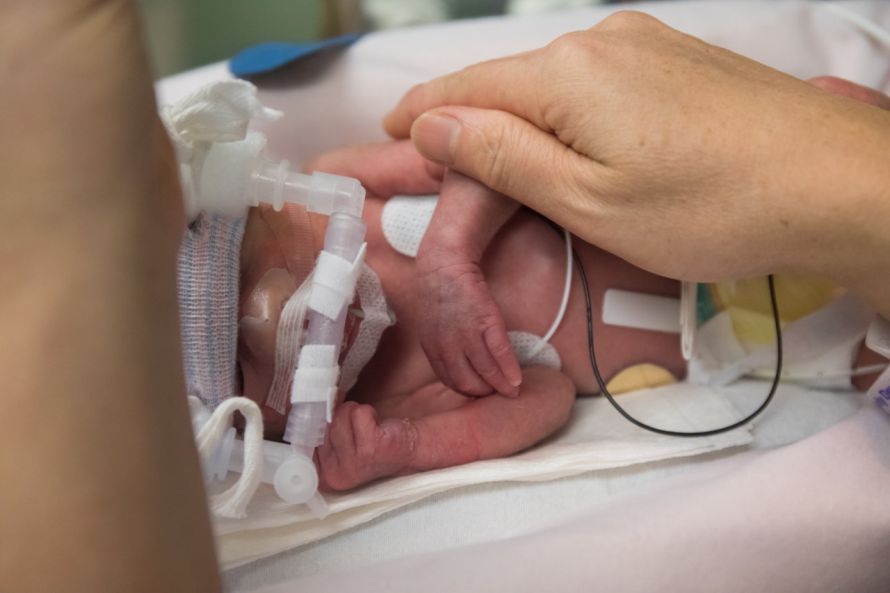
born prematurely require extensive medical care © Toshi Photography | AdobeStock
Examinations When Premature Birth Is Suspected
If a premature birth is suspected, the pregnant woman is first thoroughly examined. The obstetrician checks the dilation of the cervix and the condition of the amniotic sac.
An ultrasound examination (sonography) provides information about
- the position of the cervix,
- the position of the baby as well as its size and weight,
- the location of the placenta, and
- the amount of amniotic fluid.
A CTG (cardiotocography) measures the frequency of contractions and the baby’s heart rate.
As part of the gynecological examination, a biochemical test for preterm birth can also be performed. This test is safe for both mother and baby and uses a vaginal swab to detect various proteins that indicate an increased risk of preterm birth.
Prevention and Treatment of Preterm Birth
The treatment of preterm labor depends on the gestational week of the pregnant woman.
After the 34th week of pregnancy, it may be advisable to allow the contractions to run their course. Thanks to perinatal intensive care, the baby can be treated very effectively in modern neonatal units.
If the amniotic sac ruptures prematurely, there is often a risk of amniotic fluid infection, so delivery must take place promptly. In this case, an antibiotic is administered.
If contractions occur before the 34th week of pregnancy, it is advisable to delay the birth. Premature infants are at risk of respiratory problems if their lungs are not yet fully developed. This is because sufficient lung maturity is a prerequisite for the onset of spontaneous breathing immediately after birth.
Medications can help suppress premature labor. The mother is given tocolytics for up to 48 hours. This gives the baby time to achieve the necessary lung maturity through the administration of glucocorticoids. The mother can then be transferred to a perinatal center.
When glucocorticoids are administered to the mother via injection, they also enter the body and lungs of the unborn child through the mother’s bloodstream. Particularly between 24 and 34 weeks of gestation, cortisone can promote rapid lung maturation in the child and increase the chances of survival for preterm infants.
If the cervix is shortened prematurely, progesterone treatment can prevent preterm birth. In cases of cervical insufficiency, a cervical cerclage or a cervical pessary may help. In a cerclage procedure, a band is placed around the cervix under anesthesia to stabilize the cervix. Inserting a cervical pessary—a flexible silicone ring—can also help relieve pressure on the pregnant woman’s cervix.
If a baby is born six weeks before the estimated due date, maternity leave and maternity benefit payments are extended.
Course and Prognosis of a Preterm Birth
If the preterm birth cannot be delayed any further, the goal is now to deliver the baby as gently as possible. Depending on the obstetric situation, a vaginal birth may be attempted; however, a cesarean section is often necessary.
After birth, the premature infant is usually taken to the intensive care unit and placed in an incubator. There, the baby can receive optimal care. Humidity and temperature can be kept constant here, and the baby’s breathing can be monitored. If the baby is not yet able to feed on its own, it is fed via a nasogastric tube or through intravenous infusions.
The risk of a repeat preterm birth is 20 percent if the first child was born before the 37th week of pregnancy. If the birth occurred before the 32nd week of pregnancy, the risk rises to 30 percent. The more premature births a mother has already had, the higher the risk of a recurrence.
If a woman has already had a preterm birth, her obstetrician will monitor her more closely during a subsequent pregnancy. The doctor will then try to minimize the risks in advance.
Share this article

Sources
- Prof. Dr. med. Richard Berger (Marienhaus Klinikum St. Elisabeth, Klinik für Gynäkologie und Geburtshilfe, Neuwied) et al.: Die Frühgeburt: Epidemiologie, Prädiktion und Prävention (2019).
- https://www.frauenaerzte-im-netz.de/
- https://www.kinderaerzte-im-netz.de/
- https://www.gnpi.de/ (PDF)
- https://www.awmf.org/ (PDF)
- https://www.familienplanung.de/
- https://www.aerzteblatt.de/
- https://www.pharmazeutische-zeitung.de/
- https://www.swissmom.ch/