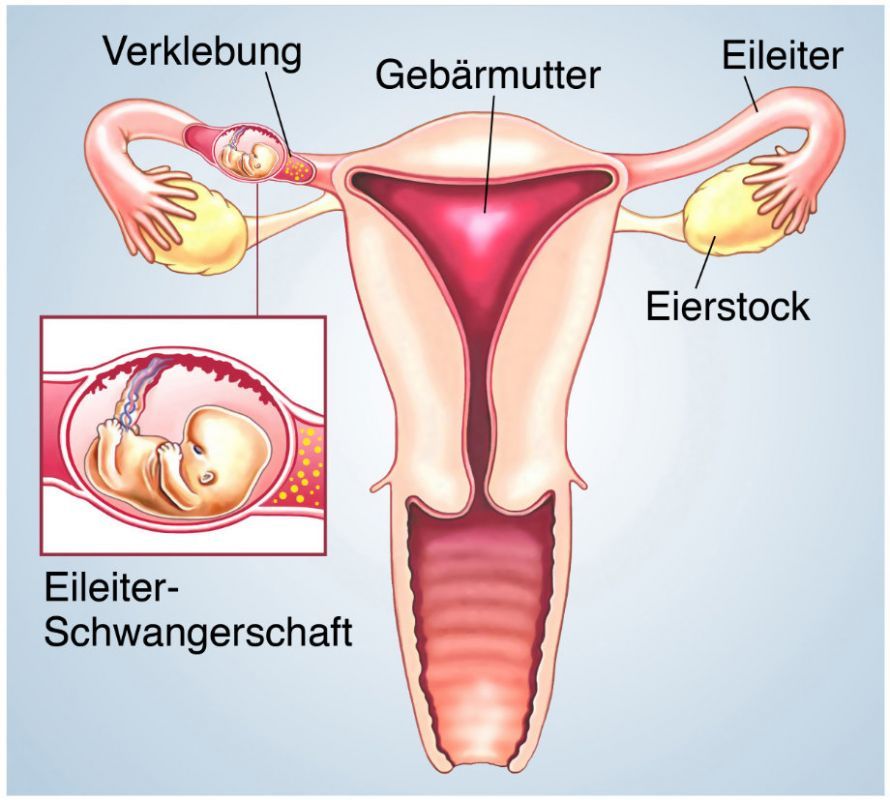
An ectopic pregnancy is an abnormal pregnancy. In this condition, the fertilized egg implants in the fallopian tube rather than in the uterus. An ectopic pregnancy cannot be carried to term. It can have serious consequences for the pregnant woman and must be terminated early.
Here you will find further information as well as a selection of specialists and centers for ectopic pregnancies.
What is an ectopic pregnancy?
Normally, after ovulation, an egg travels through the fallopian tube into the uterus. If it is fertilized by a sperm cell, it implants itself in the uterine lining. There, the fetus can develop.
If the fallopian tubes are blocked, scarred, or kinked, an egg may not be able to reach the uterus. Instead, the fertilized egg (zygote) implants itself in the lining of the fallopian tube.
In most cases, the embryo then dies within a few days or weeks after implantation. If this does not happen, the embryo initially continues to grow in the fallopian tube. However, an ectopic pregnancy cannot be carried to term.
If left undiagnosed and untreated, an ectopic pregnancy can lead to dangerous complications for the woman involved.
An ectopic pregnancy is the most common form of extrauterine pregnancy. An extrauterine pregnancy is a pregnancy in which the fertilized egg implants outside the uterus.
The statistical probability of a tubal pregnancy compared to a regular pregnancy is about 1–2 percent.
Specialists in pregnancy care are primarily obstetricians and perinatal medicine specialists.
Signs of an ectopic pregnancy
An ectopic pregnancy initially progresses similarly to a normal pregnancy. A pregnancy test yields a positive result. The period is missed, and many pregnant women experience morning sickness and breast tenderness.
As with a normal pregnancy, the pregnancy hormone beta-hCG (human chorionic gonadotropin) is also produced.
Symptoms of an ectopic pregnancy often include
- severe, pulling pain in the lower abdomen,
- irregular bleeding,
- dizziness, and
- circulatory problems.
If the ectopic pregnancy goes undiagnosed and the embryo continues to grow, the fallopian tube can rupture and cause internal bleeding. In most cases, major blood vessels (branches of the ovarian artery or the uterine artery) are damaged.
The fallopian tubes are not designed to support a pregnancy. They cannot stretch enough to accommodate the growing size of the fetus. As a result, the growing embryo can cause the affected fallopian tube to rupture.
A rupture can cause life-threatening bleeding in the abdominal cavity, leading to circulatory failure and shock.
The signs of a tubal rupture are severe and sudden-onset pain. In this life-threatening emergency, you need medical attention immediately.
Causes of Ectopic Pregnancy
In general, surgeries increase the risk of ectopic pregnancies, such as
- dilation and curettage,
- sterilization procedures, or
- other procedures involving a woman’s internal reproductive organs.
This can lead to adhesions and scar tissue in the fallopian tubes. Chlamydia infections can also cause these complications.
This impairs the patency of the fallopian tubes, and the egg cannot reach the uterus due to the adhesions. After fertilization, it implants in the lining of the fallopian tube.
Other risk factors for ectopic pregnancies include intrauterine devices (IUDs) used for contraception. Fertility treatments and advanced age are also risk factors.
The likelihood of an ectopic pregnancy increases with a woman’s age.
Other causes include:
- fallopian tube polyps
- Kinked fallopian tubes
- Previous ectopic pregnancies
- congenital anatomical abnormalities, such as cavities in the wall of the fallopian tube
- Previous abdominal or pelvic surgeries
- Abortions
- Miscarriages
If the fallopian tubes are generally patent, the hair-thin cilia on the inner walls of the fallopian tubes may also be the cause. They are responsible for transporting the egg from the ovaries to the uterus. If this transport is disrupted, the egg remains in the fallopian tube. Causes of ciliary dysfunction may include:
- an insufficient number of cilia,
- Smoking, or nicotine, which impairs transport function.
How is the diagnosis made?
Diagnosing an ectopic pregnancy is rather difficult. It is rarely detectable via ultrasound (transvaginal sonography) in the early stages of pregnancy.
Suspicion arises when, following a positive pregnancy test, an ultrasound fails to detect a pregnancy in the uterus.
If a pregnancy is still not detectable in the uterus by the 6th week of pregnancy, an ectopic pregnancy is likely. If, in addition, the pregnancy hormone rises only slowly, a tubal pregnancy is very likely.
If the diagnosis cannot be made with certainty, it must be confirmed by laparoscopy.
Making the diagnosis is of great importance. As the pregnancy progresses, there is a risk that the fallopian tube will need to be surgically removed. Therefore, early diagnosis of an ectopic pregnancy is of the utmost importance!
Treatment: How is an ectopic pregnancy treated?
There are three treatment options for an ectopic pregnancy:
- surgery,
- medical therapy, or
- watchful waiting.
The best treatment option depends
- on the individual situation and
- when the ectopic pregnancy is detected.
Surgical removal of the embryo or the entire fallopian tube
A camera and surgical instruments are inserted into the abdominal cavity through a small incision in the abdominal wall. This microsurgical procedure has the advantage of shortening both the duration of the surgery and the length of the hospital stay. Blood loss is minimal, and healing is faster.
During the surgery, the surgeon removes the pregnancy tissue. In some cases, however, the entire affected fallopian tube must be removed (salpingectomy).
As with any surgery, complications can occur. In some cases, minimal remnants of the pregnancy tissue may remain (trophoblast persistence) and continue to grow. In extreme cases, this can subsequently lead to a rupture of the fallopian tube.
Therefore, regular monitoring of the pregnancy hormone HCG is absolutely essential.
Only when no HCG is detectable in the blood can it be confirmed with certainty that no pregnancy tissue remains in the fallopian tube.
Medical Treatment
This treatment is only possible with early diagnosis of an ectopic pregnancy, before symptoms appear.
The most commonly used medication in this treatment is the cytostatic drug methotrexate (MTX). It inhibits the growth and proliferation of the cells surrounding the embryo. As a result, the embryonic tissue dies off and the body absorbs the dead tissue.
The cytostatic drug MTX is administered intravenously or intramuscularly, or it is injected directly into the pregnancy tissue.
MTX is often used when, following a surgical procedure, there is still suspicion that pregnancy tissue remains.
Observation and Waiting
There is also the option of waiting to see if the pregnancy resolves on its own. This option is rarely applicable: patients often do not notice an ectopic pregnancy until immediate action is required. A wait-and-see approach is only possible in the very early stages of pregnancy.
The main criteria are the absence of symptoms and low or declining HCG levels in the blood. This approach requires ongoing monitoring of the ectopic pregnancy’s progression.
In an emergency, immediate clinical treatment and the possibility of urgent surgery are required.
Does an ectopic pregnancy affect fertility?
After an ectopic pregnancy, the risk of another ectopic pregnancy is higher.
If one of the fallopian tubes is severely damaged, the chances of becoming pregnant again decrease. However, if the other fallopian tube is healthy, there is a good chance of becoming pregnant again.
About 60% of all women can conceive again after an ectopic pregnancy and successfully become pregnant within 18 months.
Gynecologists advise women to wait about three months before trying to conceive again after laparoscopic surgery. After open abdominal surgery, the recommendation is to wait six months to allow all scars to heal.
If you become pregnant again, you should see your doctor immediately. Your doctor should use an ultrasound to check whether the fertilized egg has implanted correctly in the uterus.
Share this article

Sources
- https://www.frauenaerzte-im-netz.de/erkrankungen/eileiterschwangerschaft/therapie/