News
Why an aneurysm of the aorta often goes unnoticed

Melanie Al Tikriti, BSc ·
Many serious illnesses present with distinct symptoms. An aortic aneurysm, however, is one of the exceptions. This pathological enlargement of the aorta usually develops slowly and causes no symptoms—or only nonspecific ones—for years. As a result, it is often discovered by chance during an ultrasound, CT, or MRI scan. If an aortic aneurysm goes undetected, it can, in the worst-case scenario, rupture—a medical emergency that can become life-threatening within a very short time.
The good news is that if an aortic aneurysm is detected early, the risk of serious complications can be significantly reduced. Modern imaging techniques also enable a reliable diagnosis, while regular checkups help to safely monitor the condition. If the aneurysm is too large or growing rapidly, minimally invasive procedures are now available, as are proven open surgical techniques.
What is an aortic aneurysm?
The aorta is the largest artery in the human body. It carries oxygen-rich blood from the heart to all organs and tissues. Over the course of a person’s life, however, the vessel wall can lose stability. If it then gives way to blood pressure, the aorta expands at a specific point like a small balloon. Doctors refer to this as an aortic aneurysm. This dilation of the vessel often occurs in the abdominal cavity. The so-called abdominal aortic aneurysm accounts for the majority of all aneurysms of the aorta. Dilatations in the chest or those that extend across multiple sections of the aorta are relatively rare.
Not every aneurysm is immediately dangerous. The key factors are the size, the rate of growth, and the overall health of the affected person. As the diameter increases, the risk of the vessel wall rupturing or splitting clearly rises—a situation that requires immediate treatment.
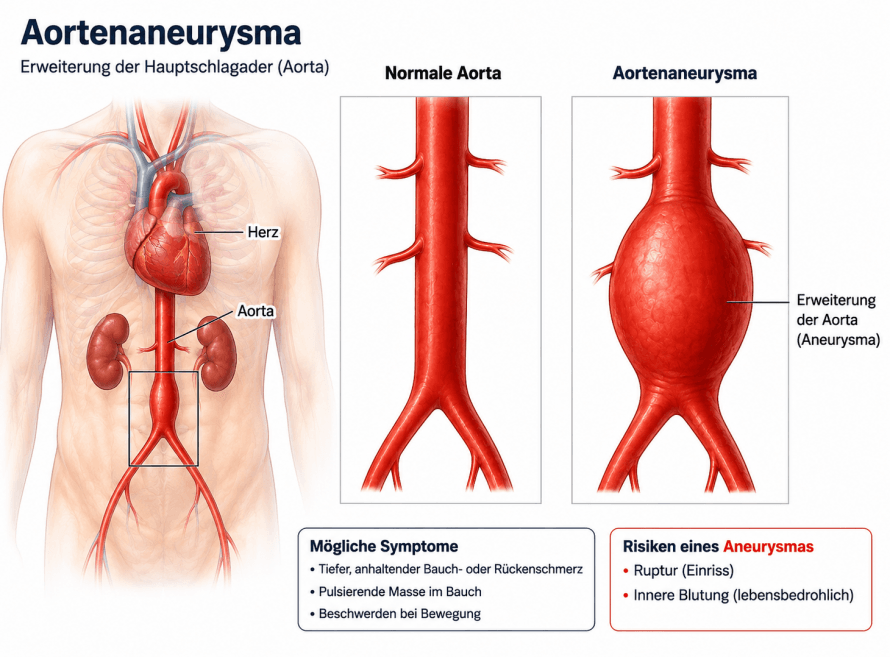
Image generated by AI
Who is at increased risk?
An aortic aneurysm usually develops over many years. Various factors can further weaken the vessel wall and increase the risk.
These include, in particular:
- advanced age
- Smoking
- high blood pressure
- Atherosclerosis (hardening of the arteries)
- Elevated blood lipid levels
- Family history
- Male gender
Men over the age of 65 are particularly at risk. People who smoke or have smoked in the past also face a significantly increased risk. For this reason, many medical societies recommend a one-time ultrasound examination of the abdominal aorta for certain risk groups as a means of early detection.
What symptoms might occur?
The insidious thing about an aortic aneurysm is that the condition often causes no symptoms at all. Many people affected feel completely healthy and only learn about the dilation of the artery during a routine examination. Larger aneurysms, however, can cause symptoms.
These include:
- dull pain in the abdomen or back
- a feeling of pressure in the abdomen
- a pulsating bulge in the abdomen
- pain in the flank
- radiating back pain
If an aneurysm ruptures, severe pain in the abdomen, back, or flank usually occurs suddenly. This is accompanied by sweating, a drop in blood pressure, dizziness, or loss of consciousness. In this situation, every minute counts, as it is a life-threatening emergency.
How is an aortic aneurysm diagnosed?
Since patients often experience no symptoms, imaging plays a crucial role. An ultrasound examination can reliably detect an aortic aneurysm and determine its diameter. If surgery is being planned or complications are suspected, a computed tomography (CT) scan or magnetic resonance imaging (MRI) is also used. These procedures provide detailed information about the size, shape, and exact location of the aneurysm and help plan the optimal treatment.
When does an aortic aneurysm require treatment?
Not every aneurysm requires immediate surgery. Smaller aneurysms are initially monitored regularly. Specialized vascular physicians check at fixed intervals to see if the aneurysm is growing.
Treatment is usually recommended when:
- the diameter reaches a critical value,
- the aneurysm is growing rapidly,
- symptoms occur, or
- there are signs of an impending rupture.
In addition, blood pressure, blood lipid levels, and other risk factors are consistently managed to minimize the strain on the vessel wall as much as possible.
What surgical procedures are available today?
Treatment options have advanced significantly in recent years. Today, two established procedures are available.
In open surgery, the affected section of the aorta is exposed through an incision in the abdomen and replaced with a vascular graft. This procedure is considered very durable and is particularly suitable for complex aneurysms.
In addition, endovascular aneurysm repair (EVAR) has gained prominence. In this procedure, a fabric-covered stent is advanced into the aorta via the femoral arteries and deployed at the site of the aneurysm. Blood then flows through the stent, relieving pressure on the weakened vessel wall. Since no large abdominal incision is necessary, many patients benefit from a faster recovery and shorter hospital stays. However, whether this procedure is suitable depends on the individual anatomy of the aorta.
Can an aortic aneurysm be prevented?
Not all risk factors can be controlled. However, a healthy lifestyle plays a key role in protecting the blood vessels. Quitting smoking is particularly important, as nicotine causes lasting damage to the vessel walls and can accelerate the growth of an aneurysm.
Equally important are good blood pressure control, regular exercise, a balanced diet, and treatment for elevated blood lipid levels or diabetes mellitus. People with a family history of the condition or other risk factors should consult a doctor to discuss whether a preventive ultrasound examination is advisable.
Conclusion: Early Detection Is Crucial
An aortic aneurysm often goes unnoticed for a long time and is frequently discovered by chance. This is precisely why early detection is of great importance for people at increased risk. Modern ultrasound and CT scans enable a reliable diagnosis, while individually tailored follow-up care and advanced surgical techniques help prevent life-threatening complications. Those who consistently manage risk factors such as smoking or high blood pressure and take warning signs seriously can play a significant role in maintaining the long-term health of the aorta.
Share this article
Verified expertise
Recommended specialists
13 specialists
13 results




Dr. med. Konstantinos Verginis
Duisburg



Dr. med. (syr) Amer Jomha
Bad Hersfeld

Dr Thomas Riester
Karlsbad

Prof. Dr. med. Alexander Albert
Dortmund







1 / 2
News
Read next
- News
Scabies: A contagious skin disease that is easily treatable
Oct 26, 2026
Severe itching and minor skin changes should be taken seriously
Read more - News
Heat Rash: What's Behind the Itchy Blisters
Oct 23, 2026
Heat Rash: Heat and Sweat Can Disrupt the Skin's Balance
Read more - News
Enlarged Prostate – When Medication Is Sufficient and When Surgery Is Recommended
Oct 21, 2026
Why Many Men Ignore Urinary Problems for Too Long
Read more