An elbow prosthesis is used when the elbow joint is severely damaged by osteoarthritis, a fracture, or rheumatoid arthritis, and conservative treatments no longer provide sufficient relief.
The goal of the surgery is to reduce pain, restore joint stability, and improve elbow mobility. Modern elbow prostheses are custom-made implants that are individually tailored to the patient’s anatomy.
When is an artificial elbow joint needed?
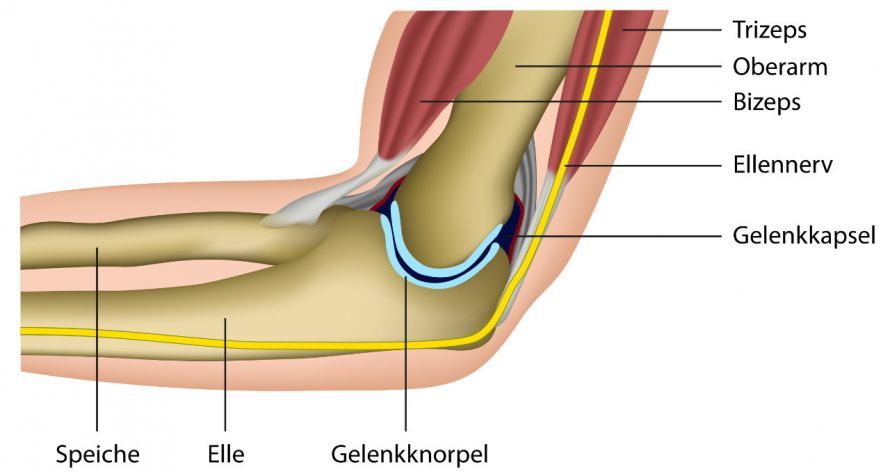
The elbow joint is very important for the mobility of the arm. It consists of three parts:
- the upper arm bone (Latin: humerus),
- the ulna (Latin: ulna), and
- the radius (Latin: radius).
The humerus and ulna together form what is known as a hinge joint. It is responsible for bending and straightening the arm. The humerus and radius work together to enable the rotational movement of the forearm. The joint surfaces between the ulna and radius at the forearm and upper arm are protected by cartilage. The cartilage acts
- as a shock absorber for the individual bones and
- protects them from abrasion and wear.
If the cartilage layer of the joint is damaged, pain results.
There are various causes of cartilage damage in the elbow:
- osteoarthritis,
- rheumatoid arthritis, and sometimes
- fractures.
When the cartilage is damaged, bone rubs against bone. At first, this causes pain only during movement, but later it also leads to limited range of motion and pain even at rest. Damage to the cartilage cannot be reversed or surgically repaired. Conservative treatments (i.e., without surgery) include physical therapy and injections.
If these are unsuccessful, debridement of the joint (e.g., arthroscopically) can be performed. If that does not help either, the only remaining treatment option for worn cartilage is the implantation of an artificial elbow joint.
What is an elbow prosthesis?
A joint endoprosthesis is not visible from the outside. It is implanted during surgery in place of the body’s own damaged joint and therefore serves as a joint replacement. It is therefore also referred to as an artificial joint.
In the case of an elbow endoprosthesis, the functional mobility
- of the elbow,
- the hand, and
- the fingers
.
An elbow prosthesis is made of a metal alloy. In most cases, this is titanium, due to
- its resistance to fracture,
- its stability, and
- low risk of allergic reactions.
Individual components of the elbow prosthesis are made of polyethylene (a high-quality, durable plastic).
The lifespan of an implanted elbow prosthesis varies greatly. Depending on the use of the artificial elbow joint and the patient’s age, it ranges from ten to fifteen years. In very rare cases, however, loosening may occur prematurely. In cases of age-related wear or premature loosening, the elbow prosthesis must be replaced with a new one.
Surgical Implantation of the Elbow Prosthesis
When replacing the elbow joint with an artificial joint, the prosthetic components are implanted into the humerus and the ulna. Healthy bone is preserved as much as possible during the procedure. Elbow prostheses are therefore anchored inside the bone (the bone marrow) using a special cement adhesive. This has the advantage of maintaining the arm’s stability through the patient’s own bone.
The prosthetic shafts inserted into the humerus and ulna are connected by an artificial elbow joint. It functions exactly like the body’s original hinge joint. When such an elbow prosthesis is implanted, it is referred to as a total prosthesis, since the entire elbow joint is replaced. In mild cases of wear and tear on the elbow joint, a so-called partial prosthesis may be implanted instead. It does not replace the entire joint, but only a small part of it.
Surgery to implant an elbow prosthesis can be performed under either general or regional anesthesia. With regional anesthesia, a local anesthetic is administered to the shoulder in the neck area. Afterward, the entire arm is numb, but the patient remains fully conscious. Under general anesthesia, the patient is put to sleep and remains asleep throughout the entire procedure. The procedure typically lasts about one to two hours.
First, an incision is made on the back of the upper arm, running lengthwise toward the elbow joint. The muscles in this area are gently moved aside to avoid damaging them. The surgeon then removes the damaged cartilage tissue from the joint.
Small sections of bone may also be removed if they have already been severely damaged by friction and wear and would no longer provide sufficient support for the elbow prosthesis. The surgeon then prepares the upper arm and forearm for the insertion of the titanium shafts into the bone marrow. The elbow prosthesis is then fully implanted and cemented into the bone. Depending on the surgical method and the patient’s condition after surgery, the hospital stay lasts between five and seven days.
Risks of an Elbow Prosthesis
As with any implanted endoprosthesis, there are, of course, some risks associated with an artificial elbow joint. These begin as early as the surgery itself with the usual side effects such as
- thrombosis,
- embolism,
- heart, lung, and circulatory problems, or
- drug intolerance
. Since these risks can occur with any surgical procedure, they are addressed in advance through a thorough consultation. Material incompatibility with the elbow prosthesis is extremely rare due to the material used (titanium).
More common complications include, among others,
- bruising,
- impaired wound healing,
- nerve damage (which is usually only temporary), and
- limited mobility of the elbow joint.
However, these generally do not affect the final outcome. In very rare cases, a so-called prosthesis infection may occur, which can only be treated surgically.
Prosthesis loosening, which usually occurs after about ten to fifteen years due to the daily stress on the elbow prosthesis, can also only be treated surgically. In this case, the prosthesis must be replaced due to wear and tear.
Immediately after surgery
After the incision on the back of the upper arm has been sutured, the entire elbow joint is immobilized. To prevent bruising within the joint and postoperative bleeding, drains have been placed beforehand. These ensure that blood drains from inside the elbow.
A so-called pain catheter may also be inserted. It allows for the continuous administration of pain medication, thereby ensuring that the patient remains relatively pain-free.
Within a relatively short time, the splint is removed and the elbow joint is mobilized. Under medical supervision, the patient is encouraged to begin moving the new joint. Thanks to the pain catheter or the administration of pain medication, this process should already be largely pain-free.
Even during the hospital stay, movement of the artificial elbow joint is repeatedly encouraged and trained through supervised physical therapy.
After Discharge
After discharge from the hospital, targeted physical therapy is still necessary and is carried out on an outpatient basis. Inpatient rehabilitation is generally not necessary for an artificial elbow joint.
During physical therapy, the elbow joint is gradually reacclimated to its actual function. Here, the patient learns how to use their artificial elbow joint and receives guidance on future activities.
In most cases, the patient should no longer perform any activities that place heavy strain on the elbow, including
- tennis,
- golf, and
- lifting loads weighing more than one kilogram.
Since the latter, in particular, isn’t always easy to avoid in daily life, physical therapy focuses on teaching elbow movements that are gentle on the joint during everyday activities. In most cases, the elbow regains full function after about six weeks, and only mild discomfort remains.
Frequently Asked Questions About Elbow Replacements (FAQ)
When is an elbow prosthesis necessary, and what types are available?
Coupled and uncoupled elbow prostheses are among the types available; the implantation of an artificial elbow joint becomes necessary when an injured or worn-out elbow joint with severely worn, worn-out joint surfaces and joint components—cannot restore the functionality of the elbow joint, even through conservative and joint-preserving procedures.
How does an uncoupled elbow prosthesis work?
The uncoupled elbow prosthesis replaces the entire joint or parts of it; it is individually tailored to the elbow and consists of the individual components of the artificial elbow joint, some of which are connected by hinges, and the artificial elbow joint mimics the function and shape of a normal elbow joint as closely as possible.
What factors determine the choice of the right prosthesis model?
The choice of treatment—such as a partially articulated prosthesis—depends on whether the stabilizing function of the ligamentous apparatus is still intact, because the choice of prosthesis depends largely on how stable the bone is, since the prosthesis relies on the bone structure as well as the ligamentous support of the elbow.
How is elbow surgery performed?
Due to the complex anatomy of the elbow joint, this is a demanding and complex surgical procedure in which diseased tissue is removed during the operation, pathological tissue and damaged bone fragments are removed, and the prosthesis is implanted so that the implant is securely anchored in the bone.
What are the goals of the surgery, and how long does an elbow prosthesis last?
The prosthesis serves as an artificial joint replacement used in cases of advanced osteoarthritis, enables improved mobility of the elbow, and aims to provide pain relief and restore functionality to the elbow joint. The lifespan of an elbow prosthesis is typically 10 to 15 years, and the prosthesis should be monitored regularly for any potential loosening.
When does postoperative care begin after the procedure?
Follow-up care begins on the very first day after surgery, since the prosthesis has been implanted and the body’s own elbow bone must adapt to it; this is why extensive experience is important for monitoring the prosthesis and ensuring the long-term stable function of the artificial elbow joint.

About the medical author
Dr med. Sebastian Gathmann Area of expertise: Shoulder / Elbow
Medical Author · Cham
Dr. med. Sebastian Gathmann – shoulder & elbow author: Explore expert medical articles on diagnosis and treatment in the Leading Medicine Guide.