Myelography is an imaging procedure in which doctors inject a contrast agent into the spinal canal to take X-rays. The procedure is used to diagnose pathological changes in the spinal canal and the spinal cord within it.
Below you will find more information about this diagnostic procedure as well as specialists who perform myelography.
Definition: What is a myelogram?
Myelography is an X-ray examination using a contrast agent that detects pathological changes in the spinal canal and the spinal cord within it.
Conventional X-rays can also be performed in combination with myelography and computed tomography (CT). Doctors currently diagnose changes in the spine and spinal cord primarily using magnetic resonance imaging (MRI). Unlike myelography, MRI does not require a puncture of the spinal canal. In some cases, however, myelography is still necessary.
RARE MR myelography (Rapid Acquisition with Enhanced Relaxation Myelography) is an MRI sequence that rapidly acquires water-sensitive images.
Like conventional myelography, it can clearly visualize narrowing of the subarachnoid space (e.g., due to tumors) without the use of contrast agents.
Reasons for performing a myelography
Myelography is used when MRI and CT do not provide information about the spatial and dynamic relationships of the spine.
To analyze the interaction between the bones of the spine, intervertebral discs, spinal cord, and nerves, doctors examine the spine dynamically.
For example, when bending forward, an intervertebral disc may bulge from the intervertebral space into the spinal canal and pinch a nerve there. At the same time, it may remain completely unnoticeable when the patient is standing upright.
Furthermore, not every herniated disc requires treatment. It always depends on how much space remains between the disc and the adjacent nerves.
The interconnected vertebrae form the bony wall of the spinal canal. This wall encloses the dural sac, which contains the spinal cord and the nerve roots emerging from it.
The spinal cord is surrounded by cerebrospinal fluid. Without a contrast agent, the contents of the spinal canal cannot be seen on an X-ray.
If the spinal cord, nerve roots, or spinal canal become narrowed, this can lead to pain and paralysis. The exact extent of the narrowing or displacement of the spinal cord can be determined using myelography.
With the advent of modern, non-invasive cross-sectional imaging techniques such as MRI and CT, the importance of myelography has declined.
Nevertheless, myelography is still used for specific problems in neurosurgery, particularly when CT or MRI cannot be performed.
Generally, myelography is primarily used to diagnose neoplasms in the spinal canal. During the evaluation, physicians should look for gaps in the contrast medium.
In cases of spinal root compression syndromes, the advantage of dynamic imaging in myelography can be particularly useful—especially for detecting filling defects in the root pockets.
Therefore, myelography is used to clarify unresolved issues prior to surgery, particularly when MRI or CT scans are not feasible—such as in cases of scoliosis.
After contrast agent injection and myelography, a computed tomography (CT) scan may also be performed to obtain images of additional cross-sections.
 Scoliosis is a three-dimensional deformity of the spine that leads to a more or less clearly visible postural abnormality @ filins /AdobeStock
The Myelography Procedure
The procedure is performed with the patient sitting or lying on their side. After administering a local anesthetic at the puncture site, the doctor inserts a thin hollow needle into the spinal canal between the lumbar vertebrae.
At this level, there is no spinal cord, only nerve roots. The doctor first uses a syringe to withdraw several milliliters of cerebrospinal fluid (CSF), which is then sent to the lab for analysis.
This ensures that the needle is correctly positioned. The doctor then injects a contrast agent into the spinal canal through the hollow needle.
The patient is then tilted head-down so that the contrast agent flows to the thoracic and cervical spine. This is followed by X-rays and cross-sectional images.
After the examination, the patient must lie down for several hours and remain in bed until the end of the day. Otherwise, the change in pressure within the spinal canal can lead to severe headaches, nausea, and vomiting. The body excretes the contrast agent in the urine within a few hours.
To assess the spatial relationships between nerve roots, myelography combined with post-myelography CT is superior to other imaging techniques.
Thanks to the strong contrast, doctors can distinguish the nerves from the surrounding structures with millimeter precision.
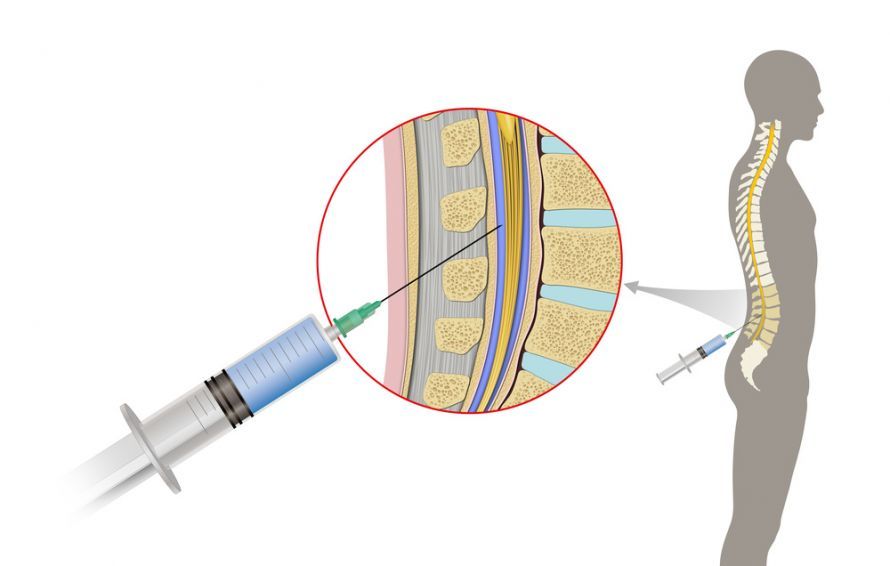 The contrast agent is injected into the spinal canal @ Aldona /AdobeStock
Patient Care Before and After Myelography
The procedure is usually performed in a hospital. One day before the procedure, you will have a consultation with your doctor, during which they will discuss the procedure and potential risks with you. You must report any intolerances (allergies) to disinfectants, iodine-containing contrast agents, and adhesive bandages in advance.
The following blood parameters must be known for the examination:
- Blood coagulation: platelet count; PTT, INR value
- Thyroid: TSH
Laboratory results should not be more than four weeks old. You can have them tested in advance on an outpatient basis. You may need to stop taking anticoagulants a few days beforehand.
After the myelography, you should rest in bed for 6 hours and drink plenty of fluids. You must not be pregnant.
Possible Complications and Risks of Myelography
Myelography is a low-risk diagnostic procedure. Despite taking every precaution, complications may occur in some cases, but they are generally easy to manage.
Possible side effects include:
- Headache
- Nausea
- Allergic reactions
- Infections
- Bleeding
- Very rarely, spinal cord inflammation and meningitis, and
- Even more rarely, nerve damage with temporary or permanent loss of function (sensory disturbances, paralysis)
The first contrast agents available for the early myelographs around 1922 were oil-based. The body could not absorb them. Far more burdensome than the injection of the contrast agent itself was the removal of the oily fluid via a puncture cannula. In many cases, this was ineffective. A few drops remained in the dural sac and caused scarring. Today, absorbable contrast agents are used, which eliminate this problem.
Any procedure that penetrates intact skin can lead to an infection. Pathogens causing pus in the spinal canal are a serious problem, as purulent meningitis can be fatal.
Today, however, this complication is extremely rare. A puncture of the dural sac often results in a loss of cerebrospinal fluid. The cerebrospinal fluid flows out through the opening much like water, creating negative pressure inside the skull. This results in severe headaches (post-dural puncture headache).
The advantages of this diagnostic method over MRI and computed tomography are offset by certain disadvantages. Myelography is an X-ray examination and an invasive diagnostic procedure.

About the medical author
Sabine Schneider
Editor-in-Chief
Sabine Schneider – medical author: Explore expert articles and medical expertise in the Leading Medicine Guide.
More about the medical author →