When is esophageal manometry recommended?
Esophageal manometry examines the swallowing process in the area of:
- the upper and lower esophageal sphincters and
- the esophagus (tubular esophagus)
Indications for esophageal manometry include:
- Swallowing difficulties with normal gastroscopy results,
- Evaluation of chest pain not caused by another condition, such as heart disease
- Prior to a planned surgery for reflux disease
- Unclear globus sensation
- When involvement in another condition, such as rheumatism, is suspected
The pressure generated in the esophagus during swallowing is transmitted to the pressure measurement points. A computer records the pressure changes and displays them as a computer graphic.
Procedure for Esophageal Manometry
Esophageal manometry is a painless, though sometimes slightly uncomfortable, examination. During the procedure, doctors insert a thin catheter through the nose and down the esophagus into the stomach.
The examination is performed while the patient is seated. After an adjustment period, the patient is given small amounts of water to drink at regular intervals. The examination lasts 15 to 20 minutes.
Side effects are rare. Injuries may occur in the nasopharyngeal region, the esophagus, or the stomach.
What procedures are available?
In principle, two procedures are available:
- Conventional perfusion manometry and
- manometry using electronic pressure transducers
For “high-resolution manometry,” catheters with 36 measurement points are now available. This allows the probe to remain stationary in the esophagus during the swallowing process, eliminating the need for a pull-through procedure. The methods differ primarily in their technical design. All methods yield valid results.
Results of an esophageal manometry
Possible diagnoses include:
Esophageal disorders: such as esophageal achalasia, diffuse esophageal spasm, and hypertensive esophagus (nutcracker esophagus)
Secondary motility disorders: associated with other conditions. It is important to rule out these conditions before performing anti-reflux surgery for reflux disease.
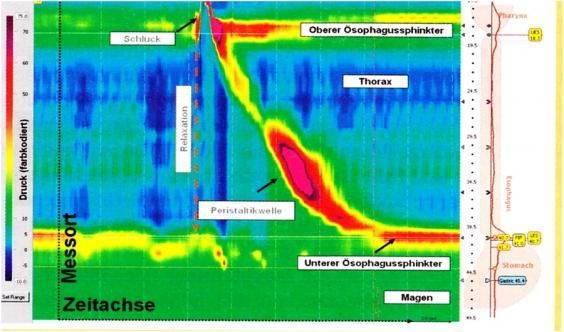
Results of high-resolution manometry (normal findings)
In addition, an X-ray examination of the esophagus with contrast medium may be indicated, and pH monitoring may be used if necessary.

About the medical author
Sabine Schneider
Editor-in-Chief
Sabine Schneider – medical author: Explore expert articles and medical expertise in the Leading Medicine Guide.
More about the medical author →