Rectal cancer (rectal carcinoma) originates in the lower section of the large intestine and usually develops from changes in the intestinal mucosa, particularly from intestinal polyps, which can become malignant over time. If the cancer is detected early, the chances of a cure are very good, as a malignant tumor can often still be removed in time. That is why regular screening, especially colonoscopy, plays a crucial role. But what does it mean when rectal cancer is diagnosed?
Here you will find all the information you need, as well as a selection of specialists in rectal cancer.
Definition: What is rectal cancer?
In the vast majority of cases, rectal cancer develops as a result of a change in the intestinal mucosa. Adenocarcinomas (“mucus-producing cells”), the actual cancerous tumors, develop from polyps—small growths on the intestinal mucosa. In 95% of cases, polyps develop spontaneously over the course of a person’s life; only 5% are due to a hereditary component.
Colorectal cancer is now one of the most common cancers among men and women worldwide, and the incidence is on the rise. Poor diet and lack of exercise are the main causes of this trend. Major risk factors include, for example, consuming large amounts of red meat, diabetes mellitus, being overweight or obese, smoking, excessive alcohol consumption, and advancing age.
Although colorectal cancer mortality rates in our country have been declining for the past 30 years, the incidence rates continue to rise. Colorectal cancer is now the second leading cause of cancer-related death for both sexes.
Depending on the tumor’s location, rectal cancer forms secondary tumors (= metastases) in various organs. Tumor foci located deeper within the rectum spread—similar to colon cancer—primarily to the liver. Closer to the rectal opening, rectal cancer spreads predominantly via the lymphatic system—that is, through the lymph vessels to the inguinal lymph nodes—as well as through the bloodstream to the lungs.
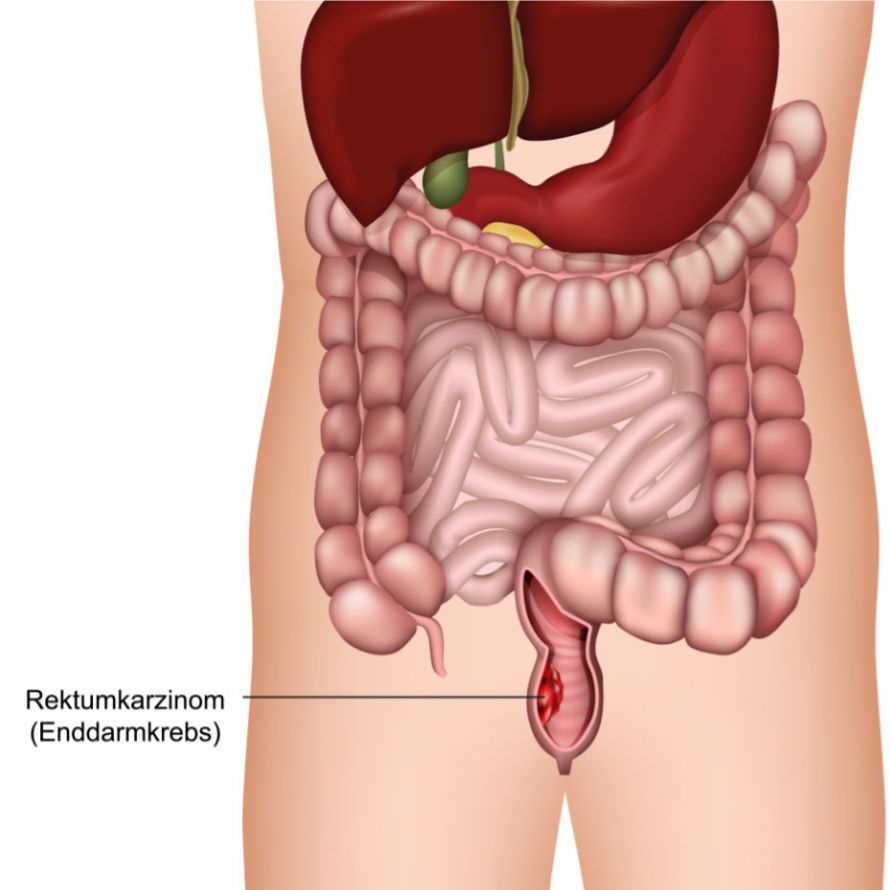
The location of rectal cancer © bilderzwerg #247748992 | AdobeStock
What are the symptoms of rectal cancer?
As with many types of cancer, rectal cancer develops over a long period of time, usually without any symptoms. However, during colorectal cancer screening, even the smallest traces of bleeding can often be detected in the early stages, which may indicate rectal cancer.
In advanced stages, rectal cancer usually becomes symptomatic and manifests, for example, as blood and mucus in the stool, changes in stool consistency (i.e., alternating between hard and soft stools), unintentional weight loss, and possibly pain during bowel movements. These are early signs that should prompt you to see a doctor for further evaluation.
How is rectal cancer diagnosed?
If rectal cancer is suspected, imaging tests are always performed for evaluation. Typically, this begins with a rectal examination combined with a colonoscopy. The colonoscopy is intended to detect secondary tumors that may have formed further up in the intestinal tract. About 7% of patients with rectal cancer have such secondary tumors in the colon.
If rectal cancer is diagnosed, an ultrasound examination is performed using a special probe—a tissue sample (biopsy) is usually taken for detailed pathological diagnosis (“grading,” classification according to TNM stages). In addition, experts use ultrasound to determine whether other organs are affected, e.g., by secondary tumors (= metastases). In the case of rectal cancer, the lungs and liver are the most likely sites.
Magnetic resonance imaging (MRI) is used to examine the lower abdomen and the pelvis for existing lymph node metastases. MRI is preferred over computed tomography (CT) because the latter exposes patients to significantly higher levels of radiation.
Assessing the extent of tumor spread and tumor markers also influences the further treatment of rectal cancer.
Treatment of Rectal Cancer
There are essentially three methods available for treating rectal cancer:
- surgery,
- chemotherapy, and
- radiation therapy
or combinations of these approaches.
These treatment methods can be further tailored depending on the stage of the tumor.
For larger localized tumors or in cases of high risk of recurrence, experts will favor partial (partial mesorectal excision) or complete removal (total mesorectal excision) of the rectum. In these cases, an artificial bowel outlet—known as a stoma or anus praeter—must be created.
If the rectal cancer has already spread to surrounding tissues and lymph nodes, the rectum is removed partially or completely, along with the adjacent lymphatic vessels. An artificial bowel outlet must be created.
For larger tumor masses, doctors often opt for radiation therapy prior to surgery in order to significantly reduce the size of the tumor tissue before the operation. In advanced stages of rectal cancer, surgery is typically followed by chemotherapy. The primary goal of this treatment is to prevent further spread (metastasis) of the rectal carcinoma.
In the terminal stage of the disease, surgical treatment of the rectum alone is no longer sufficient. If operable lung, lymph node, or liver metastases are present, these are also removed, and patients are treated with chemotherapy again after a stoma is created.
In many cases, however, a cure can no longer be achieved at this stage of the disease due to widespread metastasis, so that patients can then usually only be treated with palliative care and pain relief.
Chances of Cure for Rectal Cancer
The long-term prognosis for rectal cancer depends heavily on the stage of the disease and the presence of distant metastases. In the early stages of the disease, with no distant metastases and a locally confined tumor, 5-year survival rates of up to 75% are possible. This means that at this stage, 75% of those affected are still alive after 5 years.
If, on the other hand, limited distant metastases occur in the lungs and/or liver that can still be surgically removed, up to 30% of patients can be cured of their rectal cancer. However, any metastasis generally worsens the prognosis significantly, as does a recurrence of the disease. Close follow-up care is therefore recommended in all cases.
Which doctors are experts in rectal cancer?
Experts in the treatment of rectal cancer (rectal carcinoma) are specialists in internal medicine, proctology, and oncology. For treatment, you should contact experienced, specialized colorectal cancer centers, which you can find here, among other places.
FAQ Frequently Asked Questions:
What are the early signs of rectal cancer?
Typical signs include blood in the stool, changes in bowel habits, or pain during bowel movements. If you experience these symptoms, you should seek medical evaluation.
Is rectal cancer always detected during a colonoscopy?
Generally, yes. A colonoscopy is highly reliable in detecting colorectal polyps and early tumor changes, including the collection of tissue samples via biopsy.
How is rectal cancer treated?
Depending on the findings, treatment may involve surgery, radiation therapy, chemotherapy, or a combination of these approaches. For deep-seated tumors, a temporary colostomy may be necessary.
What are the chances of recovery from rectal cancer?
If tumors are detected at an early stage, the chances of recovery are very high. In cases of metastasis, the prognosis depends heavily on the tumor stage and the feasibility of surgical treatment.
Share this article
Sources
- https://medlexi.de/Mastdarmkrebs
- https://www.darmkrebs.de/behandlung/operation/mastdarmkrebs-operation
- www.onko-portal.de/basis-informationen-krebs/krebsarten/weitere-krebsarten/enddarmkrebs-rektumkarzinom/definition-haeufigkeit.html
- www.onko-portal.de/basis-informationen-krebs/krebsarten/weitere-krebsarten/enddarmkrebs-rektumkarzinom/symptome-diagnose.html
- www.onko-portal.de/basis-informationen-krebs/krebsarten/weitere-krebsarten/enddarmkrebs-rektumkarzinom/ursachen-und-risikofakto.html
- https://www.internisten-im-netz.de/krankheiten/darmkrebs/vorsorge-schutz.html
- www.krebsinformationsdienst.de/darmkrebs