When a radical cystectomy—that is, the removal of the bladder—becomes necessary due to invasive cancer (bladder cancer), patients and their treating urologists are faced with the question of the appropriate urinary diversion method. The orthotopic neobladder is currently considered the gold standard for quality of life, as it allows for continent urinary diversion without an artificial opening (stoma). To replace the bladder, a new bladder is formed from a segment of the intestine and connected to the urethra.
The orthotopic neobladder as a continent urinary diversion
The goal of this form of urinary diversion is to create a low-pressure reservoir that stores urine and releases it in a controlled manner. To achieve this, the urologist removes a segment of the small intestine approximately 50–60 cm long. The key step is detubularization: The intestine is cut lengthwise to interrupt the tubular peristalsis. The intestinal wall is then sutured into an intestinal sheet and shaped into a spherical (spherical) form. Depending on the technique, the reservoir is folded into an S- or W-shape. Since the urethral sphincter is preserved, the neobladder is continent.
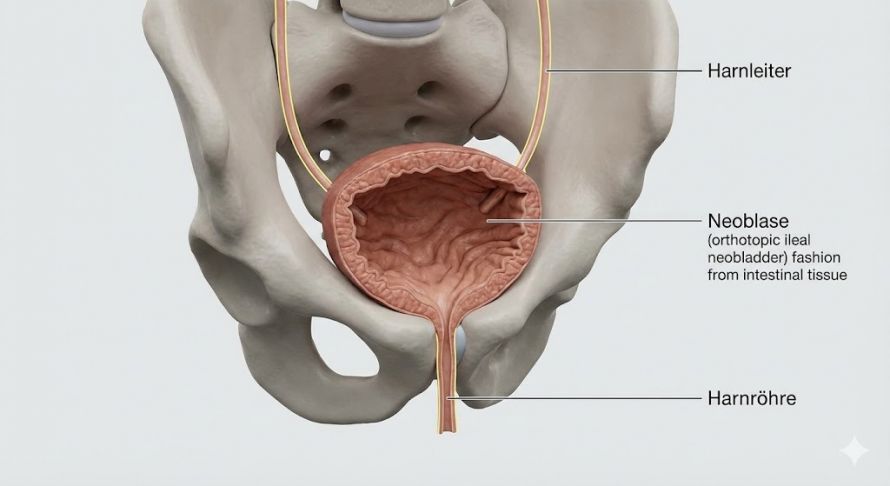
The bladder substitute formed from the small intestine is connected directly to the urethra to mimic natural bladder function.
Neobladder According to Studer and Hautmann: The Surgical Technique
There are various techniques for this orthotopic bladder substitute. The two best-known procedures were developed by Professors Studer and Hautmann.
-
Studer-type neobladder (Studer neobladder): In this procedure, a longer segment of the ileum is used as a “chimney” into which the ureters are implanted (ureteral implantation). This protects the kidneys from reflux.
-
Hautmann-type neobladder: This technique uses a W-shaped folded intestinal flap to form the reservoir. It often provides a particularly large volume.
Both methods aim to create an anastomosis (connection) to the urethra so that the patient does not have to wear a urine bag on the abdominal wall.
Bladder Emptying and Managing the Replacement Bladder
Since the replacement bladder does not have its own muscle to contract (like the original bladder), emptying it works differently. The patient must use abdominal pressure to push the urine out. Initially, patients must learn to empty the new bladder regularly (every 3–4 hours) to prevent overdistension. Since intestinal tissue produces mucus, mucus buildup can make urination difficult. Drinking plenty of fluids helps in this regard. In rare cases (hypercontinence), the patient must self-catheterize to remove residual urine. Nocturnal urine leakage may occur because the sphincter relaxes during sleep, but the reservoir may still be minimally active due to bowel movements (despite detubularization).
Complications and Contraindications for Bladder Removal
Not every patient is a candidate for orthotopic replacement. A contraindication exists if:
- The tumor has invaded the urethra (in which case the urethra must be removed).
- Renal insufficiency is present.
- The sphincter is damaged (incontinence).
Complications may include urinary tract infections, metabolic disorders (acidosis due to reabsorption of urine through the intestinal mucosa), or problems at the anastomosis site. If a neobladder is not possible, urinary diversion options such as an ileal conduit or a continent pouch (e.g., Mainz pouch) are available.
Conclusion
The creation of a neobladder (e.g., Hautmann or Studer) is a complex surgical procedure, but it offers the best chance for a physically normal life following a cystectomy. It provides the best functional and cosmetic replacement for the bladder.
FAQ: Frequently Asked Questions About the Neobladder
What is the difference between the Studer and Hautmann procedures?
Both are forms of the orthotopic ileal neobladder. The difference lies in the folding of the intestinal loops and the way the ureters are connected. The Studer neobladder uses a long inflow segment, while the Hautmann bladder is constructed in a W-shape from the intestinal flap.
How often do you need to empty the neobladder?
The neobladder is designed to store urine. Patients should empty it regularly (approximately every 4 hours), including once at night, to prevent excessive pressure buildup and kidney damage.
Do you need a catheter with a neobladder?
Generally not. Emptying is done by abdominal compression. Only if the bladder does not empty completely must the patient learn to perform sterile catheterization (self-catheterization).

About the medical author
Sabine Schneider
Editor-in-Chief
Sabine Schneider – medical author: Explore expert articles and medical expertise in the Leading Medicine Guide.
More about the medical author →