Carotid PTA is a minimally invasive procedure used to treat narrowing of the carotid artery. During the procedure, the carotid artery is dilated from the inside using a balloon catheter, often supplemented by the placement of a stent. This form of percutaneous transluminal angioplasty is used to improve blood flow to the brain and reduce the risk of a stroke. The procedure is particularly useful for patients for whom surgical endarterectomy is not possible or is too risky. Under radiological guidance, a catheter is inserted via the femoral artery and advanced to the narrowed site. By locally dilating the stenosis, deposits that narrow the carotid artery can be effectively treated. Carotid PTA is considered a modern treatment option for arterial vascular diseases and has established itself as a standard procedure in interventional vascular medicine.
What is a carotid PTA?
Carotid PTA (percutaneous transluminal angioplasty) is a minimally invasive procedure used to treat narrowing of the carotid artery. During the procedure, a thin catheter is inserted into the vascular system via the femoral artery and advanced to the narrowed site under angiographic guidance. A balloon is then inflated to widen the narrowed area and restore blood flow to the brain. In many cases, a stent is implanted to keep the treated vessel permanently open and prevent restenosis.
Carotid PTA is considered a minimally invasive alternative to surgical endarterectomy and is primarily used when the anatomical location of the stenosis is unfavorable or when there is a surgical risk. The procedure helps reduce the risk of stroke and is an important component of modern treatment for arterial vascular diseases such as carotid stenosis.
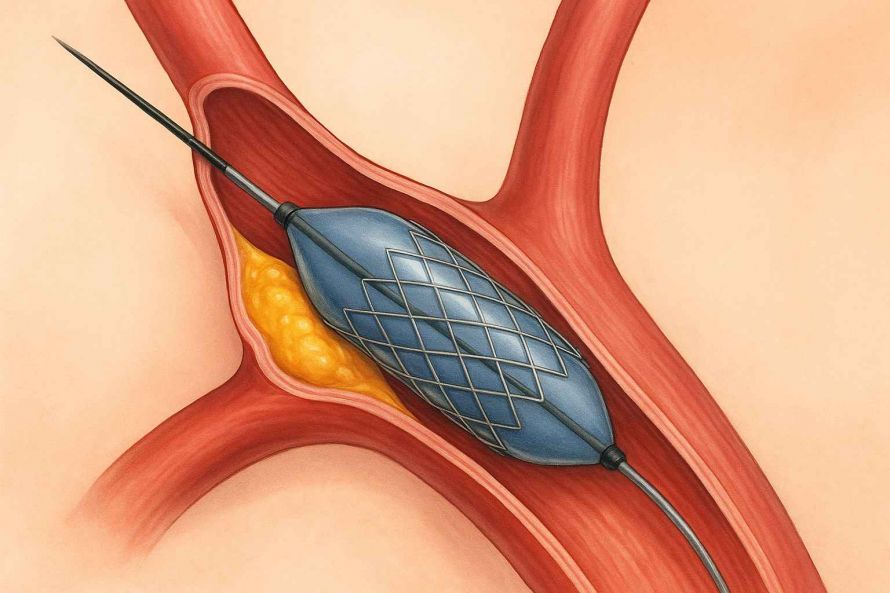
Schematic illustration of carotid stenosis and its dilation using a balloon catheter during a carotid PTA.
Treatment of Carotid Stenosis
Carotid PTA is one of the most important procedures in the endovascular treatment of carotid artery stenosis. The treatment is performed for stenosis of the carotid artery or the internal carotid artery, which is often caused by atherosclerotic plaques. The goal is to reopen a narrowed or occluded artery and restore normal blood flow. Percutaneous transluminal angioplasty is a suitable treatment, particularly for patients at increased risk of stroke. It is minimally invasive, allows for short procedure times, and is performed under radiological guidance.
Indications for Carotid PTA
The indication for carotid PTA depends on the location of the stenosis and the patient’s individual risk profile. The procedure is particularly suitable for severe, symptomatic stenoses or when surgical procedures such as endarterectomy are not possible due to anatomical conditions or comorbidities. Repeat PTA may also be appropriate in cases of restenosis following previous procedures. In addition to atherosclerotic changes, other risk factors such as diabetes mellitus, hypertension, or existing vascular diseases may necessitate treatment. Depending on the location of the stenosis, a protection system is used to prevent distal embolization during dilatation.
Procedure
Carotid PTA begins with catheter insertion via the femoral artery. The catheter is advanced through the vascular system and guided under radiological guidance to the carotid artery. After injecting a contrast agent, the exact location of the stenosis can be assessed. The balloon catheter is then positioned and slowly inflated to widen the narrowed vessel. The dilation improves blood flow and relaxes the vessel wall. Heparin is often administered before treatment, supplemented by medications such as clopidogrel to prevent blood clots. Because of the minimally invasive approach, the procedure is well tolerated by most patients.
Stent Implantation and Protection Systems
In many patients, a stent is implanted following balloon dilation to keep the artery permanently open. These stents prevent the artery from narrowing again. The protection system is designed to prevent embolization by trapping small fragments of plaque or thrombus. During stent implantation, the balloon is inflated again, the stent expands, and stabilizes the vessel wall. The use of a protection system is particularly important in the treatment of the internal carotid artery, as there is an increased risk that dislodged particles could reach the brain. Depending on the anatomical situation, various techniques are used, including distal filters or proximal flow barriers.
Risks and Possible Complications
Although percutaneous transluminal angioplasty is considered safe, complications can occur. These include hematomas at the puncture site in the femoral artery, vascular dissections, distal embolizations, or vascular occlusion. In rare cases, serious complications such as strokes may occur. Embolization during dilation is also possible, which is why modern protection systems are used. An allergic reaction to the contrast agent or restenosis in the area of the stent is also possible. Overall, however, the complication rate is low, especially when the procedure is performed at specialized vascular medicine centers.
Prognosis and Outlook
The prognosis following carotid PTA is often good, as the treatment can significantly reduce the risk of a stroke. Studies and clinical trials show that the procedure achieves a lasting improvement in blood flow for many patients. With proper stent placement, the vessel remains open for a long time, and the risk of restenosis is low. PTA can provide quick and effective relief, particularly in cases of symptomatic stenosis. The procedure represents an important alternative to open surgery and is now routinely performed in many vascular medicine clinics.
Alternatives to PTA
In addition to carotid PTA, surgical endarterectomy is an option. This surgical method is used particularly for stenoses located in specific areas. Other alternatives include conservative therapies that use medications to reduce risk. In some cases, minimally invasive treatment of other vascular segments may also be necessary if multiple arterial narrowings are present simultaneously. The choice of procedure depends on the location of the stenosis, the vascular anatomy, and the patient’s overall health.
Carotid PTA – Further Information
Carotid PTA is a central component of modern radiology, angiography, and interventional vascular medicine. It is suitable for treating narrowed vessels in the carotid artery, particularly in cases of severe stenosis, which can often lead to serious complications. Individual risks and treatment options are assessed during a specialist examination. Careful follow-up is particularly important for the early detection of restenosis.
FAQ – Carotid PTA
What exactly is a carotid PTA?
Carotid PTA is a percutaneous transluminal angioplasty of the carotid artery, in which a catheter is inserted to dilate a narrowed carotid artery—usually caused by plaque—using a balloon. A stent is often implanted afterward to prevent the narrowing from recurring.
When is a carotid PTA an option?
It is suitable for symptomatic carotid stenosis, for severely narrowed vessels of the internal or common carotid artery, and when surgical endarterectomy cannot be performed. The procedure is also used for patients who are at increased risk of complications or who already suffer from a peripheral arterial disease such as PAD.
How is the procedure performed?
The catheter is usually inserted through the femoral artery and advanced to the lesion under radiological guidance. After angiography, contrast dye is injected to determine the exact location of the stenosis. The balloon is then inflated, and a stent is implanted to stabilize blood flow.
Why is a protection system often used during carotid stenting?
During carotid stenting, there is an increased risk that plaque particles will travel distally during dilation. A protection system captures these particles and reduces the risk of distal embolization. This makes the procedure safer, especially for severe or complex lesions.
What are the advantages of percutaneous treatment over surgery?
Percutaneous angioplasty is minimally invasive, can often be performed under local anesthesia, and is less invasive for many patients than surgical intervention. For the treatment of carotid stenosis, an endovascular treatment option is thus available that often carries a lower hemodynamic risk.
Are there any risks or possible complications?
Possible risks are rare but may include vascular dissection, a hematoma at the puncture site, or distal embolization. Recurrent occlusion of the treated artery is also possible, such as restenosis. In severe cases, surgical treatment may be necessary.
What role do CT or MRI imaging play?
Imaging is used to confirm the diagnosis, assess the lesion, and plan the procedure. CT angiography (CT-A) and MRI provide precise information about the location of the stenosis, the vessel wall, and any possible comorbidities.
Is carotid PTA part of larger studies?
Yes, numerous trials have investigated the safety and efficacy of percutaneous transluminal angioplasty (PTA) and stent implantation in the carotid artery. Among other things, they compare surgical procedures such as endarterectomy with percutaneous therapy.
Can this method also be used for PAD?
Yes, the PTA technique is also used for peripheral arterial stenoses, such as in the leg arteries. The procedures are similar, as in both cases a balloon catheter is dilated under imaging guidance to improve blood flow.
How does the treatment affect blood flow?
Dilation and stent implantation significantly improve the hemodynamic condition of the artery. Blood flow is stabilized, and the risk of reocclusion is reduced.

About the medical author
Sabine Schneider
Editor-in-Chief
Sabine Schneider – medical author: Explore expert articles and medical expertise in the Leading Medicine Guide.
More about the medical author →