Stereotaxy is a highly precise procedure used in modern neurosurgery and radiation therapy. With the help of computer-assisted planning and modern imaging, surgical procedures and radiation therapy can be performed on patients with the utmost precision. This method is used in particular for tumors, vascular malformations, movement disorders, and chronic pain. The goal is to precisely treat diseased tissue while sparing healthy tissue as much as possible.
Here you will find further information as well as a selection of specialists and centers for stereotactic treatments.
Definition: What Is Stereotaxy
Stereotaxy is a procedure used in radiation therapy and neurosurgery. It enables computer-assisted radiation therapy and surgeries with millimeter-level precision to be performed with the highest accuracy. Imaging techniques such as
- X-rays,
- computed tomography (CT), or
- magnetic resonance imaging (MRI)
are used for monitoring and guidance. These techniques precisely locate the tissue to be treated in three-dimensional space.
Stereotaxy is the preferred method when tumors or vascular malformations are located in sensitive tissues. Thanks to its precision, doctors can minimize the risk of injuring or damaging healthy tissue.
Stereotactic procedures are primarily used in the treatment of diseases of the brain’s neural structures
.
Medical professionals distinguish between three different stereotactic procedures:
- stereotactic neurosurgery,
- stereotactic radiation therapy, and
- functional stereotaxy.
Stereotactic neurosurgery, or stereotactic brain surgery: One of the most important procedures for the diagnosis and treatment of deep-seated tumors or vascular malformations in the brain. In this context, preserving healthy nervous tissue is of the utmost importance.
Using stereotactic neurosurgery, surgeons can remove the tumor as completely as possible while largely avoiding unwanted neurological deficits.
Stereotactic radiotherapy or stereotactic radiation therapy: This procedure serves two purposes:
- the stereotactic implantation of radiation sources (so-called “seeds”) into a tumor,
- the “excision” of a tumor through non-invasive radiation using a linear accelerator (known as stereotactic radiosurgery or stereotactic radiation surgery).
Functional stereotaxy: A surgical procedure for treating certain chronic pain conditions and movement disorders. For this purpose,
- stimulation systems are implanted in the brain (deep brain stimulation, DBS) or spinal cord, or
- nerve structures are intentionally damaged (lesion).
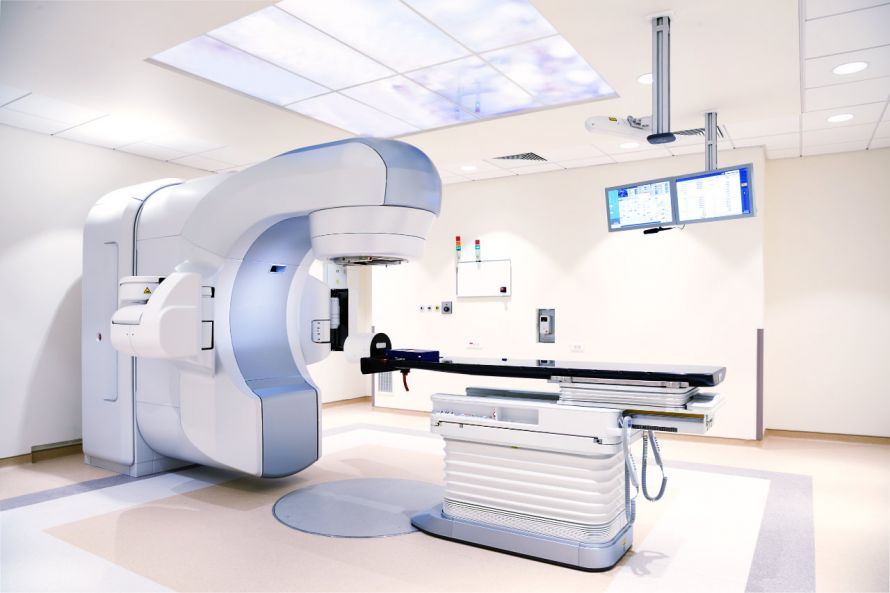
Stereotaxy involves the use of a linear accelerator such as the one shown here © VILevi | AdobeStock
Causes, Risk Factors, and Indications
The indication for stereotactic treatment is determined by the underlying condition. The procedure is used particularly frequently when abnormalities are located deep within the brain or in the immediate vicinity of important structures.
For which diseases is stereotaxy used?
Stereotaxy is a particularly important procedure in oncology, i.e., cancer treatment. This is referred to as oncological stereotaxy.
Most tumors are suitable for stereotactic radiation therapy. However, people with brain tumors as well as those with single or multiple metastases (1–5 metastases) benefit particularly from the precision of this treatment.
Another area of application for stereotactic radiotherapy is vascular malformations, particularly in the brain.
Functional stereotaxy for movement disorders treats conditions such as
- Parkinson’s disease,
- tremor, or
- dystonia.
In addition, doctors at stereotactic clinics also treat
- epilepsy,
- brain metastases
- pain, and
- psychiatric disorders such as depression and obsessive-compulsive disorder, as well as other movement disorders that cannot be treated by other methods.
Stereotactic Neurosurgery
Stereotactic radiation therapy is performed at the clinic using a radiation machine known as a linear accelerator. It operates with greater precision than conventional machines used for standard radiation therapy of tumors.
Radiation therapy and neurosurgical procedures require precision down to a few millimeters. Therefore, the patient must not move during the procedure. For this reason, the patient’s head and the surgical instruments are secured in a frame during stereotactic brain surgery. The patient receives general anesthesia or local anesthesia.
During the procedure, the surgeon inserts very fine probes, electrodes, or instruments through small openings in the skull to precisely calculated points in the brain.
Functional Neurosurgery and Deep Brain Stimulation
Functional neurosurgery deals with conditions in which specific regions of the brain need to be targeted. The field of stereotaxy and functional neurosurgery is particularly important in the treatment of movement disorders. Functional stereotaxy is used, among other things, to treat Parkinson’s disease, dystonia, and tremors. Deep brain stimulation is a well-established procedure. In this procedure, electrodes are implanted into precisely defined regions of the brain. The stimulation can modulate abnormal signal transmission and alleviate symptoms. In certain situations, catheters or special drainage devices are used as adjuncts.
Oncological Stereotaxy
Oncological stereotaxy has established itself as an important component of modern treatment approaches. Highly precise treatment is possible, particularly for small tumors and clearly defined lesions. The method is frequently used for brain tumors, brain metastases, or other locally confined lesions.
The goal is the complete destruction of tumor tissue while sparing healthy structures as much as possible. Thanks to precise planning, even sensitive regions can be treated safely.
Radiosurgery and Stereotactic Radiation Therapy
Radiosurgery is a specialized form of high-precision radiation therapy. Unlike traditional surgery, the treatment is performed without any surgical intervention.
Stereotactic radiation therapy concentrates a very high radiation dose on a precisely defined target area. Due to the characteristic steep dose gradient outside the target area, surrounding tissue is largely spared. For small tumors or metastases, treatment can sometimes be completed with a single dose. In other cases, multiple highly effective single doses are administered.
Radiation and Stereotactic Radiotherapy
Stereotactic radiotherapy is one of the most advanced procedures in radiation medicine. It is also frequently referred to as stereotactic radiation therapy. The treatment is performed using state-of-the-art radiation equipment, usually a linear accelerator.
Unlike conventional radiation therapy, the radiation is precisely directed at the defined target volume. The precise dose distribution enables high therapeutic efficacy while protecting healthy structures.
Depending on the findings, treatment can be administered in a single session or as fractionated therapy spread over several sessions. Thanks to the precise dose delivery, the target area is treated with a high dose, while surrounding areas are exposed to as little radiation as possible.
Radiation Therapy and Radiation Oncology
Radiotherapy is a central component of modern cancer treatment. In radiation oncology, radiation oncologists, medical oncologists, and specialists from other fields work closely together.
This treatment can play a particularly important role in cases of bone metastases, brain metastases, and other tumor-related conditions. The affected areas are targeted with radiation, while surrounding structures are spared as much as possible.
Today, the combination of modern technology and precise planning enables highly effective treatment.
Diagnostics and Stereotactic Biopsy
A thorough diagnostic evaluation is performed before every treatment. This is based on modern imaging techniques, particularly CT and MRI scans.
Stereotactic biopsy plays an important role. It allows for the targeted removal of tissue from deep regions of the brain. The tissue sample is then examined under a microscope.
In this way, the nature of the lesion can be precisely determined. The examination of individual cells—including tumor cells—provides important information for further treatment planning.
Treatment Process
Treatment takes place in specialized centers, often at a university hospital or within a network affiliated with a university hospital.
Before the procedure begins, the images are evaluated and the patient’s exact positioning is determined. Correct positioning is crucial for the accuracy of the procedure.
General anesthesia is often used for surgical procedures. The radiation beams are then precisely aligned with the target area.
Many procedures can now be performed on an outpatient basis. Depending on the underlying condition and the duration of treatment, only a few sessions are required. Modern technology enables highly precise treatment methods, even in sensitive regions of the brain. For certain applications, movements caused by breathing are also taken into account. The respective breathing phase can be incorporated into the planning to further increase accuracy.
Procedure, Prospects for Success, and Side Effects
Compared to conventional methods, stereotactic surgery has few side effects.
Like any X-ray examination, stereotactic treatment involves radiation exposure. However, this exposure is minimal.
Bleeding and inflammation may occur in rare cases.
The success of treatment depends on the underlying disease, its extent, and the chosen treatment strategies.
Very good results can be achieved, particularly with small tumors, isolated metastases, and benign tumors.
Precise planning ensures that healthy tissue and important brain structures are largely preserved.
This method is particularly suitable for sensitive areas of the body where conventional procedures would carry higher risks. Thanks to precise control, functionally important areas can also be protected.
FAQs on Stereotaxy
What is stereotactic treatment?
Your stereotactic treatment is a computer-assisted procedure in which surgical interventions or radiation therapy are planned and performed with the highest precision.
When is stereotactic radiation therapy used?
It is primarily used for tumors, metastases, vascular malformations, and certain neurological conditions.
Can the treatment be performed on an outpatient basis?
Many procedures can now be performed on an outpatient basis. However, this depends on the type of condition and the specific procedure chosen.
What is the difference between radiosurgery and radiation therapy?
Radiosurgery uses highly precise beams to treat small target areas.
Traditional radiation therapy is often administered over a longer period of time with multiple sessions.
Is a stereotactic biopsy safe?
Stereotactic biopsy is considered a minimally invasive and very safe method for obtaining tissue samples from deep regions of the brain.
Which specialists and specialized clinics perform stereotactic procedures?
Specialists in stereotaxy are typically radiologists (radiation oncologists) or neurosurgeons. They often work as part of an interdisciplinary team with specialists from other fields (e.g., oncologists, neurologists) at specialized clinics for stereotaxy.

About the medical author
Dr. Claus Puhlmann
Medical Author · Medical journalist
More about the medical author →