Learn more here about the procedure for total extraperitoneal mesh implantation and find selected specialists.
Background Information on Inguinal Hernias
The most common type is the lateral inguinal hernia, which occurs in 70 percent of patients. An inguinal hernia can occur on one side or both sides. The right side of the body is more commonly affected.
The following types can be distinguished:
- The lateral inguinal hernia
- The medial hernia
- The femoral hernia
In men, the groin area, including the inguinal canal, represents a natural weak spot in the abdominal wall. The spermatic cord passes through this canal, traveling through the abdominal wall into the scrotum.
In women, the round ligament runs through this canal from the uterus to the pubic bone. The peritoneum protrudes finger-like into the inguinal canal. The peritoneum can push outward through a gap in the abdominal wall, potentially containing abdominal contents or portions of the intestine.
Doctors refer to such a gap in the abdominal wall as a hernial orifice, and the protruding peritoneum as a hernial sac. If the hernia is large, it may be visible or palpable under the skin. A lateral hernia can extend into the scrotum; in women, it can extend into the labia majora.
Sometimes the hernial sac only becomes apparent when coughing or straining, as intra-abdominal pressure increases. The hernial sac then pushes outward. The doctor uses this finding during a physical examination to make a diagnosis. Rarely does the doctor need additional imaging procedures, such as a painless ultrasound examination.
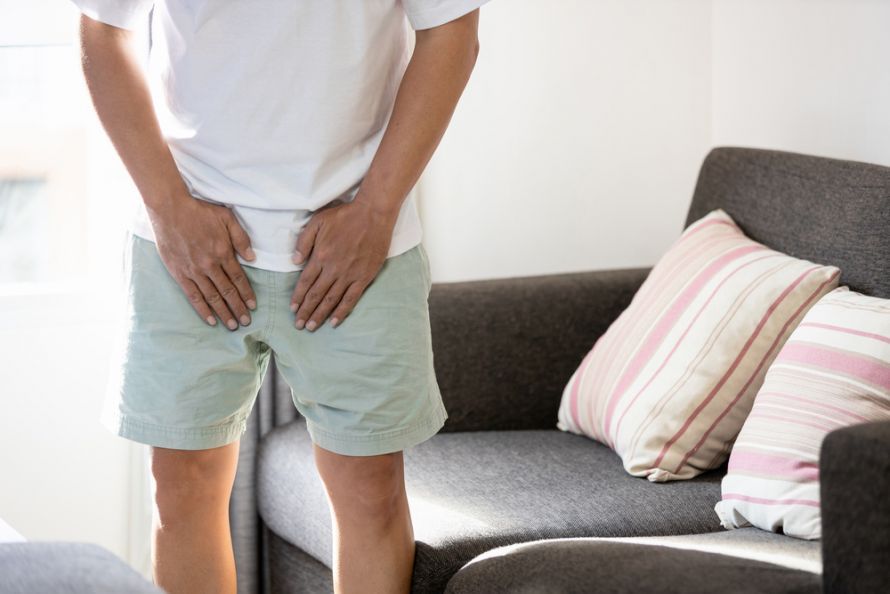
An inguinal hernia often occurs in connection with significant strain on the abdominal wall @ Satjawat /AdobeStock
Treatment Options for an Inguinal Hernia
Doctors do not always need to operate on a hernia. As long as it does not cause any symptoms, they may adopt a “watchful waiting” approach for a while.
However, the German Hernia Society recommends applying the criteria for surgery generously. Experts believe that a hernia never heals on its own and can grow larger with every increase in intra-abdominal pressure.
If sections of the intestine become strangulated in the hernia ring, it can be life-threatening, as the affected section of the intestine may die. Strangulation causes severe pain. Emergency surgery is absolutely necessary. Fortunately, strangulation is a rare occurrence.
A patient with a hernia does not necessarily have to give up physical activity. However, they should avoid or adjust movements and physical exertion that cause discomfort.
Open and Minimally Invasive Procedures
In hernia surgery, there are several open and minimally invasive procedures to choose from. During inguinal hernia surgery, doctors reposition the hernial sac back into the abdominal cavity to permanently close the hernial ring.
Since this is one of the most common surgeries, many surgeons are skilled in performing this procedure. However, there are also specialized surgeons.
In open surgical procedures, the surgeon opens the inguinal canal with a 5–8 cm incision above the groin.
In minimally invasive or endoscopic surgery (keyhole surgery), only three tiny incisions are required to insert the instruments.
- Open Surgery
The open procedures are known as the Shouldice or Lichtenstein procedures. In both procedures, doctors open the inguinal canal, reduce the hernia sac, and close the hernia opening with a suture.
In the Lichtenstein procedure, the surgeon also inserts a synthetic mesh to reduce the recurrence rate. Open surgical procedures can be performed under general or local anesthesia.
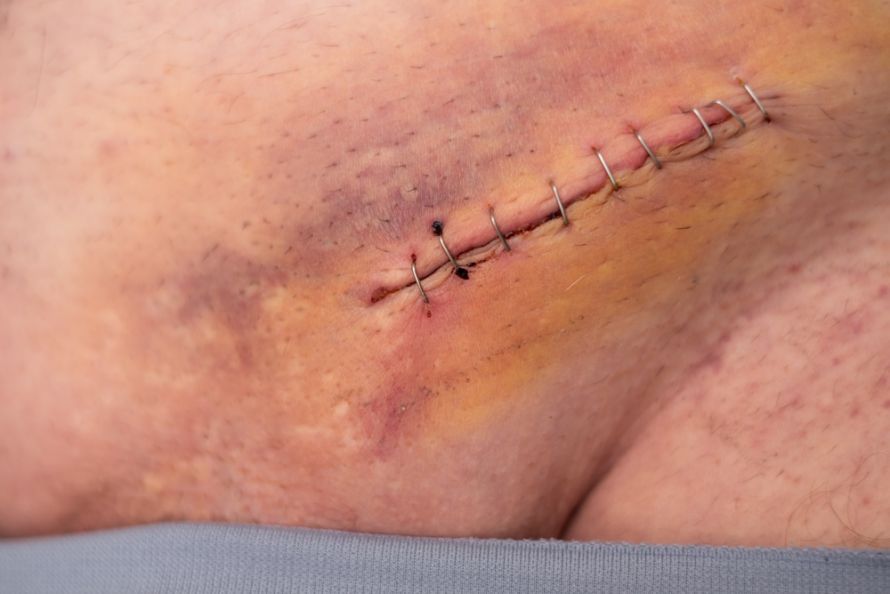
During open inguinal hernia surgery, a 5–10 cm incision is made in the groin region @ luciano /AdobeStock
Minimally Invasive Surgery- Minimally invasive procedures include:
- Transabdominal preperitoneal repair (TAPP) or
- Total extraperitoneal hernioplasty (TEP)
In the TAPP technique, access is gained through the abdominal cavity. The surgeon covers the hernia defect with a mesh from the inside. An advantage of this method is that it allows doctors to detect previously unknown hernias or other problems in the abdominal cavity, which they can then treat as well. TEP and TAPP are always performed under general anesthesia.
Although both procedures are quite safe, total extraperitoneal hernioplasty has a very low complication rate and the lowest risk of recurrence.
Procedure and Postoperative Care for the TEPP Technique: Minimally Invasive Surgery for Inguinal Hernias and as an Alternative to TAPP – Mesh Placement in the Extraperitoneal Space
Procedure for total extraperitoneal hernioplasty
First, the surgeon makes a tiny incision below the navel. He inserts the camera through this incision. He advances it over the peritoneum without piercing it. This means the surgeon does not have to open the abdominal cavity. That is why the procedure is called extraperitoneal, which literally means “outside the peritoneum.”
Using the camera, the surgeon expands the space between the peritoneum and the fascia with a balloon. The surgeon then introduces CO₂ gas into the resulting cavity to keep it open and ensure a clear field of view.
Next, the surgeon inserts two additional trocars through small incisions to the right and left of the first one. The first trocar carries the camera and ensures a clear view of the surgical cavity. The other two guide the instruments.
He carefully detaches the hernia sac and returns it to the abdomen. To prevent it from protruding outward again, he places a paper-thin mesh between the abdominal wall and the peritoneum.
This mesh is made of various synthetic materials. The surgeon does not need to secure the mesh, as intra-abdominal pressure and the abdominal muscles hold it in place. Sometimes, doctors (using the TEP technique) secure the synthetic mesh with surgical glue, sutures, or staples.
What to Expect After Surgery
The tiny incisions made for the trocars usually heal quickly and without complications. Light physical activity is possible as early as the day after surgery. Patients who do not perform heavy physical labor are typically able to return to work within a few days.
After a TEPP, the muscles generally recover quickly because only a small incision and minimal access are required. Physical capacity usually increases significantly within a few days, as the force vectors outside the gap become stronger again and the abdominal wall stabilizes more quickly.
During the surgery, a folded mesh—often a thin plastic mesh that conforms optimally—is inserted. Depending on the technique, the surgeon secures it with metal or plastic clips to ensure a secure position and reduce the risk of an incisional hernia. Variations such as patch repair can also contribute to stable coverage of the hernial orifice.
Total Extraperitoneal Mesh Implantation: Minimally Invasive Mesh Placement and the Benefits and Risks of the TEP Technique
Advantages of TEPP
Total extraperitoneal repair offers significant advantages because it is performed entirely using minimally invasive techniques and does not require opening the peritoneum during laparoscopy. This protects the internal structures, reduces pain, and lowers the risk of complications such as incisional hernias. At the same time, the natural anatomy is largely preserved, which is particularly important for maintaining stable abdominal muscles.
Another advantage is that the mesh is held in place by intra-abdominal pressure. It is often made of lightweight polypropylene, which adapts well to the various layers of the abdominal wall and reliably covers the hernial defect. As a result, few or no additional fastenings with clips are usually required, which further reduces surgical trauma.
Since the space between the abdominal wall and the peritoneum is created via a minimally invasive laparoscopy, the sum of the force vectors around the hernia site remains physiologically well-distributed. This keeps the mesh stable, protects the surrounding tissue, and allows the tissue to heal and strengthen. Overall, TEPP is considered technically challenging but, for patients, a particularly minimally invasive and permanently stable procedure.
Possible Complications of TEPP
The usual risks associated with anesthesia should be noted. These are extremely rare. To minimize them even further, the anesthesiologist administering the anesthesia will speak with you at length before the surgery.
The risk of bleeding is low, provided you are not taking any blood thinners. You must stop taking these medications around the time of the procedure in consultation with the surgeon and your primary care physician or cardiologist.
Since the surgeon does not need to open the abdominal cavity during total extraperitoneal hernioplasty, no abdominal organs (intestines) are injured. All hernia surgeries rarely result in nerve irritation after the procedure. This is usually temporary and very rare with TEP! Fortunately, the risk of recurrence after TEP (provided the mesh is correctly positioned) is very low.
Finally, it is worth noting the structural advantage of this method: With TEPP, the layer between the peritoneum and the muscle wall remains the sole surgical site. This eliminates the need for laparoscopy, and the abdominal muscles reattach securely over the inserted mesh after the procedure. Because there is no unnecessary tissue cutting or internal suturing, the area usually heals quickly and with minimal strain on the entire body—another reason why this technique is considered particularly gentle.
Conclusion on TEP surgery: a gentle, minimally invasive solution for inguinal hernias
Total extraperitoneal hernioplasty offers a safe surgical procedure for treating inguinal hernias.
Since hernias do not heal on their own and can worsen (intestinal incarceration), experts recommend surgery in every case. Total extraperitoneal hernioplasty carries a low risk of recurrence. Patients recover very quickly after the surgery.
FAQs on Total Extraperitoneal Mesh Implantation
How do I work with my doctor to choose between TAPP and TEP?
The decision depends on your anatomy, any previous surgeries, and the exact type of hernia. Both procedures are proven methods, but they differ in their approach: TAPP is performed through the abdominal cavity, while TEP is performed entirely outside the peritoneal cavity and is particularly gentle.
Does a mesh implanted in the abdomen really hold securely due to intra-abdominal pressure?
Yes. Natural intra-abdominal pressure presses the mesh firmly against the abdominal wall, so that in most cases it heals securely without additional fixation and reliably stabilizes the hernia site.
What are the advantages of minimally invasive hernia surgery?
It causes less pain, results in smaller scars, and usually allows for a quicker return to daily life. Since only tiny incisions are necessary, the muscles and soft tissues remain largely uninjured.
What role do intra-abdominal pressure and counterpressure play in healing?
Both forces work together: intra-abdominal pressure holds the mesh in place, while the counterpressure from the muscles prevents the hernia opening from reopening. This promotes stable, long-term healing.
What happens within the layers of the abdominal wall during the transabdominal preperitoneal technique?
With TAPP, the surgeon opens the abdominal cavity using a minimally invasive approach, elevates the peritoneum, and works precisely between the layers of the abdominal wall. The hernia sac is repositioned, and a stabilizing mesh is inserted to permanently reinforce the weak spot.

About the medical author
Dr. Rolf Hunkeler
Medical Editor · PracticeProprietor
Dr. med. Rolf Hunkeler – Author: Discover expert medical articles at Leading Medicine Guide.
Sources
https://www.chirurgie-minimalinvasiv.de/leistenbruch/tapp-technik/
https://flexikon.doccheck.com/de/Total_extraperitoneale_Hernioplastik
https://www.aerzteblatt.de/archiv/evidenzbasierte-behandlung-der-leistenhernie-des-erwachsenen-1e5b1738-87bf-4ef9-82f7-6882da6c2cb2