
What the father is experiencing is not an inevitable consequence of aging—it’s sarcopenia, the progressive loss of muscle mass. And it’s reversible to a degree that most people underestimate: With targeted strength training and adequate protein intake, the father can get out of his chair again in just a few months, without help. This isn’t wishful thinking. It’s the evidence from large-scale studies over the past twenty years.
As a geriatrician, I see sarcopenia every day. It is the biological foundation upon which many other problems are built—falls, fractures, prolonged rehabilitation, poorer surgical outcomes. And it is one of the most clearly modifiable problems in the entire field of geriatric medicine.
What is sarcopenia?
Sarcopenia is a progressive muscular disorder defined by three components:
- Reduced muscle mass: measurable, for example, by bioimpedance analysis (BIA), DXA, or MRI.
- Reduced muscle strength: objectively measured by handgrip strength using a dynamometer or the Chair Rise Test.
- Reduced physical performance: measured by walking speed, the Timed Up-and-Go test, or the Short Physical Performance Battery (SPPB).
For clinical diagnosis, the European Working Group (EWGSOP2, 2019) has established a two-step approach: first, screening using handgrip strength or the Chair Rise Test; if abnormalities are detected, confirmation via body composition measurement.
How common is sarcopenia?
- Ages 60 to 70: 5 to 10 percent have sarcopenia.
- Ages 70 to 80: 10 to 20 percent.
- Over 80 years: 20 to 40 percent.
- In nursing homes: over 40 percent.
- After a hospital stay: A significant increase—sarcopenia often first becomes apparent in the hospital.
These figures have remained relatively stable over the past few years, while life expectancy continues to rise. This means that more and more people are living longer with muscle loss that significantly impairs their lives—and that, for the most part, could be prevented.
How does muscle loss progress?
Starting at age 30, an adult loses an average of 0.5 to 1 percent of muscle mass per year. Starting at age 60, this loss accelerates to 1 to 2 percent per year. Muscle strength declines even faster than muscle mass—this is an important point that is often overlooked. It is possible to have large muscles that are nevertheless losing strength (dynapenia).
The consequences are not linear but occur in stages. Certain thresholds mark clinically relevant transitions: Once the ability to stand up from a chair without support is lost, the risk of falling increases sharply. When walking speed falls below 0.8 meters per second, mortality and the risk of requiring long-term care increase significantly.
A simple everyday test: If you can stand up from a standard chair five times in a row without using the armrests, in less than 15 seconds—your muscle function is age-appropriate. If it takes more than 15 seconds: Sarcopenia is suspected; consider seeing your primary care physician or a geriatrician.
Causes: Why Muscle Mass Declines with Age
Sarcopenia is multifactorial. The main drivers:
- Lack of physical activity: The strongest single factor. Every day spent in bed or in an armchair results in muscle loss. An 80-year-old loses up to 10 percent of their muscle mass after just one week of being bedridden.
- Inadequate protein intake: Most older adults do not meet the age-appropriate recommendation of 1.0 to 1.2 g per kg of body weight. During acute illness, this increases to 1.5 g per kg. More on this: Malnutrition in older adults.
- Chronic inflammation: So-called “inflammaging”—chronically elevated levels of interleukin-6, TNF-alpha, and CRP—accelerates muscle loss.
- Hormonal changes: Decline in testosterone, growth hormone, IGF-1, and vitamin D.
- Neurodegeneration: Loss of motor neurons leads to functional decoupling of muscle fibers.
- Medications: Corticosteroids, certain statins (in cases of myopathy), proton pump inhibitors (via B12 malabsorption). See also: Deprescribing and polypharmacy in older adults.
- Chronic diseases: Heart failure, COPD, chronic kidney disease, cancer, and diabetes—all of which exacerbate sarcopenia.
- Hospitalization: Acute illnesses requiring bed rest drastically accelerate muscle loss—one reason why early mobilization is so important.
→ On the overarching importance for resilience and overall prognosis: Frailty syndrome.
Diagnosis: How to identify sarcopenia
Structured diagnosis follows the EWGSOP2 algorithm:
Step 1: Screening (SARC-F questionnaire)
Five simple questions about strength, walking, standing up, climbing stairs, and falls. A score of 4 or higher indicates suspected sarcopenia. A frailty screening is also recommended.
Step 2: Strength measurement
- Handgrip strength measured with a dynamometer: Men with less than 27 kg and women with less than 16 kg are considered abnormal.
- 5-Chair-Rise Test: Standing up five times without arm support in under 15 seconds.
Step 3: Muscle Mass Assessment
- Bioimpedance analysis (BIA): Practical for everyday use and widely available.
- DXA (Dual-Energy X-ray Absorptiometry): The gold standard; often performed in conjunction with bone density testing.
- MRI: Research standard; rarely necessary in clinical practice.
Step 4: Physical Performance
- Walking speed: A speed below 0.8 m/s is considered abnormal.
- Timed Up-and-Go: A time of over 13.5 seconds indicates sarcopenia.
- SPPB (Short Physical Performance Battery): A score below 8 out of 12 is pathological.
The diagnosis is confirmed when reduced strength, reduced mass, and reduced physical performance are demonstrated. The most severe form is referred to as “severe sarcopenia.” A comprehensive geriatric assessment places this diagnosis within the broader clinical context.
Treatment: What Really Works
Sarcopenia is one of the few geriatric diagnoses in which non-pharmacological therapy significantly outperforms pharmacological treatment. Two pillars are crucial:
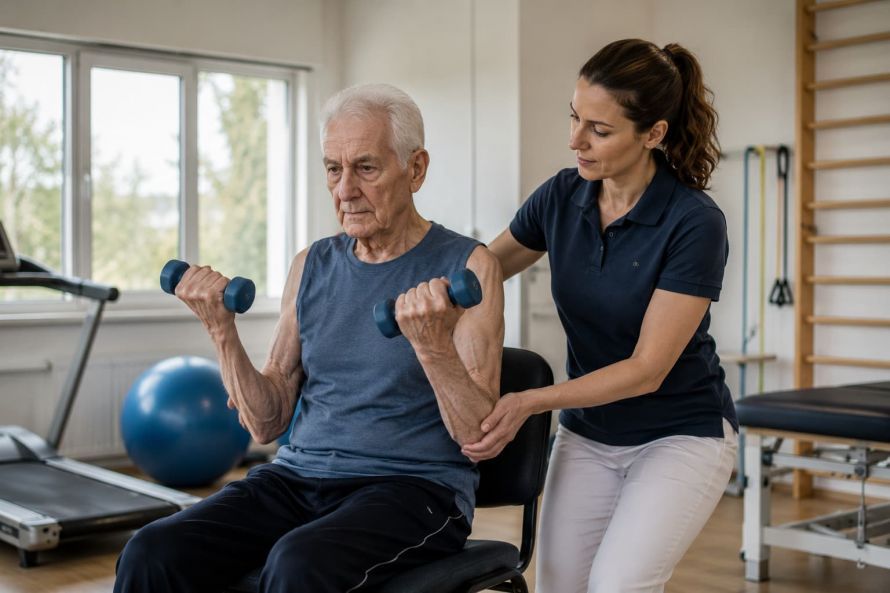
1. Progressive strength training
This is the core of the treatment. “Progressive” means that the weight or resistance is increased at regular intervals because the muscle adapts. The evidence is overwhelming:
- Strength training two to three times a week for at least eight to twelve weeks
- Intensity: moderate to heavy (depending on baseline condition)
- Repetitions: 8 to 12 per exercise, two to three sets
- Target muscles: major leg muscles (quadriceps, hip extensors, calf muscles) and core
- Study results: Strength gains ranging from 30 to over 100 percent—even among 85- and 90-year-olds
Important: Strength training is not the same as aerobic endurance training. Walking, cycling, and swimming are good for the heart and circulation, but they are not sufficient for building muscle. Sarcopenia requires resistance training—ideally under supervision, starting with one’s own body weight or light equipment, then gradually increasing the intensity. Early geriatric rehabilitation can also be beneficial, especially after a hospital stay.
2. Adequate Protein Intake
The critical figure: 1.0 to 1.2 g of protein per kg of body weight per day for healthy older adults. In cases of illness or stress, 1.2 to 1.5 g per kg. For a 65-kg patient, this means 65 to 80 g of protein per day—an amount that is often not achieved without conscious planning. The risk of malnutrition in older adults is closely linked to the development of sarcopenia.
Even more important than the total amount is the distribution: 25 to 30 g of protein per main meal is necessary to stimulate muscle protein synthesis. A breakfast of toast with jam provides barely 5 g. A breakfast of quark with nuts and berries provides 25 g.
- Protein-rich foods: quark, cottage cheese, eggs, fish, lean meat, legumes, tofu, soy products, whey powder.
- If intake is insufficient: nutritional drinks or protein powder—medically recommended, not just sports marketing.
3. Combination: Exercise plus protein
These two pillars work synergistically. Protein alone, without exercise, does not lead to muscle growth. Exercise without sufficient protein leads to fatigue without muscle growth. When combined, the effects are multiplied.
4. Vitamin D Supplementation in Case of Deficiency
In cases of confirmed vitamin D deficiency (below 50 nmol/l), supplementation is advisable—it moderately improves muscle strength and balance. Do not use routinely unless a deficiency is present.
5. Additional Interventions
- Treatment of underlying conditions (heart failure, COPD, kidney failure)
- Treat depression—it exacerbates muscle loss through reduced physical activity and loss of appetite
- Medication review for drugs that promote sarcopenia—consider deprescribing
- Hearing aid and vision correction to facilitate social participation and physical activity
→ How malnutrition and sarcopenia are linked: Malnutrition in older adults.
→ On the significance of immobility during illness: Immobility in older adults.
Sarcopenia as a warning sign of other problems
Sarcopenia rarely occurs in isolation. It is often an early sign of a broader condition:
- Frailty: Sarcopenia is one of the central components of frailty syndrome.
- Risk of falls and fractures: A threefold increase in the risk of falls and a twofold increase in the risk of fractures. Particularly concerning: femoral neck fractures in older adults.
- Impaired surgical outcomes: More postoperative complications, longer recovery times. This is relevant to surgical risk in older adults.
- Delayed recovery from illness: Each phase of hospitalization results in additional muscle loss.
- Mortality: An independent predictor of increased 1- and 5-year mortality risk.
The implication: Anyone who suddenly avoids stairs in old age, feels exhausted after shopping, or needs armrests to stand up should not dismiss these signs. It is a structural warning sign that can be reversed through targeted intervention. Attention should also be paid to possible osteoporosis in older adults, as the two conditions often occur together.
→ For an overview of frailty: Frailty Syndrome.
→ On fall prevention: Fall Prevention.
When should you see a doctor?
Specific reasons:
- Increasing difficulty getting up from a chair, climbing stairs, or carrying objects
- Unexplained weight loss
- Increasing unsteadiness when walking, tendency to fall
- Rapid fatigue during everyday activities
- Before or after a planned major surgical procedure—particularly relevant for joint replacement in older adults
- After a hospital stay with significant loss of function
The first point of contact is the primary care physician. In geriatrics, sarcopenia is part of every assessment and is treated in collaboration with physical therapy, nutritional counseling, and—if necessary—neurology or endocrinology.
→ How a comprehensive geriatric assessment incorporates the diagnosis of sarcopenia: Geriatric Assessment.
Share this article
Sources
- Cruz-Jentoft AJ, Bahat G, Bauer J et al. (2019): Sarcopenia: revised European consensus on definition and diagnosis (EWGSOP2). Age and Aging. DOI: 10.1093/aging/afy169
- Fiatarone MA, Marks EC, Ryan ND et al. (1990): High-intensity strength training in nonagenarians. Effects on skeletal muscle. JAMA.
- Bauer J, Biolo G, Cederholm T et al. (2013): Evidence-based recommendations for optimal dietary protein intake in older people: a position paper from the PROT-AGE Study Group. Journal of the American Medical Directors Association.
- Dent E, Morley JE, Cruz-Jentoft AJ et al. (2018): International Clinical Practice Guidelines for Sarcopenia (ICFSR): Screening, Diagnosis and Management. Journal of Nutrition, Health & Aging.
