
That’s the insidious thing about osteoporosis: it gives no warning. It causes no pain before the bone breaks. It often progresses silently over twenty years until the first fracture leads to a diagnosis. And that is precisely why it is one of the most commonly untreated conditions in geriatric medicine—even after the fracture, when the need for treatment is actually beyond doubt.
As a geriatrician, I frequently see patients after their first fracture who have neither undergone a bone density test nor been started on antiresorptive therapy. This gap in care costs them quality of life, independence, and—not infrequently—years of life.
Prevalence of Osteoporosis
Bone density decreases progressively, particularly in women starting around age 45. Men tend to be affected starting around age 55.
Overall, women are significantly more likely to develop osteoporosis than men. Approximately 15% of women between the ages of 50 and 60 develop osteoporosis after menopause. Nearly 50% of people over 70 have age-related osteoporosis. Frailty syndrome and sarcopenia often occur alongside osteoporosis and increase the risk of fractures.
To ensure healthy and stable body posture, the human skeletal system consists of approximately 206 bones. The video illustrates the structure and interaction of the bones, from the little toe to the skull:
Causes and Risk Factors of Osteoporosis
There are various factors that contribute to osteoporosis.
Normal (physiological) bone loss begins as early as age 30. At the same time, however, the body continues to build bone. Bone formation and bone resorption are regulated by various factors in the body. These include, for example, corticosteroids, estrogens, and iodothyronines.
In women, this balance is disrupted around the ages of 40 to 45 due to a decreasing level of estrogen. Bone loss then exceeds the normal rate, which can lead to osteoporosis. About 90% of all cases of osteoporosis are attributable to this estrogen deficiency (so-called primary osteoporosis). Osteoporosis therefore usually occurs in women starting at age 50.
In postmenopausal osteoporosis, birth control pill use plays only a minor role. Combination preparations containing estrogen can slow bone loss in the short term, while progestin-only preparations promote a decrease in bone density when taken over the long term. However, the main cause remains estrogen deficiency after menopause, along with other risk factors for osteoporosis such as vitamin D deficiency, calcium deficiency, or certain medications.
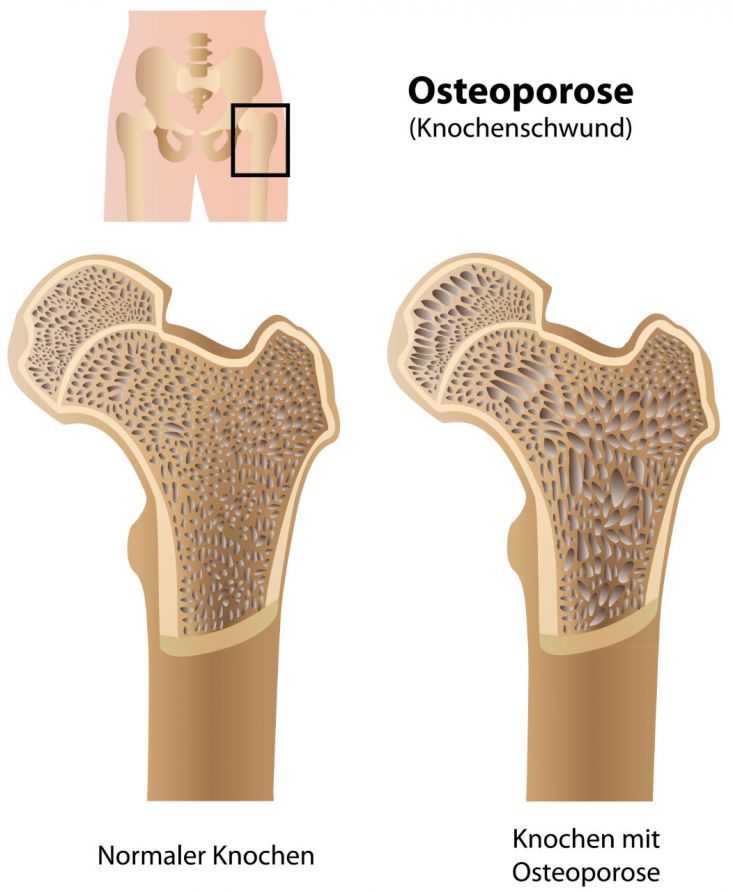
In addition to this primary osteoporosis, there is also secondary osteoporosis, which develops as a result of other medical conditions. The cause could be, for example, anorexia or chronic intestinal diseases. In these cases, the underlying issue is often a nutrient deficiency in bone tissue, most commonly a lack of calcium and vitamin D. Malnutrition in older adults also significantly contributes to this process.
Certain medications also pose risk factors, such as
- cortisone,
- blood thinners,
- thyroid hormones, and
- immunosuppressants.
Medications used in the treatment of
- cancer,
- depression in older adults,
- diabetes in older adults, and
- epilepsy
also increase the risk of developing osteoporosis. Anyone taking multiple long-term medications should have them regularly reviewed for their impact on bone health as part of a structured deprescribing process.
Risk factors include
- advanced age,
- female gender,
- certain medical conditions,
- an unhealthy lifestyle (e.g.,
- a diet low in vitamin D,
- insufficient physical activity,
- alcohol consumption,
- smoking,
- being underweight) and
- genetic predisposition
.
Symptoms and Progression of Osteoporosis
Osteoporosis is a condition that initially causes no symptoms. However, as the disease progresses, bone fractures occur without any apparent cause. These fractures are therefore also called spontaneous fractures.
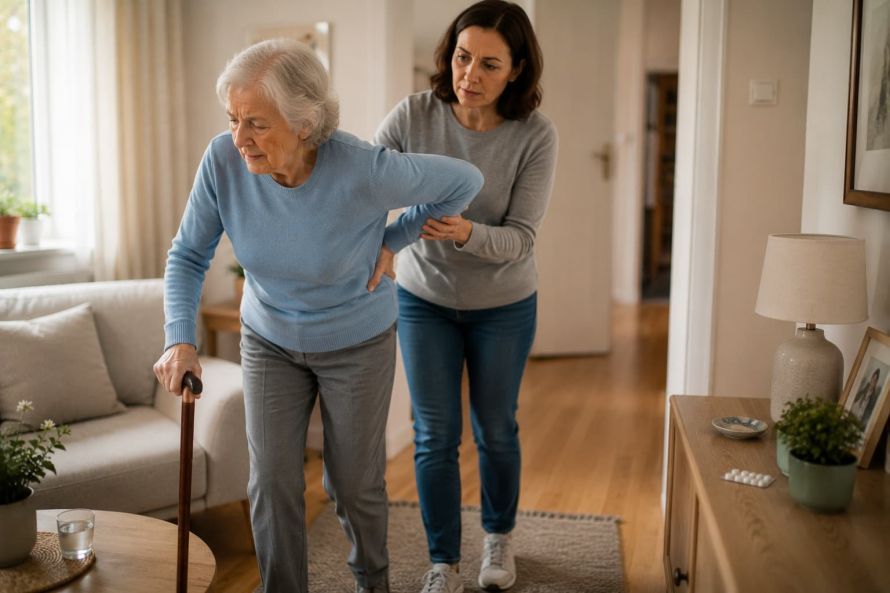
If these fractures occur in the vertebrae (vertebral fractures), they result in back pain. Patients often mistakenly attribute this back pain to lumbago or sciatica.
If left untreated, patients become shorter due to progressive bone loss and vertebral fractures. They develop a hunched back, and the lumbar spine curves forward. To avoid the resulting pain, patients adopt a protective posture, which in turn usually leads to painful muscle tension.
Quality of life declines with advanced osteoporosis due to chronic pain and limited mobility. Concomitant immobility in old age can further worsen the situation.
Falls become more common in older adults, with an increased risk of fractures and other injuries that result in further disability for the patient. A femoral neck fracture in older adults is particularly feared, as it is associated with a high mortality rate.
Diagnosis of Osteoporosis
Because there are no early signs of osteoporosis, the condition is often not recognized in its early stages. Early-stage osteoporosis can only be detected by measuring bone density.
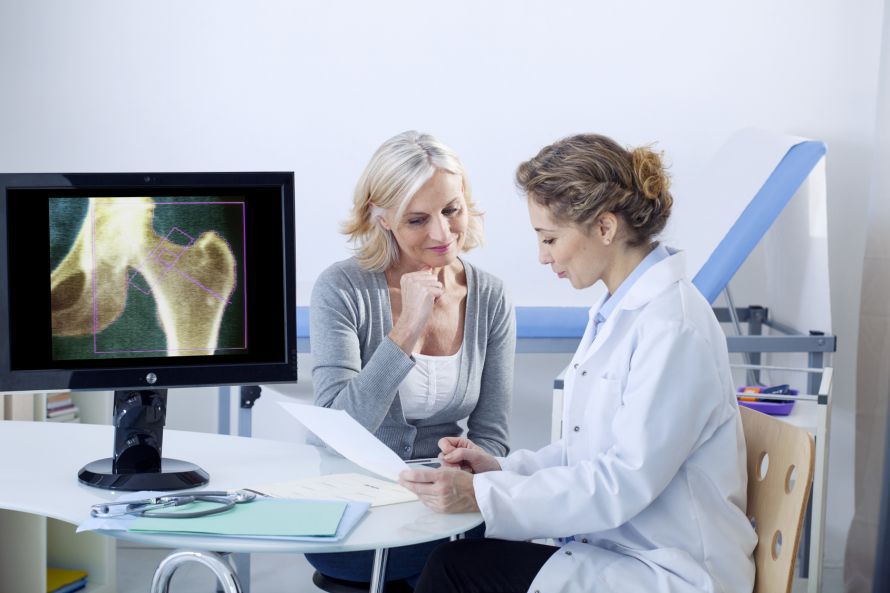
Bone density can be reliably determined using the DXA method. This is a specialized X-ray procedure that uses low-dose X-rays. Depending on the amount of X-ray radiation that passes through the bone, the so-called T-score is determined. It serves as a measure of bone density. A T-score of -1.00 is considered normal; a score between -1.01 and -2.49 indicates osteopenia (reduced bone density, but without an increased risk of fracture); and a score of -2.5 or lower indicates osteoporosis.
In addition to the DXA method, there are two other procedures for determining bone density: QCT (quantitative computed tomography) and QUS (quantitative ultrasound). However, QCT is not as accurate as the DXA method. With QUS, patients are not exposed to radiation; however, the method is not yet fully developed.
In addition to measuring bone density, the diagnostic process also includes
- the medical history (review of the patient’s medical history),
- a physical/clinical examination,
- blood tests, and
- imaging procedures (X-rays) if bone fractures are suspected.
According to current guidelines, the diagnosis and treatment of osteoporosis take into account the presence of the condition in individuals aged 50 and older, as well as risk factors for osteoporosis. A comprehensive geriatric assessment helps evaluate osteoporosis in the context of other age-related conditions.
Treatment of Osteoporosis
Treatment can be divided into basic therapeutic measures and specific medications.
Basic therapeutic measures play a very important role and consist of
- pain relief,
- sufficient exercise or consistent participation in osteoporosis-specific exercises aimed at building muscle—also to prevent sarcopenia—as well as
- ensuring the body receives an adequate supply of calcium and vitamin D.
Existing osteoporosis cannot be reversed. Therefore, prevention and halting bone loss are of particular importance. A calcium-rich and balanced diet, as well as regular exercise, are important in this regard. Calcium, in particular, reduces the risk of bone fractures. Vitamin D supplements are also recommended.
In cases of advanced osteoporosis, medications are used to stop excessive bone loss. They are also intended to strengthen the remaining bone mass. At the same time, targeted fall prevention is essential, as most osteoporosis-related fractures result from falls.
Bisphosphonates are frequently used to inhibit bone loss, but other medications are also approved. Estrogens and progestins are prescribed only in exceptional cases and on a temporary basis, e.g., for severe hot flashes and night sweats during menopause.
Is there a medication for treating osteoporosis?
Drug therapy depends not only on the severity of osteoporosis but also on age and gender.
There are several highly effective, well-tolerated, and safe medications for treating osteoporosis. Most of these are tablets that must be taken weekly or monthly. Other medications are administered as injections or infusions at varying intervals.
Currently, the following classes of active ingredients are used to treat established osteoporosis:
- Bisphosphonates – accumulate in the bone and inhibit bone loss.
- Strontium ranelate – reduces the risk of suffering a fracture of the spine or hip. Today, strontium ranelate is rarely used due to its unfavorable side effect profile.
- Raloxifene – belongs to the group of selective estrogen receptor modulators (SERMs). It not only reduces bone resorption but also the loss of calcium through the kidneys. Raloxifene can be used to treat and prevent bone loss during menopause.
- Teriparatide – is similar to the body’s own parathyroid hormone and stimulates bone formation. It is administered as an injectable solution, primarily for the treatment of osteoporosis during menopause.
- Denosumab – is an antibody-based medication that specifically targets bone metabolism. It prevents the maturation of bone-resorbing cells (osteoclasts).
Prevention of Osteoporosis
Key factors in preventing osteoporosis include
- a calcium-rich and balanced diet—and, for at-risk patients, measures to prevent malnutrition in older adults,
- regular exercise, and
- strengthening muscles to prevent falls in old age,
- avoiding excessive alcohol consumption and smoking.
Being underweight is also harmful. Medications that can contribute to bone loss should only be used as needed and not without medical supervision. Read more about this in the article on deprescribing. These medications include, for example, corticosteroids or thyroid hormone preparations.
Osteoporosis Specialist – Training and Qualifications
If you suspect you have osteoporosis, you can consult an orthopedist. This is a doctor who, in addition to their medical degree, has completed specialized training to become a specialist in orthopedics and trauma surgery. This training takes 6 years.
Osteologists are also experts in osteoporosis. An osteologist deals with all possible diseases of the skeleton, bone structure, and bone metabolism. The additional qualification as an osteologist has only been available since 2004. It is awarded by the Dachverband Osteologie e.V. (Osteology Umbrella Association). For older patients with multiple comorbidities, a consultation in geriatrics and geriatric medicine is also recommended.
Frequently Asked Questions About Diagnosis:
What should people with osteoporosis keep in mind?
People with osteoporosis should ensure they have a balanced diet rich in calcium and vitamin D, incorporate regular exercise into their routine, and avoid falls. Early diagnosis and treatment of osteoporosis in older adults are also important.
What are the early signs of osteoporosis?
Early signs of osteoporosis may include unexplained back pain, a decrease in height, or spontaneous fractures. However, the disease often goes unnoticed for a long time until fractures occur.
What kind of pain is associated with osteoporosis?
Typical pain associated with osteoporosis results from fractures of the spine or vertebral bodies. Those affected often complain of chronic back pain that worsens with physical activity and limits mobility. In the case of a femoral neck fracture in older adults, immediate medical care is necessary.
Share this article
Sources
- Dachverband Osteologie (DVO): S3 Guideline on the Prophylaxis, Diagnosis and Therapy of Osteoporosis. AWMF Register 183-001, current version.
- Kanis JA, Cooper C, Rizzoli R, Reginster JY (2019): European guidance for the diagnosis and management of osteoporosis in postmenopausal women. Osteoporosis International. DOI: 10.1007/s00198-018-4704-5
- Cosman F, Crittenden DB, Adachi JD et al. (2016): Romosozumab Treatment in Postmenopausal Women with Osteoporosis. New England Journal of Medicine. DOI: 10.1056/NEJMoa1607948
- Black DM, Rosen CJ (2016): Postmenopausal Osteoporosis. New England Journal of Medicine.
