Gastric reduction is a surgical procedure that can be performed in cases of obesity to reduce the volume of the stomach and thereby prevent excessive calorie intake.
For overweight patients who meet the criteria for gastric bypass surgery, the risks of the procedure are considered to be lower than the potential consequences of morbid obesity.
Gastric bypass surgery is performed when a person is obese. But at what point is that the case?
In Germany, approximately 62 percent of men and 43 percent of women are currently overweight, which corresponds to a BMI of over 30. About 25 percent of all adults are considered obese, defined as having a BMI of over 30. The number of overweight people has risen sharply in recent years, primarily due to a lack of physical activity and an unhealthy, high-calorie diet.
The so-called BMI (Body Mass Index) is a value calculated from height and weight (body weight [kg] / height squared [m²]) and is used in medicine to classify body weight. A BMI between 20 and 25 is considered a medically healthy normal weight; a BMI of 30 or higher is classified as obesity. Obesity is divided into three degrees:
- BMI > 30 = Class I
- BMI > 35 = Class II
- BMI > 40 = Class III
Long-term excess weight often leads to comorbidities such as high blood pressure, lipid metabolism disorders (such as elevated cholesterol levels) with cardiovascular risks, or diabetes mellitus with long-term complications such as kidney, nerve, vascular, and eye damage.
 Obesity refers to severe overweight that is harmful to health. @ BillionPhotos.com /AdobeStock
What are the effects of gastric bypass surgery?
Many people who are severely overweight are unable to lose weight despite attempts at dieting and exercise. Since the long-term consequences of obesity lead to health problems, gastric bypass surgery can help in these cases. This procedure reduces the stomach’s capacity, thereby limiting calorie and nutrient intake. As a result, patients feel full more quickly and can lose a significant amount of weight in a short period of time. The procedure is also known as bariatric surgery, with “baros” deriving from ancient Greek and meaning “weight.”
When is gastric bypass surgery appropriate?
Gastric bypass surgery is performed exclusively on patients who are severely obese, with a BMI of 35 or higher.
Before gastric bypass surgery is considered, the obesity must have been treated for at least 24 months without surgery. This so-called conservative (i.e., non-surgical) weight-loss treatment must have been carried out according to specific, defined quality criteria (e.g., through nutritional counseling). Only when these requirements are met can gastric bypass surgery be considered.
In addition, organic and otherwise treatable causes of obesity (such as hypothyroidism and other hormonal disorders) must have been ruled out.
The disadvantages of gastric bypass surgery include potential complications during or after the procedure, as well as long-term risks such as nutrient deficiencies or digestive problems; in some cases, gastric bypass surgery is not possible due to certain health conditions.
Who performs gastric bypass surgery?
Stomach surgeries generally fall under the field of visceral surgery and, within that, gastroenterology. Specialists in visceral surgery may specialize in gastric bypass surgery for patients with obesity, thereby becoming bariatric surgeons.
There are specialized obesity centers—that is, specialized clinics or departments—where specialists provide interdisciplinary care for patients with obesity, bringing together extensive expertise under one roof.
Surgical Methods for Gastric Reduction
The most commonly performed surgical procedures for gastric reduction are:
- sleeve gastrectomy,
- gastric bypass surgery,
- gastric band placement.
- the gastric balloon
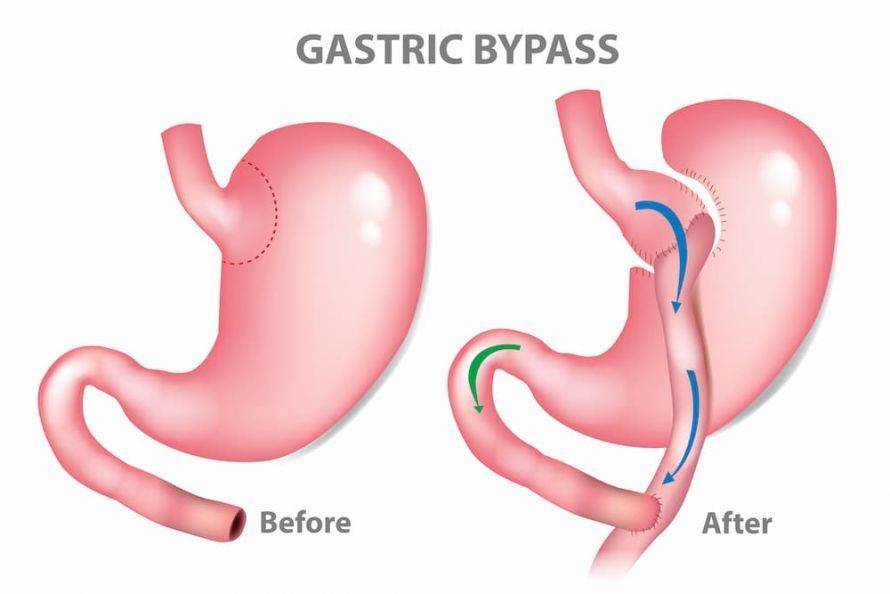 In gastric bypass surgery, the stomach is reduced in size and the small intestine is shortened @ sakurra /AdobeStock
In a sleeve gastrectomy, a large portion of the stomach is surgically removed. This leaves only a tube-shaped remnant of the stomach. This procedure reduces the stomach’s volume and is therefore considered a so-called restrictive procedure. As a result, food can only be consumed in small portions.
A gastric bypass is a type of gastric reduction surgery in which a portion of the small intestine—where nutrient absorption takes place—is also shortened. This so-called absorption tract is thus shorter, which leads not only to weight loss but also to a reduction in blood sugar levels.
In gastric banding, a band is placed around the stomach and connected via a tube to a chamber under the skin. This makes it possible to fill the gastric band with more or less fluid as needed, thereby restricting or increasing the passage of chyme from the small pre-stomach through the band into the main stomach.
All four surgical methods for gastric reduction can be performed laparoscopically (keyhole surgery). This is a minimally invasive procedure in which only small incisions are made instead of a large one. It causes significantly less postoperative pain, facilitates a quick recovery, and allows for an earlier discharge from the hospital.
The clinic also offers the insertion of a gastric balloon as a minimally invasive procedure to provide long-term support for overweight patients in their weight loss journey.
Advantages of Gastric Bypass Surgery
Every surgical method for gastric reduction carries a risk, albeit a low one. Perioperative (occurring around the time of the procedure) risks or possible complications include impaired wound healing or cardiovascular problems such as thrombosis.
Possible long-term complications include adhesions or incisional hernias. However, the risk of these long-term complications has been significantly reduced by the introduction of laparoscopic surgical techniques.
Overall, for overweight patients who meet the criteria for surgery, the surgical risks are considered lower compared to the long-term consequences of morbid obesity.
Nevertheless, the pros and cons should be discussed in detail with the surgeon before any surgical procedure.
What follow-up care is required after gastric reduction surgery?
Postoperative medical follow-up is necessary after any of these gastric reduction procedures. For example, after gastric bypass surgery—and frequently after sleeve gastrectomy—the body requires lifelong vitamin B12 supplementation. This is typically administered via an injection every three months.
The position of a gastric band should be checked regularly via endoscopy, i.e., through a gastroscopy.
After gastric reduction surgery, the patient’s eating and dietary habits must be permanently changed to achieve long-term weight loss. Based on general experience, a consistent dietary change under medical supervision is absolutely essential. This involves not only eating less food but also making conscious food choices to ensure a balanced intake of all essential nutrients.
Conclusion on Gastric Bypass Surgery
The effectiveness of bariatric surgery varies by procedure but is generally supported by a large number of clinical studies. Weight loss typically leads to improvements in comorbid conditions such as
- high blood pressure,
- diabetes mellitus, or
- lipid metabolism disorders, such as elevated cholesterol levels.
Cost Coverage for Gastric Bypass Surgery
The cost of gastric bypass surgery depends on the specific procedure chosen and ranges from 8,000 to 15,000 euros per operation. Under certain conditions, your health insurance provider may cover the costs. An application can be submitted for patients with a BMI over 40 or, if the BMI is over 35, if they already have severe complications.

About the medical author
Dr. med. Markus von der Groeben
Medical Author
Dr. med. Markus von der Groeben – medical author: Explore expert articles and medical expertise in the Leading Medicine Guide.
More about the medical author →