

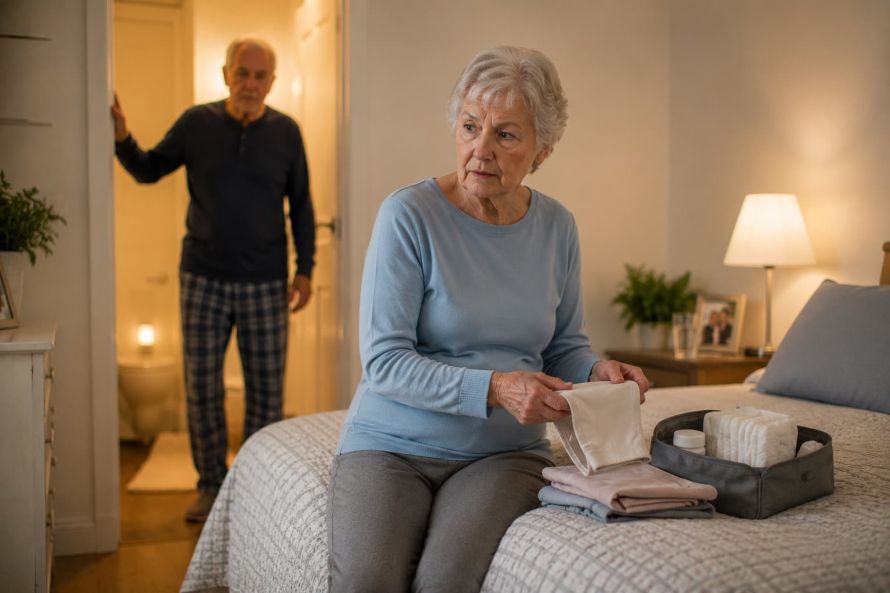
I hear variations of this story every week. And it shows why incontinence is so rarely treated in time. It’s not the condition that disrupts daily life—it’s the shame. And the belief that “it’s just part of getting older.” Both are wrong.
As a geriatrician, I don’t view urinary incontinence as a standalone problem, but as part of a pattern. Incontinence rarely occurs in isolation—it often goes hand in hand with falls, immobility, social withdrawal, and depression. Those who treat it usually regain more than just bladder control.
How common is urinary incontinence in older adults?
- Women over 65: 25 to 50 percent report significant incontinence symptoms.
- Men over 65: 10 to 20 percent, often related to prostate issues.
- In nursing homes: Over 70 percent of residents.
- Ages 80 and older: Nearly one in two women and one in three men.
These figures are likely even too low—many patients do not mention the problem even when asked directly. This is a distinct geriatric challenge: ask proactively; don’t wait for patients to bring it up on their own. More on the specialty: Geriatrics and Geriatric Medicine.
The Five Types of Urinary Incontinence
Each type has a different cause and a different treatment. Correct classification is the first step toward treatment.
1. Stress incontinence
Urine leakage during physical exertion—coughing, sneezing, laughing, climbing stairs, or lifting. The cause is a weakened urethral sphincter. This is the most common form in women after childbirth or in postmenopausal women, and in men after prostate surgery. No urge to urinate before leakage occurs.
2. Urge incontinence
A sudden, uncontrollable urge to urinate, often resulting in urine leakage before reaching the restroom. The cause is overactivity of the bladder muscles (overactive bladder, OAB). Patients often report: “By the time I hear the key in the lock, it’s already too late.” Nighttime trips to the bathroom (nocturia) are also typical.
3. Mixed incontinence
A combination of stress and urge incontinence—the most common form among older women. Treatment must address both components.
4. Overflow incontinence
The bladder is chronically overfilled and empties drop by drop without the patient feeling a real urge to urinate. In men, this is usually caused by an enlarged prostate; in both sexes, it can be caused by nerve damage (e.g., due to diabetes mellitus in older adults) or certain medications.
5. Reflex incontinence
Involuntary bladder emptying without control, often seen in spinal cord disorders or severe dementia in older adults. It differs from functional incontinence—the condition in which mobility or cognition prevents the person from reaching the restroom in time, even though bladder function itself is intact. More on this: Immobility in older adults.
Causes and Contributing Factors in Older Adults
In older adults, several factors combine that can collectively trigger or exacerbate urinary incontinence:
- Pelvic floor weakness: In women, caused by childbirth, changes in connective tissue, and postmenopause.
- Prostate conditions: The most common cause in men over 65.
- Neurological disorders: Stroke in older adults, Parkinson’s disease, dementia, multiple sclerosis, and diabetic polyneuropathy in older adults.
- Medications: Diuretics increase urine output; anticholinergics can trigger overflow incontinence; sedatives reduce awareness of the urge to urinate. More on this: Polypharmacy in older adults.
- Infections: An acute urinary tract infection can trigger temporary but severe incontinence in older adults.
- Limited mobility: If getting up, walking to the bathroom, and undressing take too long, even normal bladder function can lead to incontinence. See also: Immobility in older adults.
- Cognitive impairment: The patient forgets the way to the bathroom or no longer recognizes the urge to urinate in time. Possible causes: Mild cognitive impairment (MCI).
???? If incontinence occurs suddenly and for the first time, the first consideration should not be age, but rather an infection. In older adults, a urinary tract infection often does not present with burning or pain, but rather with precisely these symptoms: sudden incontinence, confusion, and weakness.
Diagnosis: What the Evaluation Involves
The path to the right treatment begins with a structured evaluation. In geriatric practice, this includes:
- Medical history and voiding diary: Over two to three days, the patient records fluid intake, bathroom visits, urine volume, and episodes of urine leakage. The voiding diary is often more informative than any additional test.
- Physical examination: Targeted urogynecological or urological examination; assessment of mobility and functional status.
- Urinalysis: To rule out a urinary tract infection.
- Residual urine ultrasound: Detects an overflow bladder—crucial for determining treatment.
- Medication review: Which current medications may contribute to incontinence? Systematic review with a focus on deprescribing.
- Urodynamic testing, if necessary: In complex or unclear cases.
→ How a comprehensive geriatric assessment is structured: Geriatric Assessment.
Treatment: The Stages of Treatment
Treatment follows a stepwise approach that begins with the lowest-risk and often most effective measures—not with medications or surgery.
Stage 1: Behavioral therapy and exercise
- Pelvic floor exercises: The most effective single measure for stress incontinence. With structured guidance and consistent training over three months, 60 to 70 percent of women show significant improvement.
- Bladder training: Gradually increasing the intervals between trips to the bathroom. Particularly effective for urge incontinence.
- Toilet training (prompted voiding): For patients with cognitive impairment: regular, structured reminders to use the restroom.
- Weight loss: Even a 5 to 10 percent reduction in body weight can significantly improve symptoms.
- Adjusting fluid intake: Do not drink less, but distribute intake differently—moderate amounts in the evening, with reduced caffeine. This should also be considered in the context of malnutrition in older adults.
Stage 2: Assistive Devices and Adaptations
- Anatomically fitting incontinence aids: Not diapers, but individually fitted pads and underwear. In Germany, these are provided through the medical aids directory.
- Home environment adaptations: Night light, accessible toilet, toilet seat riser, grab bars. Such measures overlap with fall prevention in older adults.
- Functional support: Loose-fitting clothing with fasteners that are easy to open, especially for older patients with osteoarthritis in their hands.
Stage 3: Medications
For urge incontinence, anticholinergics (solifenacin, darifenacin) or the beta-3 agonist mirabegron may be considered. Anticholinergics should be used with caution in older adults—they can impair cognition and trigger delirium. Delirium prevention is particularly relevant here. Mirabegron is better tolerated in this regard. For men with an enlarged prostate, alpha-blockers (tamsulosin) and 5-alpha-reductase inhibitors (finasteride) are the standard of care.
Stage 4: Surgical Procedures
For treatment-resistant stress incontinence, minimally invasive sling systems (TVT, TOT) are used—with good success rates even in older women. In men following prostate surgery, an artificial sphincter may be helpful. Surgical decisions are always made within the context of a preoperative geriatric assessment.
→ Why geriatric assessment is important before every surgery: Surgical risk in older adults.
The Geriatric Perspective
What distinguishes geriatric incontinence treatment from purely urological or gynecological therapy? The answer lies in taking a holistic view.
A patient with urge incontinence, four medications, and unsteady gait does not primarily need an anticholinergic medication—she needs a structured evaluation: Which of her medications are exacerbating the problem? How can her mobility be improved so she can reach the bathroom in time? Falls caused by nighttime trips to the bathroom are a real risk—more on this: Falls in Older Adults. Is there coexisting depression in older adults? Can a urinary tract infection be ruled out? Is there frailty syndrome that affects treatment planning?
These questions are not just additional considerations—they are the prerequisites for any sustainable treatment. That is why incontinence belongs in geriatrics and geriatric medicine just as much as in urology and gynecology.
→ How medications contribute to falls and incontinence: Polypharmacy in older adults.
→ Why depression in older adults is often overlooked: Depression in older adults.
When should you see a doctor?
If incontinence affects your daily life—and it does in the vast majority of cases—it should be managed by a doctor. Specifically:
- If you’re avoiding activities that you used to do without a second thought
- If you’re constantly on the lookout for restrooms
- If your sleep is disrupted by frequent trips to the bathroom
- If you experience skin problems or recurring infections
- If sudden changes have occurred—in this case, prompt action is needed to rule out an infection
The first step is to see your primary care physician, who may refer you to a urologist, gynecologist, or—in cases involving multiple factors—to a geriatric specialist. A combination of these approaches is often particularly effective. For frail patients, a frailty screening is also recommended.
Frequently Asked Questions
Is urinary incontinence normal in older adults?
No. It is common, but not normal in the sense of “just part of aging.” Most forms are easily treatable—with a combination of behavioral therapy, exercise, and, if necessary, medication or surgery. The notion that incontinence is simply something one must accept with age unnecessarily diminishes many people’s quality of life. The same applies to other frequently underestimated conditions, such as sarcopenia.
Which medications can cause or worsen incontinence?
Diuretics increase urine output. Anticholinergics and tricyclic antidepressants can lead to residual urine and trigger overflow incontinence. Sedatives and sleep aids reduce the sensation of the urge to urinate. Alpha-blockers (used to treat high blood pressure) can worsen stress incontinence in women. A systematic review of medications is a must—not an option—when incontinence first appears. More on this: Deprescribing.
Does pelvic floor training also help older women?
Yes, and it has been proven to work even for women over 70. The evidence is clear: In cases of stress incontinence, about 60 to 70 percent of patients show significant improvements after three months of structured training. This requires guidance from a qualified physical therapist specializing in the pelvic floor—general information sheets alone are usually not enough. Pelvic floor exercises are also part of early geriatric rehabilitation.
Are incontinence pads a solution?
They are an important part of care, but never the first line of treatment. Anyone who immediately turns to pads without investigating the cause is missing out on the chance for real improvement. Modern aids are anatomically tailored, barely visible, and are provided by a medical supply store with a doctor’s prescription.
What can I do if the person affected doesn’t want to talk about their incontinence?
This is one of the most common scenarios—and one of the most important. A helpful approach is to address the topic not as the person’s personal problem, but as a general health issue. “I read recently that most older adults deal with this—and that there are very effective ways to manage it. ‘Should we talk about this at our next doctor’s appointment?’ is often a good way to break the ice.” The second option is to inform the primary care physician in advance and ask them to actively bring up the topic. Similar communication challenges are also common when discussing depression in older adults.
Share this article
Sources
- Syan R, Brucker BM (2016): Guideline of guidelines: urinary incontinence. BJU International. DOI: 10.1111/bju.13187
- S2e Guideline on Urinary Incontinence in Geriatric Patients, German Society for Geriatrics (DGG) and German Society of Gerontology and Geriatrics (DGGG). AWMF Register 084-001.
- Dumoulin C, Cacciari LP, Hay-Smith EJC (2018): Pelvic floor muscle training versus no treatment for urinary incontinence in women. Cochrane Database of Systematic Reviews. DOI: 10.1002/14651858.CD005654.pub4
- Wagg A, Gibson W, Ostaszkiewicz J et al. (2015): Urinary incontinence in frail elderly persons: Report from the 5th International Consultation on Incontinence. Neurourology and Urodynamics.
