Histoplasmosis is an infectious disease that typically affects the lungs. It is caused by the fungus Histoplasma capsulatum. During the acute phase of histoplasmosis, patients develop a dry cough, fever, chest pain, and a general feeling of illness. There are a variety of types of histoplasmosis (acute, chronic, disseminated), each of which has further subtypes. In rare cases, histoplasmosis can lead to very severe symptoms or become life-threatening.
Here you will find further information as well as a selection of histoplasmosis specialists and centers.
Causes of Histoplasmosis
Histoplasmosis (also known as reticuloendothelial zygomycosis) is a systemic infectious disease. Systemic means that the entire body can be affected, not just specific organs.
Histoplasmosis is caused by the fungus Histoplasma capsulatum. The fungus is dimorphic, meaning it can exist in two forms: as a yeast and as mycelium (a filamentous fungal mass).
Histoplasmosis is triggered when spores of the mycelial form of the fungus enter the alveoli via the air we breathe. The immune system recognizes the spores as invaders and begins to fight them with macrophages (“giant phagocytes”). Macrophages engulf the fungal spores, but the spores then develop into the yeast form within 15 to 18 hours.
Normally, the body can successfully fight off histoplasmosis, as the cells of the immune system destroy the yeast forms. However, if the exposure to Histoplasma capsulatum is particularly high, the immune response may be insufficient. As a result, symptomatic histoplasmosis develops.
The causative fungus, Histoplasma capsulatum, was first described in 1906 by Samuel Darling. In 1932, Katharine Dodd and Edna Tompkins made the first diagnosis of histoplasmosis in an infant. Since then, histoplasmosis has been diagnosed worldwide.
The disease is particularly common in hot valleys and in Central Africa. Major outbreaks usually occur when a group of people travels to certain regions and becomes infected.
Most infections occur through inhalation of the spores in places where the fungus thrives. Such places include, for example,
- caves inhabited by bats,
- bird cages,
- chicken coops, and
- any places where large amounts of bird droppings accumulate.
Unfortunately, the spores can remain in the soil for years. When the soil turns to dust, the pathogens can be inhaled particularly easily.
Histoplasmosis can also affect other mammals, such as dogs or cats. Both animals and humans affected by histoplasmosis primarily exhibit symptoms similar to those of pneumonia.
The disease is not contagious, neither from animals to humans nor from person to person. However, a rare exception involves transplanted organs, which can carry the fungal infection.
What forms of histoplasmosis are there?
Histoplasmosis can be divided into various forms. These include, among others:
- acute pulmonary histoplasmosis: Can occur with or without symptoms (symptomatic or asymptomatic) which can be either symptomatic or asymptomatic,
- chronic pulmonary histoplasmosis: Causes chronic lung symptoms,
- ocular histoplasmosis syndrome: Affects vision,
- progressive disseminated histoplasmosis: causes lesions and inflammation in the mouth and throat,
- subacute progressive disseminated histoplasmosis: Has serious effects on the central nervous system, the brain, or the skin.
Signs and symptoms of histoplasmosis
About 90 percent of infections with Histoplasma capsulatum cause no symptoms at all. Sometimes, small scars can be seen on chest X-rays in asymptomatic patients.
Symptomatic patients with histoplasmosis often develop
- a dry cough,
- chills,
- fever,
- weakness,
- sweating spells, and
- severe stomach pain
Symptoms begin to appear approximately 3 to 14 days after exposure to the fungus.
As histoplasmosis progresses,
- weight loss,
- weakness,
- shortness of breath,
- chest pain, and
- vision problems
.
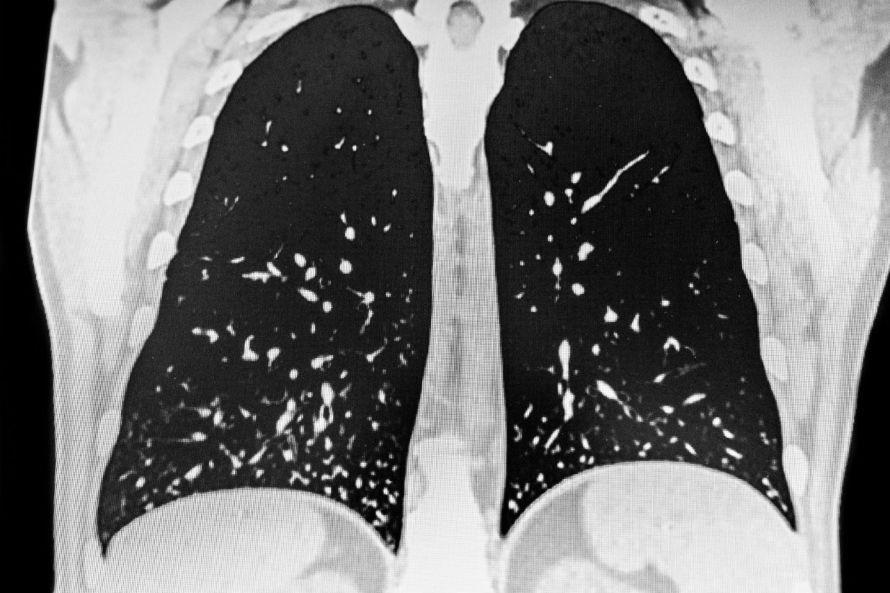
A sign of worsening histoplasmosis is the presence of patchy areas visible on X-rays. These typically appear in the lower regions of the lungs.
Other symptoms are primarily seen in people with weakened immune systems:
- encephalopathy,
- headaches,
- mouth sores, and
- seizures
In rare cases, histoplasmosis can become life-threatening.
How is histoplasmosis diagnosed?
A definitive diagnosis of histoplasmosis can be difficult to make. Many bacterial and fungal diseases share similar symptoms with histoplasmosis. These include, for example,
- sarcoidosis,
- tuberculosis, or
- infection with blastomycosis or Aspergillus.
In fact, before 1932, many patients with histoplasmosis were misdiagnosed with tuberculosis. Even today, making an accurate diagnosis remains a challenge. If the patient has visited high-risk areas or the locations described above, the doctor must be informed! This information can provide crucial clues for the correct diagnosis.
Fungal Culture
One method for reliably detecting Histoplasma capsulatum is to perform a fungal culture. This involves applying a previously collected saliva, blood, or tissue sample to a culture medium. If the fungus grows, the diagnosis is confirmed.
However, in cases of chronic histoplasmosis, cultures grow in only about 60 percent of cases. In acute cases, they grow in as few as 15 percent of cases.
In addition, the culture process can take 2 to 12 weeks. This time is lost that could be used for targeted treatment. Acute, progressive, disseminated histoplasmosis, however, can lead to death within a few weeks.
Therefore, if the condition is suspected, appropriate treatment must be initiated immediately—without waiting for the results.
Serological Tests
There are a number of serological tests available. These tests look for antigens or antibodies in the blood, urine, or cerebrospinal fluid. These are produced when the immune system has come into contact with Histoplasma capsulatum.
These tests can provide largely accurate results. They are particularly effective in cases of chronic, symptomatic, and progressive histoplasmosis (75 to 90 percent). However, it can take up to three weeks to detect even a small number of acute cases (15 percent). Additionally, the test results can be falsified by other pathogens.
However, in areas with a high incidence of histoplasmosis, these tests can provide sufficient evidence. In such cases, early treatment can begin.
Additional Diagnostic Methods
There are other methods that may help a doctor diagnose histoplasmosis. These include
- a blood cell count in a sample,
- chest X-rays,
- computed tomography (CT),
- echocardiogram, and
- tests to measure the level of alkaline phosphatase in the blood—which is elevated in affected individuals.
A surgeon may need to be consulted to perform a biopsy.
Treatment of Histoplasmosis
Specialists in infectious diseases and pulmonology are generally the ones who treat histoplasmosis.
Antifungal treatment is not an option for patients with
- asymptomatic histoplasmosis or
- acute localized inflammation.
Patients usually recover from histoplasmosis on their own within a few weeks.
If symptoms persist for a month or longer, treatment with
- itraconazole,
- ketoconazole, or
- amphotericin B
may be effective.
Treatment with itraconazole or amphotericin B is likely necessary if
- the central nervous system is affected,
- the patient has other underlying medical conditions, or
- their immune system is suppressed and they have severe, advanced, disseminated histoplasmosis.
The duration of treatment and dosages depend on the individual patient.
Some newer azole-based medications may be effective in cases that do not respond to other therapies.
In some cases of histoplasmosis, surgery may be necessary. Surgical procedures include
- pericardiocentesis or
- a pericardial window procedure.
Both techniques are designed to drain fluid that is putting pressure on the heart.
Also,
- resection of lesions in the lungs,
- surgery on lymph nodes or
- the heart
may be necessary if histoplasmosis has caused corresponding effects on the body.
Complications of histoplasmosis
About 90 percent of people with histoplasmosis make a full recovery without further complications. In some cases, minor scarring may develop in the lungs.
As the severity of histoplasmosis increases, so does the risk of complications.
- Pleural effusions or
- pericarditis (inflammation of the pericardium)
occur in 5 percent of cases of acute, symptomatic histoplasmosis. Another 5 percent of those affected experience rheumatological problems such as
- arthritis,
- erythema nodosum, or
- coccardial erythema.
About 90 percent of patients with chronic pulmonary histoplasmosis develop
- lung damage,
- pulmonary fibrosis,
- shortness of breath.
Some patients develop inflammation of the adrenal glands. This may be associated with Cushing’s syndrome (elevated cortisol levels due to obesity).
Other patients develop ocular histoplasmosis syndrome. In this condition, the fungus enters the blood vessels of the retina via the lungs. This leads to inflammation of the retina, which can subsequently result in scarring. The consequences can range from restricted visual fields to partial blindness.
Patients with acute progressive disseminated histoplasmosis may experience problems with the central nervous system. This can lead to
- seizures,
- kidney failure, or
- heart problems
.
People with this form of histoplasmosis require immediate treatment. Otherwise, histoplasmosis will lead to death within a few weeks.
How can histoplasmosis be prevented?
Histoplasma capsulatum is found wherever large amounts of bird droppings accumulate. Construction sites are also breeding grounds for the fungus. Since the spores are very resilient, they remain in the soil when it breaks down into dust.
People with weakened immune systems are at increased risk of developing histoplasmosis. They should avoid such high-risk areas.
There is no vaccine for histoplasmosis. However, most people develop enough antibodies against the infection to recover. This, however, does not provide sufficient protection against reinfection with histoplasmosis.
Prognosis for Patients with Histoplasmosis
About 90 percent of those affected do not develop any symptoms. Another 5 to 7 percent show symptoms but make a full recovery.
Only a few cases of histoplasmosis progress to the point of causing long-term or even life-threatening complications. In many cases, individuals with such severe histoplasmosis already have underlying health conditions. For example, they may have a weakened immune system.
People with chronic pulmonary histoplasmosis may experience impaired lung function.
If left untreated, progressive disseminated histoplasmosis can lead to death within a few weeks. However, even with appropriate treatment, relapses can occur, and long-term treatment may be necessary.
Share this article

About the medical author
Sabine Schneider
Editor-in-Chief
Sabine Schneider – medical author: Explore expert articles and medical expertise in the Leading Medicine Guide.
View full expert profile →