A ligament injury is a common occurrence. Active individuals and athletes are among those at particular risk. Ligament injuries can also easily occur in everyday life: Often, a single wrong movement or a sudden jolt is enough to cause a sprain or tear.
The following sections provide more information on the different types of injuries, including treatment methods and prognosis. You can also find selected specialists for the treatment of ligament injuries.
What is the function of ligaments in the body?
Ligaments are tough, cord-like fibrous structures that stabilize all the joints in the body. They are particularly important in joints that are subjected to heavy stress, such as the ankle, wrist, and shoulder joints, and are therefore more prone to injury.
They consist of connective tissue with both firm (rigid) and flexible (stretchy) structures. They provide stability to joints, allowing them to move only in certain directions. In addition, they sometimes connect the bones of the respective joint to one another (for example, the cruciate ligaments in the knee joint).
If the ligaments are too tight and inflexible, joint mobility is reduced. This is the case, for example, with prolonged immobilization of the shoulder joint, which for this reason should be avoided whenever possible or, if necessary, limited to just a few days.
What types of ligament disorders exist?
There are congenital ligament disorders, though these account for only a minority of cases. These primarily involve ligaments that are too weak. When ligaments are underdeveloped, the joints become overly stretchy, increasing the risk of dislocation (joint luxation).
However, the majority of ligament injuries are acquired and result from a recent or past injury. In the latter case, they are referred to as chronic conditions. These include, in particular, ligaments that are too tight and inflexible, which subsequently lead to reduced joint mobility (stiffness). This is the case, for example, following a shoulder dislocation with subsequent immobilization of the shoulder joint. Therefore, self-administered immobilization of the shoulder joint using a sling is strongly discouraged, as it can result in stiffness of the shoulder joint within just a few days.
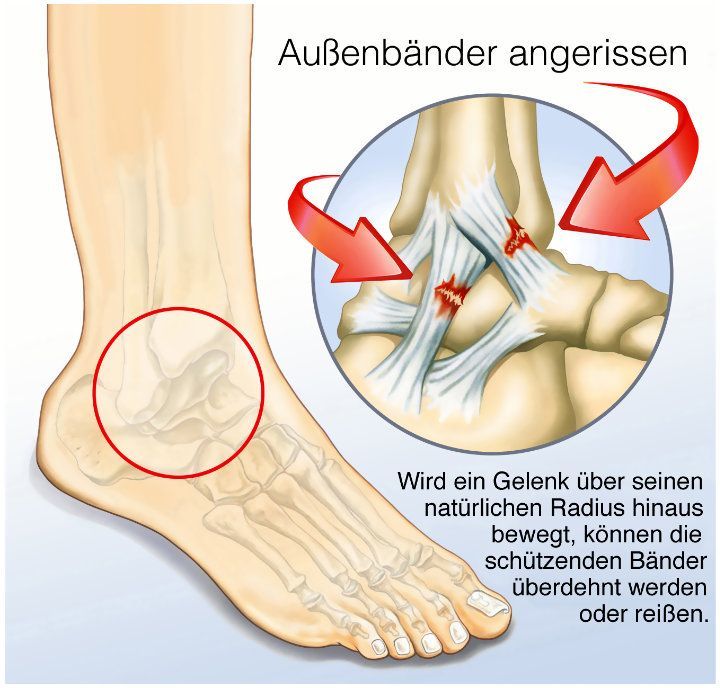
By far the most common ligament injury is a sudden injury caused by an accident or physical force. This includes, for example, ankle trauma, in which twisting the ankle leads to overstretching or tearing of the ligaments in the ankle joint. The following text will therefore focus primarily on this type of injury.
What types of ligament injuries are there?
Medical professionals classify ligament injuries into different types based on the severity of the damage:
- Sprain: A sprain is the simplest type of injury; it occurs very frequently in athletes but heals quickly. In most cases, no treatment other than rest is necessary.
- Strain: A strain is also an injury that usually resolves quickly; however, it requires temporary immobilization and, in many cases, pain management.
- Torn ligament: A torn ligament (medically known as a ligament rupture) is the most severe form of ligament injury, in which the ligamentous structure is torn, resulting in joint instability. Surgery is often necessary to restore stability to the joint. However, if the muscles are well-developed, conservative treatment (i.e., without surgery) may also be possible. This is the case, for example, with a cruciate ligament tear.
A ligament tear is sometimes classified as either a partial or complete rupture:
- Partial tear involving numerous micro-tears in the ligament tissue. While some fibers of the ligament are torn, others remain intact. This type is often accompanied by severe pain and swelling, which make normal function and movement of the affected joint impossible.
- Complete rupture, involving a full tear of the ligament, accompanied by swelling and pain. The joint, which was originally stabilized by the ligaments, loses its support and becomes unstable.
What are the most common causes of ligament injuries?
Sports-related accidents are among the main causes of ligament injuries. In sports such as soccer, basketball, and tennis, the joints of the lower extremities—specifically the knee and ankle joints—are particularly at risk. Cycling and skiing also place particular strain on the knee joints. In handball, volleyball, and rock climbing, on the other hand, excessive use of the upper extremities carries an increased risk of ligament injuries to the hand and finger joints.
Ankle injuries also frequently occur in everyday life. In such cases, an unfortunate twist of the ankle can be enough to cause a sprain of the relevant ligaments. However, in most cases, the joint has already sustained previous injuries that have led to instability.
How can a ligament injury be diagnosed?
If you’ve been in an accident and suspect damage to the joint, you should seek medical attention. In particular, if you’re experiencing pain, swelling, or bruising in the affected joint that doesn’t subside after rest, immobilization, and pain management, you should seek medical attention. Your primary care physician can often make an initial diagnosis. Depending on the type and severity of the injury, you may also need to see
- sports orthopedists,
- trauma surgeons,
- orthopedists, and/or
- physical therapists
be necessary.
What examinations are performed?
First, an initial consultation is conducted to gather background information (medical history). During this consultation, questions are asked about the circumstances of the accident, any pre-existing conditions, and previous surgeries involving the injured area of the body.
This is followed by a physical examination. During this examination, the injured area is inspected (examined) and checked for signs of injury. Of particular interest are:
- Swelling
- Pain on pressure and during movement, as well as
- the presence of a hematoma and/or joint effusion.
Another important factor in this phase of diagnosis is the stability and range of motion of the affected joint.
Often, the two methods mentioned above—the medical history and the physical examination—are sufficient to diagnose a ligament injury.
Further tests are often ordered, particularly an X-ray, to rule out or confirm a fracture of the joint or bony ligament avulsions.
Ultrasound is also often part of the initial evaluation when a ligament rupture is suspected. This allows the extent of the ligament injury to be visualized relatively easily and without side effects such as radiation exposure or contrast agent allergies.
Other important diagnostic procedures for a more precise assessment of the ligament injury include
- magnetic resonance imaging (MRI), as well as
- arthroscopy, known in medical jargon as arthroscopy.
The latter is not only used to provide the most comprehensive diagnosis possible; if necessary, it can also be used as a minimally invasive form of treatment.
What treatment options are available for a ligament injury?
A careful diagnosis is absolutely essential for selecting a “tailored” treatment.
For mild ligament injuries, such as a simple ligament sprain, conservative methods are recommended. These include:
- consistent rest
- the application of bandages to stabilize the joint and support the healing process.
This treatment typically takes about two to three weeks.
A ligament strain, on the other hand, requires a longer recovery time, as it often involves minor tears and tissue bleeding. Although joint stability is not affected—or at most only slightly—in the case of a ligament strain, However, it is important to prevent the condition from taking a negative turn due to premature or excessive strain.
After the rest period, a ligament strain is often followed by physical therapy. This helps gradually restore the joint to its former full function and load-bearing capacity.
Healing a torn ligament, whether in the knee or ankle, requires a great deal of patience. The first step in the treatment approach—which is generally divided into two phases—is immobilization. This involves stabilizing the affected limb using bandages or special splints (orthoses). For people who wish to quickly restore their joints’ ability to bear weight, surgery is an alternative option. Professional athletes, in particular, often opt for this solution.
The second part of the treatment for a torn ligament begins once the injury has fully healed. It consists of individually tailored physical therapy exercises designed to promote muscle rebuilding and optimize movement coordination.
Can a torn ligament heal completely?
In general, it’s important to note that the course and recovery from ligament injuries are greatly influenced by the patient. For example, if you do not follow your doctor’s recommendations for rest and put strain on the injured area too soon, complications are not uncommon.
Specifically, this means that even minor strains can progress to a tear or cause the recovery period to be unnecessarily prolonged. An intensification of accompanying symptoms, such as pain and swelling, is also to be expected.
Strictly following the doctor’s treatment recommendations usually ensures that the ligaments heal optimally. Serious long-term consequences following a ligament injury are generally not to be expected.
Share this article

Sources
- Gotzen, L./Baumgaertel, F. (Hrsg.): Bandverletzungen am Sprunggelenk. Grundlagen Diagnostik Therapie in: Hefte zur Zeitschrift „Der Unfallchirurg“, Band 204, Springer Verlag Berlin 1989.
- Wülker, N. (Hrsg.): Taschenlehrbuch Orthopädie und Unfallchirurgie, 3. Auflage, Thieme Verlag 2015.
- Schneider, T. (Dr. med.): Bänderriss und Bänderdehnung: Bandverletzungen am Sprunggelenk unter https://gelenk-klinik.de/sprunggelenk/bandverletzungen.html, abgerufen am 7. 12. 2021.