Everyone is familiar with that unpleasant jolt in the “musician’s bone” that sends an electrifying sensation all the way down to the hand. However, if this tingling persists or the ring finger and little finger become numb, it is often a sign of ulnar sulcus syndrome. In this nerve compression syndrome, the ulnar nerve is compressed on the inner side of the elbow. This damage is often caused by chronic pressure on the elbow or anatomical narrowing in the bony canal, the sulcus nervi ulnaris. What begins as a mild numbness in the hand can, if left untreated, lead to permanent muscle atrophy and the characteristic claw hand. Whether conservative treatment with padding is sufficient or whether the nerve must be surgically decompressed depends on the severity of the symptoms and the measured nerve conduction velocity.
The ulnar nerve runs through the elbow and is responsible for many different motor movements of the hand. For example, it controls the movement of the fourth and fifth fingers. It also enables the muscles of the thumb pad and the back of the hand to contract.
If the nerve is pinched or damaged, this impairs the function of the hand muscles and restricts range of motion.
Causes of Sulcus Ulnaris Syndrome
The ulnar nerve is located in the elbow. Due to its proximity to the skin’s surface and its exposed position, it is susceptible to the development of a compression.
A compression can also occur during periods of physical rest. For example, if you fall asleep in an unhealthy position or rest your arms on a table, the nerve is subjected to pressure. In the process, it is literally pushed into the arm and pinched off.
However, pulling motions can also contribute to the development of a compression. The condition is particularly advanced when ulnar sulcus syndrome results from a misalignment of the arm bones. In this case, surgery is often the last resort.
The syndrome can also occur as a result of polyneuropathy. Polyneuropathies are characterized by disorders affecting multiple nerves of the peripheral nervous system and primarily affect
- people with high alcohol consumption,
- people with diabetes, and
- patients with leprosy.
The causes and risk factors for ulnar sulcus syndrome are therefore:
- pressure on the elbow from leaning on it or an unhealthy sleeping position,
- tensile stress (e.g., during heavy physical labor),
- anatomical deformities, and
- polyneuropathies (including those resulting from alcoholism and diabetes).
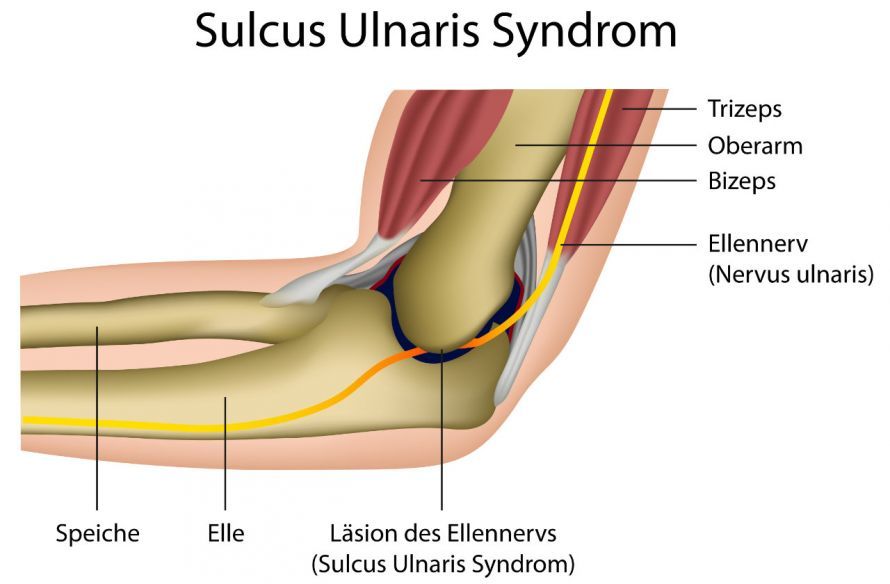
In ulnar sulcus syndrome, the ulnar nerve is compressed © bilderzweg | AdobeStock
Symptoms of sulcus ulnaris syndrome
The syndrome manifests as sensory disturbances such as tingling (as if the arm has fallen asleep) or numbness. In more severe cases, partial or complete muscle paralysis may also occur.
Those affected often feel limited in their daily lives, especially when the syndrome affects the dominant hand. The occasional muscle paralysis makes many activities difficult.
This is not only frustrating in daily life but can also affect one’s ability to work, depending on one’s profession. Those who
- with heavy loads,
- at a desk, or
- in a trade-related business
are often unable to work due to these complications. In any case, their performance is impaired.
Moreover, most of those affected also report severe, radiating pain
- in the palm,
- the forearm, and
- the elbow.
In chronic cases, muscle atrophy in the hand may occur. This can lead to the development of what is known as claw hand.
Typical symptoms of sulcus ulnaris syndrome include:
- tingling in the fingers,
- numbness in the fingers and hand,
- Inability to fully extend or bend the ring finger and index finger,
- Weakness of the muscles on the back of the hand,
- difficulty gripping objects,
- muscle wasting, and
- claw hand.
Diagnosis of the syndrome
The primary specialists to consult are neurologists. Neurologists are experts in nervous system disorders and problems. In their practices, they have a wide range of diagnostic tools at their disposal to reliably diagnose nervous system disorders.
Orthopedic surgeons can also raise an initial suspicion during an examination. However, they will subsequently refer patients to a neurologist.
First, the doctor measures the nerve conduction velocity. The result shows how quickly the nerves transmit impulses. Damage to the nerves is reflected in their function.
If necessary, this is followed by an X-ray examination. In some cases, it is also helpful to examine the elbow using ultrasound (sonography) and magnetic resonance imaging (MRI).
Using these methods, doctors can usually confirm the presence of ulnar sulcus syndrome beyond a doubt. They must then determine the severity of the syndrome in order to develop a treatment plan.
Sulcus Ulnaris Syndrome: Treatment and Prognosis
If the ulnar nerve is compressed, the affected arm should initially be rested. In mild cases, a period of rest allows the nerve to return to its normal position on its own.
Decongestants and anti-inflammatory medications can be used alongside rest to provide additional relief for the nerve. In addition, supporting the arm with a positioning splint is often helpful.
If ulnar sulcus syndrome does not resolve on its own with rest, surgery may be considered. The procedure involves exposing the nerve, a process known as neurolysis.
During this simple procedure, surgeons release adhesions and eliminate irritations.
If the syndrome results from a chronic anatomical malalignment, a more extensive surgical procedure may be necessary. In this procedure, the nerve is repositioned.
The surgery is usually associated with immediate pain relief. However, sensation and mobility may be limited at first.
After surgery, the elbow is usually functional again immediately. This means it can be used, but should generally be rested. The duration of the rest period depends on the type of surgery (usually 2–6 weeks).
A follow-up examination should be scheduled some time later (e.g., after six months). During this examination, nerve conduction velocity is measured again. The result indicates whether the surgery was successful.
FAQ: The 8 Most Important Questions About Sulcus Ulnaris Syndrome
What symptoms does ulnar sulcus syndrome cause?
The most common symptoms begin with a tingling or pins-and-needles sensation along the edge of the hand, which radiates into the little finger and half of the ring finger. These abnormal sensations often occur at night or when bending the elbow, such as while talking on the phone. As the condition progresses, numbness and weakness in the hand develop. Patients often notice that objects fall out of their hands or that they can no longer spread their little finger.
How is cubital tunnel syndrome treated?
Treatment for ulnar sulcus syndrome depends on the stage of nerve damage. Conservative treatment is the first line of treatment if there are no motor deficits. This includes avoiding pressure on the nerve—for example, by padding the elbow—and wearing a night splint to prevent extreme flexion. In addition, anti-inflammatory medications and occupational therapy can help alleviate the irritation.
When is surgery necessary?
Surgery for ulnar sulcus syndrome is recommended if conservative measures fail to bring about improvement over several months, if the pain increases, or if muscle wasting (atrophy) of the hand muscles is already visible. Surgery is also advisable in cases of a measurable decline in nerve conduction velocity to prevent permanent nerve damage and preserve hand function.
What happens during the surgery?
Open decompression is usually performed for ulnar sulcus syndrome. During this procedure, the tight band of tissue over the nerve sheath is incised to relieve the compression on the ulnar nerve. If there is instability—where the nerve slips out of its groove during flexion—or if the canal is altered by bone spurs, the ulnar nerve is transposed forward into the muscle bed in the elbow region (anterior transposition).
How is the diagnosis made?
The doctor begins by taking a medical history and testing sensation in the ring finger and little finger, as well as hand strength. A typical sign is the Froment sign, in which the ability to grasp paper is impaired due to weakness in the thumb. To confirm the diagnosis, an electrophysiological examination by a neurologist is essential; this shows whether the conduction of the ulnar nerve is slowed in the elbow region. A high-resolution ultrasound or an MRI can also reveal anatomical causes such as cysts.
What are the causes of ulnar nerve compression?
The nerve runs very close to the surface on the inner side of the elbow and is therefore susceptible to pressure. Causes and risk factors include chronic leaning (on a desk or in a wheelchair), past fractures or contusions, and osteoarthritis of the elbow joint. Thickening of the flexor carpi ulnaris muscle can also narrow the cubital tunnel. In cubital tunnel syndrome, sleeping with the arm strongly bent often plays a role as well.
How long does recovery take after surgery?
The recovery time after surgery depends on the severity of the compression. Wound healing takes about two weeks. However, it can take months for the numbness to disappear completely, as nerve tissue regenerates very slowly. Accompanying physical therapy is important to restore elbow mobility and prevent adhesions in the nerve sheath.
What distinguishes ulnar sulcus syndrome from carpal tunnel syndrome?
While in carpal tunnel syndrome the median nerve is compressed at the wrist and affects the thumb and index finger, in sulcus ulnaris syndrome the compression occurs at the elbow and affects the ulnar nerve. This specifically leads to problems with the ring finger and little finger. Both conditions are types of nerve compression syndromes, but they have different causes and locations.
Share this article

About the medical author
Sabine Schneider
Editor-in-Chief
Sabine Schneider – medical author: Explore expert articles and medical expertise in the Leading Medicine Guide.
View full expert profile →