Tarsal tunnel syndrome is a rare nerve entrapment syndrome of the foot caused by narrowing or compression of the tibial nerve in the tarsal tunnel. It causes sensory disturbances, pain, and abnormal sensations in the sole of the foot, as well as motor impairments when flexing and spreading the toes. Tarsal tunnel syndrome is typically diagnosed through nerve conduction studies. Treatment involves surgery to open up the entire tarsal tunnel.
Here you will find further information as well as a selection of tarsal tunnel syndrome specialists and centers.
Carpal Tunnel Syndrome (Hand) and Tarsal Tunnel Syndrome (Foot)
The nerves in the extremities pass through narrow passages or even canal-like tunnels at certain locations.
Carpal tunnel syndrome is quite well known. It causes severe pain—especially at night—in the forearm, wrist, and the three-and-a-half fingers on the thumb side.
Tarsal tunnel syndrome in the foot is much rarer. Even doctors often fail to recognize this condition. As a result, those affected have frequently endured a long period of suffering.
What is the tarsal tunnel?
The tarsal tunnel is a “channel system” located behind the inner ankle. It is bounded on the outside by strong ligamentous structures. These ligaments are also known as the retinaculum flexorum and form the outer boundary of the tarsal tunnel. These ligaments run from the inner ankle down to the heel.
Important tendons also pass through the tarsal tunnel. Furthermore, one of the two foot arteries, the posterior tibial artery, which supplies arterial blood to the sole of the foot, lies within the tarsal tunnel. The corresponding vein for venous return also runs through the tarsal tunnel.
Tarsal Tunnel Syndrome: Nerve Compression in the Foot
Let’s first examine the anatomical structure of the foot. From the back of the lower leg, the tibial nerve (nerve of the tibia) runs toward the area behind the inner ankle. There, it divides into two terminal branches: the medial plantar branch and the lateral plantar branch. The term “plantar” refers to the sole of the foot.
The nerve transmits electrical impulses
- on the one hand to the periphery—to the muscles and nerve fibers—and
- on the other hand, following stimulation of the plantar membrane, toward the central nervous system.
The tibial nerve initially contains all the nerve fibers in the sole of the foot responsible for the skin and muscles. As a result, these functions are vulnerable to injury and disease affecting the tibial nerve.
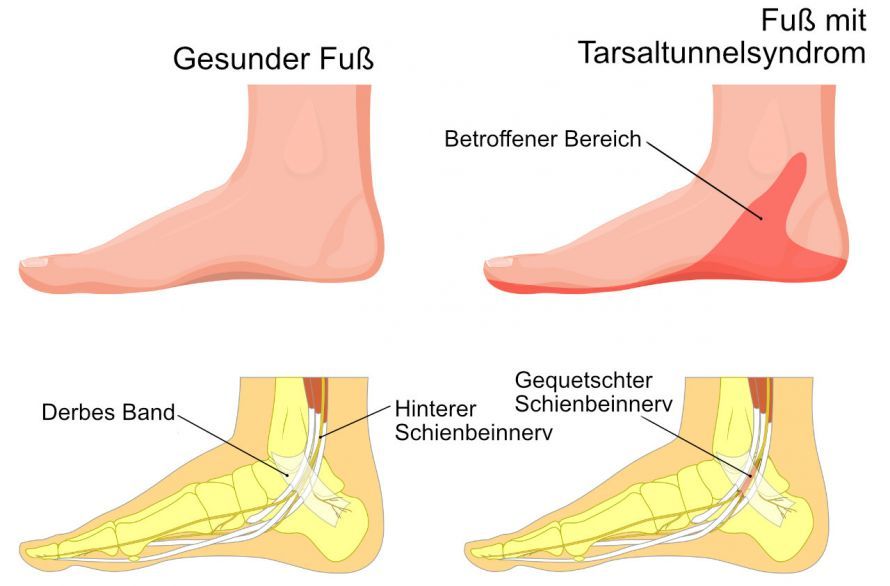
Causes of tarsal tunnel syndrome
Impairments of the tibial nerve can have several causes, such as
- scarring resulting from bruising following injuries or contusions in the ankle region,
- chronic tenosynovitis with swelling of the tendon sheaths of the tendon systems that also pass through the tarsal tunnel, as well as
- unusual strain during long hikes, particularly in individuals with excess body weight.
Inflammatory or mechanical nerve compression can also contribute to the development of tarsal tunnel syndrome. However, attempts to explain the cause of tarsal tunnel syndrome often prove unsuccessful.
Symptoms of tarsal tunnel syndrome
The main symptom of tarsal tunnel syndrome is pain in the sole of the foot. The skin on the soles of the toes is also affected. This pain is not necessarily related to recent physical exertion.
At the same time, the skin on the sole of the foot feels “numb,” and those affected have difficulty bending and extending their toes. Another typical symptom is an electric-shock-like sensation that can radiate down to the toes. Tarsal tunnel syndrome thus causes both sensory disturbances and motor impairments.
For the doctor, this points to the tibial nerve, which is composed of sensory and motor nerve fibers.
However, motor impairments in the foot are not as clearly noticeable as they are, for example, in the hand. As a result, those affected notice pain in the sole of the foot, a tingling sensation, and a “pins-and-needles” feeling much earlier.
Examination and Diagnosis of Tarsal Tunnel Syndrome
The transmission of electrical impulses via the tibial nerve serves, among other things, to signal pain following an injury to the sole of the foot.
These nerve fibers can be electrically stimulated from the outside. The neurologist uses this to make a diagnosis.
Electrical Stimulation for Diagnosing Tarsal Tunnel Syndrome
The doctor applies an electrical stimulus to a specific point on the lower leg, which the patient may find quite uncomfortable. After a few fractions of a second, this triggers a reaction in the muscles of the foot. The connected computer system calculates the speed at which the stimulus travels through the tarsal tunnel.
It is advisable to perform the same test on the other leg to allow for a side-by-side comparison. Slowed nerve conduction indicates a functional impairment, which is also accompanied by microanatomical changes in the nerve fibers.
Conducting such nerve conduction velocity measurements is the most important diagnostic tool for confirming tarsal tunnel syndrome.
Imaging Techniques for Diagnosing Tarsal Tunnel Syndrome
Imaging techniques, such as magnetic resonance imaging (MRI), cannot detect a pure compression syndrome such as tarsal tunnel syndrome.
Goals of tarsal tunnel syndrome surgery
Surgery for tarsal tunnel syndrome must achieve two goals:
- the division of the ligaments that define the outer boundaries of the tarsal tunnel between the medial malleolus and the heel,
- to open the passageway through which the medial and lateral plantar branches pass through the plantar aponeurosis into the sole of the foot.
The latter objective is particularly important when foot strain is suspected as the cause of tarsal tunnel syndrome. Repeated local pressure on the sole of the foot, such as from frequent hiking, can trigger this entrapment syndrome. The surgical procedure is designed to relieve pressure on the nerve in the tarsal tunnel and permanently eliminate the compression.
Procedure for Tarsal Tunnel Syndrome Surgery
For anatomical reasons, tarsal tunnel syndrome surgery requires a longer incision.
The surgeon first identifies the tibial nerve and the posterior tibial artery above the tarsal tunnel. From there, the surgeon then cuts through the tough ligamentous structure (retinaculum flexorum) covering the tarsal tunnel toward the periphery, or the sole of the foot.
This initial exposure just above the tarsal tunnel also prevents the surgeon from entering the adjacent tendon sheath. Doing so would carry the risk of the tendons around the medial malleolus slipping out of place and losing their function.
The surgeon must take care not to damage the vital accompanying arterial vessel or the small branches extending laterally. The one or two veins accompanying the nerve, along with their collateral connections, must also be preserved during the surgical procedure.
Surgery for tarsal tunnel syndrome is time-consuming and must therefore be performed under general anesthesia.
Currently, only open surgery is possible. Whether endoscopic, and thus minimally invasive, surgical methods will become standard remains to be seen. These methods would also have to
- ensure the patency of the accompanying arterial and venous vessels in the tarsal tunnel and
- ensure that the nerve passageways through the plantar aponeurosis remain open.
Open surgery does not require a microscope. Exposing the interior of the nerve under a microscope using fine microinstruments (microsurgical neurolysis) can exacerbate pain.
Medication for Tarsal Tunnel Syndrome
Occasionally, physicians treat tarsal tunnel syndrome with anti-inflammatory medications and injections of crystalloid cortisone suspensions. In the case of carpal tunnel syndrome, this constitutes a permissible treatment attempt according to new interdisciplinary guidelines from the respective professional societies.
In the case of tarsal tunnel syndrome, however, such procedures must take into account the important blood vessels that run alongside the nerve. Bleeding must be avoided, as it can lead to hematoma-induced scarring of the tibial nerve. Such injections should therefore be considered problematic.
Pain medications are largely ineffective for tarsal tunnel syndrome. This also applies to a new generation of antiepileptic drugs (gabapentin).
Postoperative Care Following Tarsal Tunnel Syndrome Surgery
Specific follow-up treatment is not absolutely necessary. However, the patient must take care not to put weight on the sole of the foot and ensure that the ankle remains immobilized. To support healing, conservative treatment methods such as shoe inserts or gentle mobilization of the nerves under the guidance of a physical therapist may be helpful in individual cases. This also includes stepping on the affected foot as little as possible for a few days and rolling it off the forefoot. The patient is provided with a walking aid for this purpose.
However, this rest is not sustainable for long, as the use of the calf muscles is the most important preventive measure against venous thrombosis. The patient should therefore receive subcutaneous heparin until normal weight-bearing is resumed.
There is no specific postoperative physical therapy regimen following tarsal tunnel syndrome surgery.
Possible Complications and Risks of Tarsal Tunnel Syndrome Surgery
Complications occur primarily when the structures within the tarsal tunnel that need to be protected are injured. This can also result in damage to the tissue or blood vessels. Injury to any of these structures inevitably leads to impairment or even adverse outcomes.
Wound closure should be secured with a drain in place for at least 24 hours to prevent the risk of a new, impairing hematoma in the event of unintended postoperative bleeding.
The main problem following tarsal tunnel syndrome surgery arises because the patient puts weight on the surgical site with every step:
- When stepping down, they compress the two nerve branches that run into the sole of the foot
- As the foot rolls over the forefoot, the entire surgical region is stretched longitudinally each time.
The very soft, sensitive nerve fibers are repeatedly compromised by the weight-bearing stress with every step. As a result, the chances of nerve recovery—despite the most meticulous tarsal tunnel syndrome surgery—are lower than with surgery on the hand.
However, another risk worth mentioning is the difficulty in making a diagnosis. There are numerous conditions in the sole of the foot that can cause pain and have nothing at all to do with tarsal tunnel syndrome. Only nerve conduction velocity tests performed by a neurologist can provide the decisive clue.
A patient may also be dissatisfied if, despite an accurate diagnosis and careful surgery, a pain-causing heel spur remains. It is therefore a risk that other pain-causing conditions may also be present in combination.
Conclusion on Tarsal Tunnel Syndrome Surgery
Tarsal tunnel syndrome is a rare condition that not every doctor is familiar with. Neurological impairments affect the skin and muscles throughout the sole of the foot. The diagnosis is based on nerve conduction velocity tests performed by a neurologist. Treatment is surgical. The tunnel system to be opened is longer than comparable systems in the hand.
The surgical site is problematic due to the inevitable subsequent stress placed on the patient while standing or walking. Therefore, the chances of improvement are always compromised by the subsequent compression of the nerves with every step.
The earlier tarsal tunnel syndrome is diagnosed and treated, the greater the chances of preventing neurological damage and alleviating symptoms. Despite these limitations, only the careful release of the entire tarsal tunnel can help—there are no effective alternatives.
FAQ
What is tarsal tunnel syndrome?
Tarsal tunnel syndrome is a rare nerve compression disorder of the foot. In this condition, the tibial nerve (nervus tibialis) is compressed within the tarsal tunnel behind the inner ankle, leading to pain, tingling, and numbness in the sole of the foot.
What are the symptoms of tarsal tunnel syndrome?
Typical symptoms include burning or stabbing pain on the sole of the foot, a sensation of numbness, and abnormal sensations or tingling in the toes. Some people also have difficulty bending or straightening their toes.
How is tarsal tunnel syndrome diagnosed?
The most important test is a nerve conduction study performed by a neurologist. This determines whether the tibial nerve is responding more slowly in the area of the tarsal tunnel. Imaging techniques such as MRI are usually not conclusive.
How is tarsal tunnel syndrome treated?
In most cases, treatment involves surgery to open the tarsal tunnel and relieve pressure on the trapped nerve. Pain relievers or injections usually do not provide long-term relief. After surgery, it is important to rest the foot to promote proper healing.
Share this article