News
Scoliosis: When the Spine Goes Off Course

Melanie Al Tikriti, BSc ·
A curvature of the spine that, if detected early, can be effectively treated.
The spine forms the stable framework of the human body. It ensures an upright posture, protects the spinal cord, and enables a wide range of movements in everyday life. If its natural shape changes, this can have long-term effects on the entire musculoskeletal system. One of the most common deformities is scoliosis. This is a lateral curvature of the spine in which the individual vertebrae also rotate around their own axes.
Many people with scoliosis do not notice the condition at first. Mild curvatures, in particular, often cause no symptoms and are frequently discovered by chance.
What Causes Scoliosis
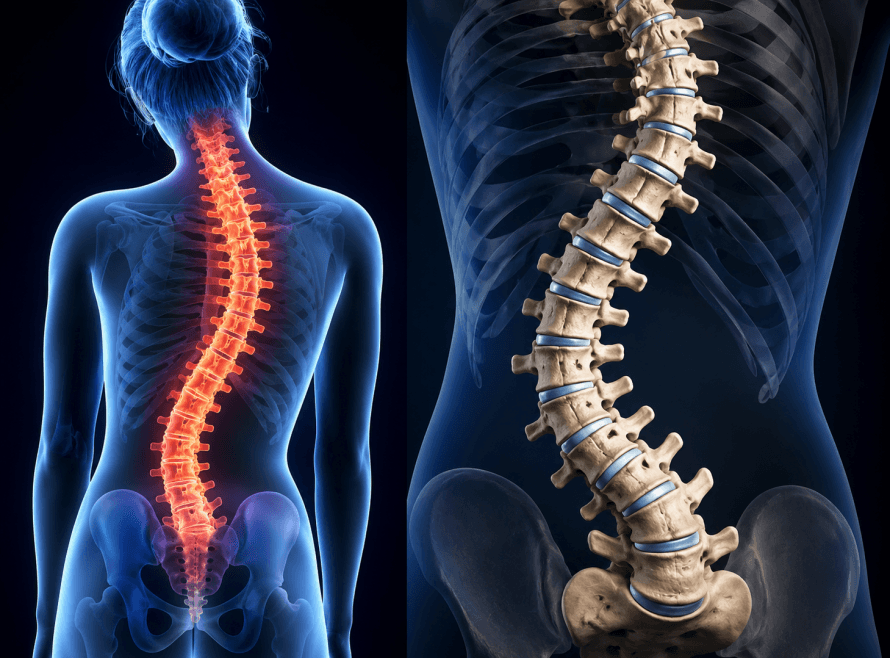
In a healthy spine, the spine appears straight when viewed from the back. In scoliosis, it deviates permanently to the side and twists at the same time. This can result in a C- or S-shaped curvature. Depending on the severity, it is not only the position of the spine that changes. The shoulders, pelvis, or rib cage may also be at different heights or appear asymmetrical. To determine the severity, doctors measure the so-called Cobb angle on an X-ray.
Why Scoliosis Can Develop
In most cases, no clear cause can be identified. Experts refer to this as idiopathic scoliosis. It usually occurs during growth in childhood and adolescence and affects girls more frequently than boys. In addition, there are congenital forms caused by spinal malformations. Disorders of the nervous system or the muscles can also contribute to scoliosis if the stabilizing muscles no longer function adequately.
In older age, some people develop what is known as degenerative scoliosis. In this condition, signs of wear and tear on the intervertebral discs and vertebral joints cause the spine to gradually lose stability.
Initial changes often go unnoticed for a long time
Scoliosis usually develops gradually. Since there is often no pain at first, it is usually not detected until changes in posture become visible.
Typical signs include:
- shoulders at different heights
- a tilted pelvis
- a protruding shoulder blade
- an uneven waistline
- rib hump when bending forward
- Back pain
- Muscle tension
- Limited mobility
In cases of more severe curvature, the chest may also be affected. In rare cases, this can make breathing difficult and reduce physical endurance.
How the Diagnosis Is Made
Initial signs of scoliosis can be detected during a physical examination. Doctors pay close attention to posture, the alignment of the spine, and any possible asymmetries.
An important part of the examination is the Adams forward-bending test. As the patient slowly bends forward, spinal twists often become visible as a rib hump. To confirm the diagnosis, an X-ray of the entire spine is then taken. These images allow the Cobb angle to be determined and the extent of the curvature to be accurately assessed. If necessary, additional imaging techniques may be used.
Treatment Options
Treatment depends on the patient’s age, the severity of the scoliosis, and the risk of further progression. Mild curvatures often require only regular monitoring. In addition, physical therapy helps strengthen the back muscles, maintain mobility, and correct poor posture.
For children and adolescents, a custom-fitted brace may be necessary once the curvature reaches a certain level. It is intended to prevent the spine from deforming further during growth. If the scoliosis is very severe or if symptoms worsen despite conservative treatment, surgery may be necessary. The goal of the procedure is to straighten the spine and stabilize it permanently.
Exercise plays an important role
Even in everyday life, those affected can do a lot on their own to support their back health. Regular exercise strengthens the muscles and supports the spine. Sports such as swimming, cycling, or specific exercises prescribed by a physical therapist are particularly suitable. At the same time, prolonged sitting and one-sided strain should be avoided as much as possible.
It is also important to keep medical follow-up appointments and consistently follow prescribed therapies.
What the outlook is
The prognosis depends primarily on when the scoliosis is detected and how severe the curvature is. If the condition is treated early during growth, its progression can often be successfully slowed.
Adults also benefit from a personalized treatment plan. While an existing curvature usually cannot be completely reversed, pain can be reduced and mobility can be maintained in the long term.
Conclusion: Early treatment improves the long-term prognosis.
Scoliosis is a permanent curvature of the spine that can affect people of all ages. While mild forms often cause hardly any symptoms, severe cases can lead to pain and limitations in daily life. Early diagnosis, regular follow-up examinations, and a personalized treatment plan are crucial. With physical therapy, adequate exercise, and other therapeutic measures, the course of the condition can often be positively influenced, and quality of life can be maintained in the long term.
Share this article
Verified expertise
Recommended specialists
19 specialists
19 results





Dr. med. Gregor Ostrowski
Karlsbad


Dr. med. Hans-Jürgen Becker
Wallisellen



Dr René Malzkorn
Founder and Practice Proprietor

PD Dr. med. Friedrich Kutscha-Lissberg
Gelsenkirchen


Prof. Dr. Christoph G. Wölfl
Neuwied




Prof. Dr. med. OliverP. Gautschi
In-patientphysician, St. Anna Hospital Neurology and Spinal Centre
Lucerne

Prof. Dr. med. Timo Zippelius
Karlsbad


1 / 2
News
Read next
- News
Scabies: A contagious skin disease that is easily treatable
Oct 26, 2026
Severe itching and minor skin changes should be taken seriously
Read more - News
Heat Rash: What's Behind the Itchy Blisters
Oct 23, 2026
Heat Rash: Heat and Sweat Can Disrupt the Skin's Balance
Read more - News
Enlarged Prostate – When Medication Is Sufficient and When Surgery Is Recommended
Oct 21, 2026
Why Many Men Ignore Urinary Problems for Too Long
Read more