Spinal stabilization involves surgical procedures used when the spine loses its stability. Causes may include degenerative processes, spondylolisthesis, damaged intervertebral discs, or structural instabilities. Modern spinal surgery techniques range from minimally invasive procedures to stable fusion surgeries, in which vertebral bodies are connected using implants, screws, and rods.
Stabilization can be dynamic or involve rigid spondylodesis, depending on mobility, segment findings, and load-bearing capacity. The goal is always to reduce pain, prevent neurological deficits, and restore the spine’s full load-bearing capacity. Specialized techniques are used for the lumbar spine as well as the cervical and thoracic spines. Dynamic systems allow for greater movement, while fusion procedures provide high stability.
Fundamentals of Spinal Stabilization – Why Spinal Stabilization Becomes Necessary
Spinal stabilization is used when the spine no longer provides adequate support due to degenerative changes, spondylolisthesis, or instability. Such problems often arise from disc degeneration, injuries, or structural changes in the vertebral bodies. Stabilization is intended to prevent affected segments from giving way further and causing pain or neurological disorders. In the lumbar spine in particular, instability quickly leads to significant limitations in mobility. The goal of any treatment is to reduce symptoms and restore the spine’s natural function.
In some cases, instability develops only as a degenerative disease progresses. The intervertebral disc loses height, the vertebra slips forward, and mechanical overload occurs. In such cases, surgical stabilization may be necessary to prevent further progression. Neurosurgeons carefully assess whether conservative treatments have been exhausted. Surgical stabilization of the spine is considered only if pain or neurological deficits persist.
Spinal stabilization may also be necessary following severe injuries. Unstable fractures or traumatic intervertebral disc damage can lead to dangerous instability. To protect the spinal cord, vertebrae often need to be stabilized using screws, rods, or cage systems. In such cases, stabilization lays the foundation for safe healing and the spine’s ability to bear weight in the future.
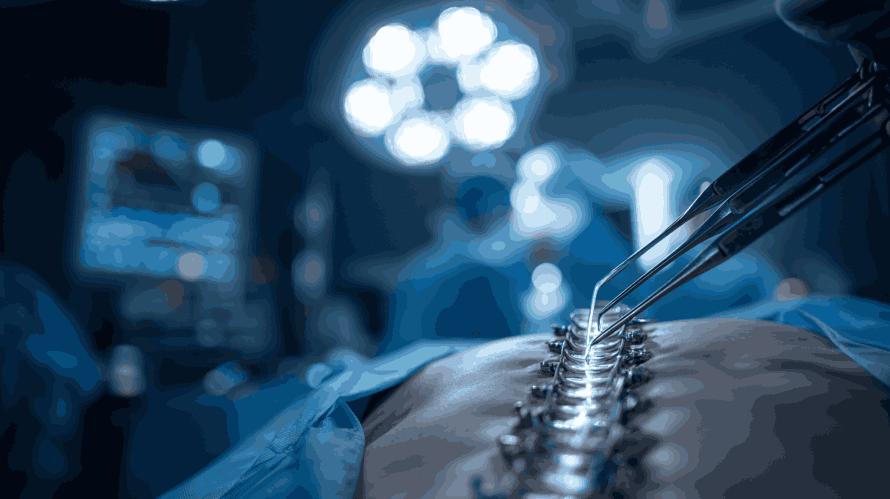
Preparation for minimally invasive spinal stabilization in the neurosurgical operating room.
Modern Procedures: A Comparison of Dynamic Stabilization, Spondylodesis, and Spinal Fusion
Dynamic stabilization stabilizes the spine without completely losing the mobility of a segment. This method is particularly suitable for moderate instabilities or early degenerative changes. Dynamic implants act as flexible shock absorbers and are designed to largely preserve the spine’s natural mobility. This can reduce wear and tear on adjacent segments, offering long-term benefits. The lumbar spine is the most common region for dynamic stabilization systems.
Spondylodesis, or spinal fusion, is used when a segment is severely damaged or unstable. In this procedure, two or more vertebral bodies are fused together with screws, often supported by a cage that replaces the intervertebral disc. The affected segment is deliberately fused to achieve complete stability. This fusion surgery offers a reliable solution, particularly in cases of severe instability or advanced spondylolisthesis. Spinal surgery uses pedicle screw-based systems with high stability for this purpose.
In a direct comparison, both methods offer different advantages. Dynamic stabilization is intended to preserve mobility, while spondylodesis provides absolute stability. Modern spinal fusion procedures are often minimally invasive, which can significantly shorten recovery time. Depending on the extent of disc damage, spondylolisthesis, or osteoporosis, the treating specialist selects the optimal technique. A careful assessment of the patient’s individual factors determines whether a dynamic or a traditional fusion procedure is more appropriate.
Spinal Slippage, Intervertebral Discs, and the Lumbar Spine—When Surgery Is Recommended
Spinal slippage usually occurs in the lumbar spine when the surrounding tissue no longer provides sufficient support. Those affected experience pain when standing, walking, or after prolonged periods of sitting. If instability is confirmed and conservative measures are insufficient, stabilization may be necessary. Especially when accompanied by a herniated disc, the vertebrae’s ability to withstand stress deteriorates significantly. Surgical stabilization often provides lasting relief in such cases.
The intervertebral disc plays a central role in the decision to proceed with surgery. If it is severely damaged, a cage may be required to restore height and function. The lumbar spine, in particular, is susceptible to such degenerative processes. Neurosurgeons use MRI and CT images to assess whether conservative treatment is sufficient. Stabilization of the spine is only considered if symptoms persist.
The progression of mobility is also taken into account. Some patients benefit from dynamic stabilization, while others require a complete fusion. The key factors are whether the instability is progressing or whether neurological symptoms are present. The goal of all procedures remains the restoration of function, stabilization of the spine, and reduction of pain in daily life.
Benefits and Risks of Spinal Stabilization
Benefits of Spinal Stabilization – Stabilization, Pain Reduction, and Restoration of Function
A major benefit is the immediate stabilization of a previously unstable segment. This reduces the strain on surrounding intervertebral discs and joints. Many patients report a significant reduction in pain following fusion surgery. Stabilization often offers a long-term solution, particularly for spondylolisthesis. Improving mobility in daily life is also one of the main goals.
Dynamic stabilization offers additional benefits, as it partially preserves mobility. This can help reduce degenerative changes in adjacent segments. Physically active or younger patients benefit from this in particular. Spinal stabilization also provides an important foundation for resuming occupational activities. This makes earlier mobilization after surgery more likely.
Modern minimally invasive techniques also contribute to improved outcomes. Smaller skin incisions and less tissue damage accelerate recovery. Patients regain full spinal function more quickly. Following successful stabilization, many pre-existing limitations can be reduced or completely eliminated. This significantly improves quality of life.
Risks and Possible Complications—From Limited Mobility to Problems Related to Fusion Surgery
As with any surgical procedure, there are risks. Spondylodesis can result in limited mobility because the operated segment is fused. In some cases, increased wear and tear on the adjacent vertebrae develops over the years. This is known as adjacent-segment degeneration. Despite modern implants, this complication cannot be completely ruled out.
Other risks include wound healing complications and potential infections. With minimally invasive procedures, the risk is lower but cannot be completely avoided. Problems with screws and rods are also rare but possible, such as loosening or fracture of individual components. Some patients develop temporary nerve irritation, which usually resolves on its own. In rare cases, a repeat surgery may be necessary to adjust the implant materials.
A particular risk exists in cases of severe degenerative diseases or osteoporosis. Stabilizing the spine can be technically more challenging in these cases. For this reason, a thorough assessment is conducted before every surgery to determine whether medication or physical therapy alone would be sufficient. The goal is always to carefully weigh the benefits against the risks. Close collaboration between neurosurgery, pain medicine, and physical therapy is crucial.
Minimally Invasive Procedures and Current Developments—Dynamic, Gentle, and Increasingly Precise
Many stabilization procedures are now performed using minimally invasive techniques, which significantly accelerate the healing process. Small skin incisions and precise access points minimize trauma to muscles and ligaments. This results in less tissue damage and reduced postoperative pain. Minimally invasive techniques are particularly well-suited for targeted fusion surgeries in the lumbar spine. Dynamic systems can also often be implanted through small access points.
Modern implants greatly facilitate spinal stabilization. Screws, rods, and flexible elements are becoming increasingly safe and durable. Navigation and intraoperative imaging further improve accuracy. The use of vertebral body replacement systems is also becoming more precise. The Journal of Neurosurgery regularly reports on new developments in this field.
At the same time, new concepts for dynamic stabilization are being developed. The goal is to stabilize the spine without completely losing its natural mobility. Intervertebral disc prostheses and hybrid constructions are also gaining importance. As a result, patients today have access to a wider range of more personalized options. Spinal surgery remains a highly dynamic field.
FAQ
When is spinal stabilization truly necessary?
Stabilization becomes necessary when spondylolisthesis, instability, or degenerative changes persist despite conservative treatment and cause pain or neurological deficits. MRI, CT, and clinical examinations of the spine provide key diagnostic information.
What is the difference between dynamic stabilization and spondylodesis?
Dynamic stabilization preserves a certain degree of mobility, whereas spondylodesis completely fuses the affected segment. Both procedures provide effective stabilization but differ in terms of mobility, load-bearing capacity, and long-term effects.
How long does recovery take after spinal stabilization?
The recovery time depends on the procedure but usually ranges from several weeks to months. Minimally invasive procedures often allow for faster mobilization and less pain. Full weight-bearing capacity of the spine is achieved gradually.
What are the risks associated with spinal fusion?
Possible complications include limited mobility, problems with the implant material, infections, or wear and tear on adjacent segments. Modern implants and precise surgical techniques reduce the risk, but it cannot be completely ruled out.

About the medical author
Sabine Schneider
Editor-in-Chief
Sabine Schneider – medical author: Explore expert articles and medical expertise in the Leading Medicine Guide.
More about the medical author →