
Sascha Zink
Specialist in Cranial & Brain Neurosurgery, Peripheral Nerve Surgery, and Spine Surgery in Bottrop
Knappschaft Kliniken Bottrop GmbH· Osterfelder Straße 157, 46242 Bottrop
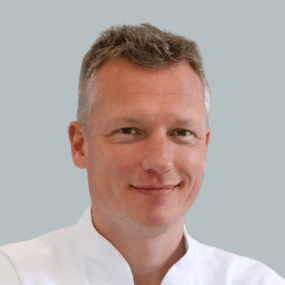
Sascha Zink stands for neurosurgical expertise with a clear focus on disorders of the brain, spine, and nervous system. His medical work combines thorough diagnostics, surgical experience, and modern treatment approaches.
Areas of focus
- Treatment of cerebrovascular diseases
- Management of traumatic brain injuries
- Treatment of brain tumors
- Disorders of the cerebrospinal fluid system
- Skull base surgical procedures, including pituitary surgery
- Microsurgical procedures throughout the entire spine: cervical, thoracic, and lumbar spine
- Cervical spine disc replacement
- Interventional pain management procedures
- Endoscopic spinal surgery
- Peripheral nerve surgery
- Conservative treatment approaches
Admission criteria
- At least 10 years of surgical and treatment experience
- Expertise in modern diagnostic and surgical procedures
- An outstanding treatment focus within your own specialist area
- Member of a leading national professional association
- Leading professional position
- Active participation in specialist events (e.g. lectures)
- Active in research and teachin
- Evaluated quality management (e.g. certification)
- Quality management (Spinal Surgery)
- Recording of complications (Spinal Surgery)
- Quality circle (Spinal Surgery)
- Inpatient treatment (Spinal Surgery)
- Authorization for further training (Spinal Surgery)
About Sascha Zink
Sascha Zink is a board-certified specialist in neurosurgery and Chief Physician of the Department of Neurosurgery at Knappschaft Kliniken Bottrop. His medical focus is on the diagnosis and surgical treatment of disorders of the brain, spine, and peripheral nervous system. He therefore represents neurosurgical care that combines surgical precision with a structured clinical approach.
Sascha Zink completed his medical training after studying human medicine at Heinrich Heine University Düsseldorf. He then worked for many years at Evangelisches Klinikum Niederrhein, where he advanced from resident physician through positions as senior physician to leadership roles within neurosurgery. This continuous professional career has shaped his experience in treating complex neurosurgical conditions.
Sascha Zink’s medical expertise includes both classic neurosurgical procedures and specialized techniques. According to the hospital profile, he holds certifications in interventional radiology and radiation protection, as well as a special certificate from the German Society for Neurosurgery in specialized oncological neurosurgery. In addition, he holds a special certificate in endoscopic spine surgery, underscoring his experience in the treatment of tumors of the nervous system and minimally invasive procedures of the spine.
Sascha Zink completed his medical training after studying human medicine at Heinrich Heine University Düsseldorf. He then worked for many years at Evangelisches Klinikum Niederrhein, where he advanced from resident physician through positions as senior physician to leadership roles within neurosurgery. This continuous professional career has shaped his experience in treating complex neurosurgical conditions.
Sascha Zink’s medical expertise includes both classic neurosurgical procedures and specialized techniques. According to the hospital profile, he holds certifications in interventional radiology and radiation protection, as well as a special certificate from the German Society for Neurosurgery in specialized oncological neurosurgery. In addition, he holds a special certificate in endoscopic spine surgery, underscoring his experience in the treatment of tumors of the nervous system and minimally invasive procedures of the spine.
Facts & experience
- Neurosurgical pain therapy (Cranial and Brain Neurosurgery)
over 3000
- Nerve reconstruction (Cranial and Brain Neurosurgery)
over 400
- Neuronavigation (Cranial and Brain Neurosurgery)
over 1500
- Stereotaxy (Cranial and Brain Neurosurgery)
over 100
- Brain aneurysm surgery (Cranial and Brain Neurosurgery)
over 120
- Brain tumor surgery (Cranial and Brain Neurosurgery)
over 1002
- Brain surgery (Cranial and Brain Neurosurgery)
over 1200
- Plexus surgery (Cranial and Brain Neurosurgery)
over 5
- Surgery to the base of the skull (Cranial and Brain Neurosurgery)
over 400
- Injuries (Spinal Surgery)
over 500
Minimum requirement: 40
- Deformities (spondylodeses) (Spinal Surgery)
over 30
Minimum requirement: 15
- Degenerative disease (Spinal Surgery)
over 5000
Minimum requirement: 100
- Inflammatory disease (Spinal Surgery)
over 2000
Minimum requirement: 15
- Tumor diseases (Spinal Surgery)
over 300
Minimum requirement: 20
- Facility certificate valid until (Spinal Surgery)
April 13, 2023
- Personnel certificate (Spinal Surgery)
1000
Video presentation
Expert interviews
Location
How to reach Sascha Zink

Knappschaft Kliniken Bottrop GmbH
Osterfelder Straße 15746242 BottropGermany
Specialisation
The medical spectrum of Sascha Zink
Diseases
- Arteriovenous Malformation (opens in a new tab)
- Neurofibromatosis (opens in a new tab)
- Tethered Cord Syndrome (opens in a new tab)
- Brain hemorrhage (opens in a new tab)
- Cerebrovascular Diseases (opens in a new tab)
- Neurovascular Diseases (opens in a new tab)
- Subarachnoid hemorrhage (opens in a new tab)
- Herniated Disc (opens in a new tab)
- Herniated disc in the cervical spine (opens in a new tab)
- Kyphosis (opens in a new tab)
- Osteochondrosis (opens in a new tab)
- Spinal Canal Disorders (opens in a new tab)
- Spinal Canal Stenosis (Spinal Canal Narrowing) (opens in a new tab)
- Spondylodiscitis (inflammation of the intervertebral discs and vertebrae) (opens in a new tab)
- Spondylolisthesis (Spinal Slippage) (opens in a new tab)
- Spondylosis (arthrosis of the vertebral joints) (opens in a new tab)
- Spinal Disorders (opens in a new tab)
- Cauda equina syndrome (opens in a new tab)
- Dystonia (opens in a new tab)
- Hydrocephalus (opens in a new tab)
- Paralysis (opens in a new tab)
- Meralgia Paresthetica (opens in a new tab)
- Supinator loge syndrome (opens in a new tab)
- Thoracic Outlet Syndrome (opens in a new tab)
- Trigeminal Neuralgia (opens in a new tab)
- Angioma (opens in a new tab)
- Astrocytoma (opens in a new tab)
- Glioblastoma (opens in a new tab)
- Glioma (opens in a new tab)
- Brain metastases (opens in a new tab)
- Brain tumor (opens in a new tab)
- Pituitary adenoma (pituitary tumor) (opens in a new tab)
- Cavernomas (opens in a new tab)
- Meningioma (opens in a new tab)
- Nerve Cancer (opens in a new tab)
- Neuroblastoma in Children (opens in a new tab)
- Oligodendroglioma (opens in a new tab)
- Spinal cord tumor (opens in a new tab)
- Skull base tumor (opens in a new tab)
- Spinal Tumor (opens in a new tab)
- Brain Injury (Traumatic Brain Injury) (opens in a new tab)
- Spinal Cord Injury (opens in a new tab)
- Vertebral Fracture (opens in a new tab)
- Cerebral arteriovenous malformation (opens in a new tab)
- Brain aneurysm (opens in a new tab)
- Lower Back Pain (opens in a new tab)
- Acromegaly (opens in a new tab)
- Hyperprolactinemia (opens in a new tab)
- Pituitary insufficiency (opens in a new tab)
- Post-Traumatic Kyphosis (opens in a new tab)
- Degenerative Disc Disease (opens in a new tab)
- Spinal Instability (opens in a new tab)
- Spinal Sprain (opens in a new tab)
- Whiplash (opens in a new tab)
- Spondylopathy (opens in a new tab)
- Spondylitis (inflammation of the vertebrae) (opens in a new tab)
- Flat Back (Postoperative Flat Back Syndrome) (opens in a new tab)
- Postnucleotomy Syndrome (Postoperative Pain Syndrome) (opens in a new tab)
- Low-grade glioma (opens in a new tab)
- ISG Syndrome (opens in a new tab)
- Thoracic Vertebrae Problems (opens in a new tab)
Treatments
- Cervical Spinal Disc Surgery (opens in a new tab)
- Brain Aneurysm Surgery (opens in a new tab)
- Brain Tumor Surgery (opens in a new tab)
- Neuromodulation (opens in a new tab)
- Spinal Disc Surgery (opens in a new tab)
- Brain Surgery (opens in a new tab)
- Spinal Stabilization (opens in a new tab)
- Spinal Correction (opens in a new tab)
- Stereotaxy (opens in a new tab)
- Spondylodesis (opens in a new tab)
- Skull Base Surgery (opens in a new tab)
- Plexus Surgery (opens in a new tab)
- Neurosurgical Pain Management (opens in a new tab)
- Percutaneous Spinal Surgery (opens in a new tab)
- Minimally Invasive Disc Surgery (opens in a new tab)
- Kyphoplasty (opens in a new tab)
- Neuronavigation (opens in a new tab)
- Nerve Reconstruction (opens in a new tab)
- Spinal Stabilization Surgery Using a Cage (opens in a new tab)
- Back Pain Treatment (opens in a new tab)
- Facet Infiltration (opens in a new tab)
- TLIF Procedure (Spinal Fusion) (opens in a new tab)
- Electrophysiology (opens in a new tab)
- Epilepsy Surgery (opens in a new tab)
- Vertebroplasty
Diagnostics
- CT (Computed Tomography) (opens in a new tab)
- Myelography (Myelogram) (opens in a new tab)
- 1.5 T MRI
- 3 T MRI
- Intraoperative neuromonitoring
- Intraoperative ultrasound
- Intraoperative angiography
- Digital subtraction angiography (DSA)
- Functional X-ray imaging
- Intraoperative tumor fluorescence
Areas of Expertise

Sascha Zink
Specialist in Cranial & Brain Neurosurgery, Peripheral Nerve Surgery, and Spine Surgery in Bottrop