Neurofibromatosis is a rare genetic disorder characterized by the formation of mostly benign tumors along the nervous system. Neurofibromatosis type 1, also known as Recklinghausen’s disease, is particularly common and is caused by a mutation in the NF1 gene.
Clinically, the disease presents in a wide variety of ways and can affect the skin, peripheral nerves, the central nervous system, and the skeleton.
In addition to visible skin changes, neurological symptoms and functional limitations may occur, requiring lifelong medical care.
Definition: Neurofibromatosis
Neurofibromatoses are genetic disorders that are either
- are inherited by offspring or
- arise as a de novo mutation, usually during germ cell development.
This group also includes neurofibromatosis type 1, which is one of the most common genetic disorders. Approximately one in every 3,000 to 4,000 people is affected by it.
The other types, however, are significantly less common. In Germany, about 40,000 people are affected by one of these diseases.
In about 50 percent of patients, the disease is attributable to a genetic change that occurred during germ cell formation. In these cases, a so-called germline mutation or de novo mutation leads to the disease. Compared to other genetic disorders, this is a very high proportion.
In the other half of cases, the genetic predisposition was passed down from parents to their children.
Classification of Neurofibromatosis
Neurofibromatosis encompasses several disorders. They differ
- in the gene or chromosome that has been altered by a mutation, and
- in their symptoms.
Types 1, 2, and 3 are of particular clinical significance.
Neurofibromatosis Type 1 (NF1)
Neurofibromatosis type 1 is also known as Recklinghausen’s disease or von Recklinghausen disease. The disorder is caused by changes in the NF1 gene, which is located on chromosome 17.
This gene encodes a protein called neurofibromin, which influences regulatory processes within cells. If cell regulation no longer functions correctly, tumors, for example, can develop.
With a prevalence of 1 in 3,000 to 1 in 4,000, NF1 is one of the most common genetic disorders.
Clinically, neurofibromatosis type 1 manifests itself, among other things, through
- skin patches,
- neurofibromas (benign tumors of certain nerve and connective tissue cells), and
- nodules in the iris.
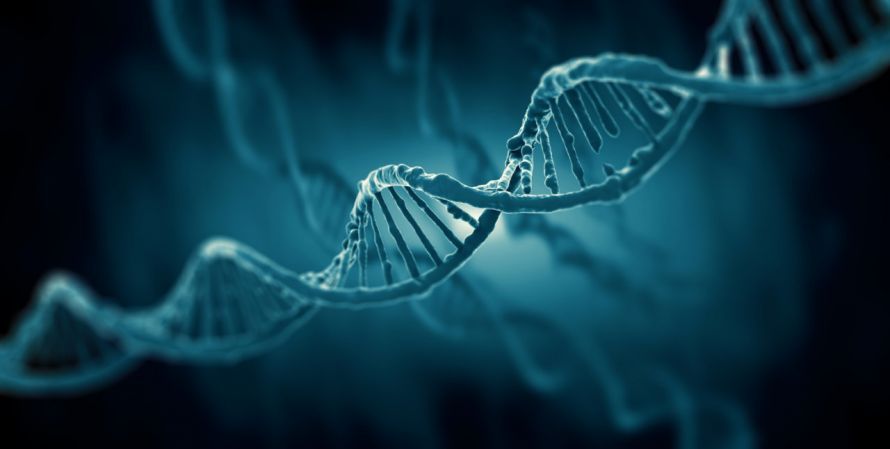
Neurofibromatoses are caused by genetic mutations © Giovanni Cancemi | AdobeStock
Neurofibromatosis Type 2 (NF2)
This form of the disease is much less common. It is also known as central neurofibromatosis or bilateral acoustic neuroma.
Approximately one person per 50,000 residents has NF2. The ratio of patients with NF1 to patients with NF2 is therefore roughly 15 to 1.
In type 2, a mutation in the NF2 gene, located on chromosome 22, is responsible for the development of the disease. The exact role of the gene product, known as Schwannomin or Merlin, is not yet fully understood. It may play a role in the signaling of growth factors and in cell adhesion (cell binding).
Clinically, neurofibromatosis type 2 is characterized by tumors of the central and peripheral nervous systems. Schwannomas, in particular, are common. These are benign tumors of the nerve sheath, which consists of Schwann cells.
Neurofibromatosis Type 3 (NF3) – Schwannomatosis
This form of neurofibromatosis, also known as schwannomatosis, is likewise a very rare disorder. Depending on the study, its prevalence is estimated to be approximately 1 in 25,000 to 1 in 70,000.
Since schwannomatosis is clinically similar to NF2, there are sometimes difficulties in distinguishing between the two in clinical practice. As a result, schwannomatosis is sometimes misdiagnosed.
In about half of patients with schwannomatosis, mutations have been found in the SMARCB1 gene, which, like the NF2 gene, is located on chromosome 22. However, very little is known about the function of the gene product.
Symptoms of Neurofibromatosis
Symptoms of Neurofibromatosis Type 1
In Type 1, the first symptoms appear as early as infancy or early childhood. By age five, the disease has manifested in nearly all individuals who carry the mutated gene. The severity of symptoms, however, can vary greatly.
For example, pigmentation abnormalities may be visible at birth or shortly thereafter. Because these spots have a light brownish color, they are also called café au lait spots. At first, they are only a few millimeters in size, but they can grow as the person ages. In addition, skin lesions that look very similar to freckles (known as lentigines) may appear. The underarm and groin areas are particularly prone to this.
The presence of at least two so-called Lisch nodules is also a sign of type 1 neurofibromatosis. However, they do not impair vision. Lisch nodules are small, brownish nodules that appear on the iris (the colored part of the eye) and are also called iris hamartomas.
This condition can cause benign tumors of certain nerve and connective tissue cells. These are known as neurofibromas and can occur in or under the skin and in any part of the body.
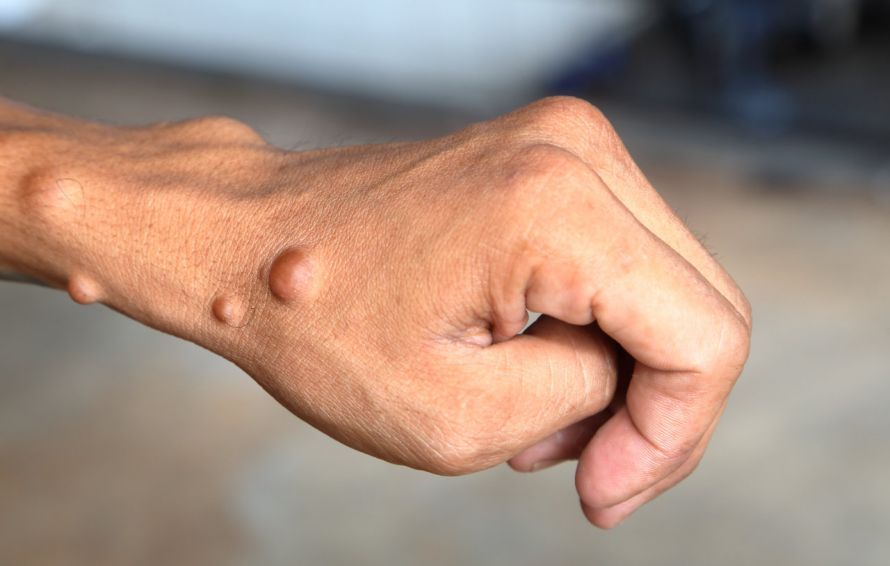
These growths, which are usually nodular but sometimes grow in a net-like pattern, often do not appear until puberty. They multiply over time or grow larger. Although these are benign lesions, in some cases they can develop into malignant tumors.
Tumors can also form on the optic nerve. These are called optic gliomas, which can then cause visual disturbances.
Another sign of the disease is characteristic bone changes. These include, for example, a malformation of the bone behind the eye socket (known as sphenoid dysplasia). This often manifests as a protruding eye or, less commonly, an eye that has shifted downward.
Thinning of the long bones is also possible. For example, tibial malalignment, which is an excessive curvature of the lower leg. In the area of the spine, curvature (scoliosis) may also occur.
Symptoms also relatively frequently include learning, performance, and behavioral disorders, as well as cardiovascular diseases. Slightly slower physical growth accompanied by faster head growth may also be observed. In some cases, headaches or vomiting may accompany these symptoms.
Symptoms of Neurofibromatosis Type 2
The symptoms of Type 2 usually do not appear until much later in life. The symptoms also differ significantly from those of Type 1. For example, café-au-lait spots are either absent or present in much smaller numbers.
In contrast, tumors in the nervous system—particularly in the brain, along the cranial nerves, and in the spine—are very common. Almost all patients develop acoustic neuromas, which are tumors on the right and left auditory nerves.
In Type 2, the following symptoms typically occur as a result of the tumors:
- initially, hearing problems, including tinnitus, or dizziness,
- sometimes also neurological deficits (such as sensory disturbances, pain in the arms and legs, or paralysis) or
- visual disturbances.
In addition, benign skin tumors and changes in the eyes (such as strabismus or cataracts) may occur.
Symptoms of Neurofibromatosis Type 3—Schwannomatosis
The first symptoms usually appear between the ages of 20 and 40. The most common symptom of NF3 is pain. This pain is related to the size, number, and location of the tumors.
Schwannomas are found primarily on the peripheral nerves and spinal nerves; meningiomas (tumors originating from the meninges) develop in only about five percent of cases. Tissue overgrowth and muscle weakness are also occasionally observed, but there are no skin changes or skin tumors.
Diagnosis of Neurofibromatosis
Diagnosis of Neurofibromatosis Type 1
NF1 can usually be diagnosed based on the typical symptoms alone.
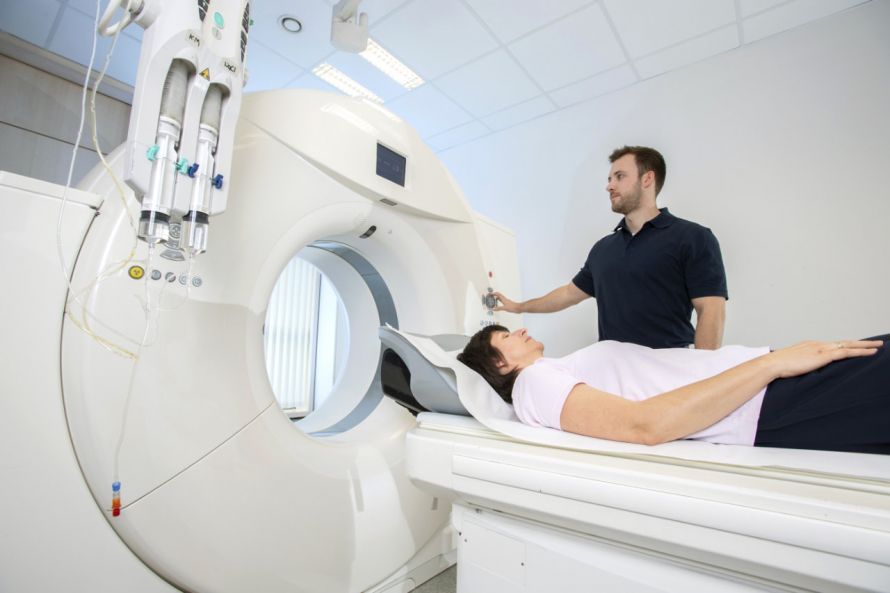
Skeletal changes can be assessed using an X-ray examination. If a patient experiences headaches or vomiting accompanied by rapid head growth, a computed tomography (CT) scan or magnetic resonance imaging (MRI) should be performed. MRI is also used to diagnose tumors. An ophthalmologist should examine affected individuals at least once a year for visual disturbances.
Café-au-lait spots are often the first sign indicating NF1. Since other features often do not appear until later, a definitive diagnosis can often not be confirmed until years later. Regular checkups are therefore very important.
A diagnosis can only be made if at least two of the following seven characteristics are present:
- Six or more café-au-lait spots
- Freckle-like pigmentation of the armpits and/or groin
- Two or more neurofibromas
- Two or more Lisch nodules
- Skeletal abnormalities
- Optic glioma
- A first-degree relative (parent or sibling) diagnosed with NF1 based on these criteria
Diagnosis of Neurofibromatosis Type 2
The diagnosis of NF2 can be made based on
- physical,
- audiological (such as hearing tests, measurement of auditory evoked potentials—which are specific brain waves),
- neurological (for example, measurement of nerve conduction velocity), and
- imaging studies (MRI, CT)
. An annual eye exam should also be performed.
The following criteria can be used as a basis:
- Tumor (schwannoma) on one or both auditory nerves
- Other (brain) tumors, such as neurofibromas, gliomas, and meningiomas
- Neurological and other complications, such as bilateral hearing loss, facial nerve paralysis (facial palsy), subcutaneous tumors, and cataracts
Diagnosis of Neurofibromatosis Type 3—Schwannomatosis
As with the other two types, physical, audiological, neurological, ophthalmological, and imaging examinations are used. However, distinguishing this condition from NF2 based on clinical presentation alone is particularly difficult. The following criteria are taken into account in the diagnosis:
- At least two schwannomas that are not located in the skin.
- No acoustic neuroma is present.
- First-degree relatives have schwannomatosis.
For all forms of neurofibromatosis, affected individuals should see a doctor regularly. This is the only way to detect deterioration and the onset of malignant tumors in a timely manner.
In certain situations, genetic testing may also be advisable.
Treatment of Neurofibromatosis
Neurofibromatosis is incurable. Treatment, therefore, is aimed solely at alleviating symptoms and preventing the condition from worsening.
For example, neurofibromas can be surgically removed. This is particularly appropriate if they cause pain or become malignant.
Tumors in the brain are often not surgically removed. Therefore, the doctor, in consultation with the patient, decides whether to treat the affected area with radiation therapy.
In the case of an optic glioma, depending on the test results,
- surgery,
- radiation therapy, or
- chemotherapy
may be required. However, many tumors on the optic nerve do not cause any symptoms, so no treatment is necessary.
Cuneiform dysplasia generally does not require treatment. However, the deformity can be improved through cosmetic surgery.
Scoliosis can be treated with a brace in milder cases and surgically in severe cases.
Special exercises can be used to address physical and psychological developmental delays.
No treatment required
- Café-au-lait spots,
- Lisch nodules, and
- freckle-like pigmentation.
Treatment of tumors in the brain and along the nerves in neurofibromatosis type 2 is usually surgical; radiation therapy is used less frequently. However, surgery is delayed for as long as medically justifiable, since any procedure involving nerves is always associated with an increased risk. The benefits and risks must always be weighed against one another.
Nerve pain associated with neurofibromatosis type 3 is treated with medications such as
- gabapentin and pregabalin,
- and sometimes with antidepressants
. Mood-stabilizing medications, such as lamotrigine or valproic acid, have also proven effective.
Surgery can also be attempted to remove the tumors pressing on the nerves. However, due to the increased risk, the surgeon must have extensive experience.
Prognosis for Neurofibromatosis
Patients with type 1 neurofibromatosis must be monitored regularly, as
- the course of the disease cannot be predicted,
- the severity varies greatly, and
- there is an increased risk of malignant tumors.
The development of severe complications, such as facial or leg deformities, has so far been observed only in the first few years of life. Overall, they occur very rarely. It is also extremely unlikely that all affected individuals will develop all complications.
Overall, however, many patients with neurofibromatosis can lead a largely normal life. Life expectancy is reduced in a certain proportion of patients, however.
This depends primarily on the course of the disease and the success of treatment for individual symptoms.
FAQs on Neurofibromatosis
What is neurofibromatosis?
Neurofibromatosis is a rare genetic disorder in which benign and, less commonly, malignant tumors of the nervous system form. It belongs to the group of neurofibromatoses and affects the skin, nerves, and other organ systems.
What distinguishes neurofibromatosis type 1 from type 2?
Neurofibromatosis type 1 is characterized by neurofibromas, café-au-lait spots, and Lisch nodules, whereas neurofibromatosis type 2 is primarily characterized by schwannomas of the nervous system. NF1 is significantly more common than NF2.
What are the symptoms of NF1?
Typical symptoms of neurofibromatosis type 1 include café-au-lait spots, cutaneous and plexiform neurofibromas, neurological symptoms, and skeletal changes such as scoliosis. The clinical presentation varies widely.
Is neurofibromatosis hereditary?
Yes, the condition is inherited in an autosomal dominant pattern. However, about half of patients with NF1 develop the condition due to a de novo mutation without a family history.
How is neurofibromatosis diagnosed?
The diagnosis is made clinically based on defined criteria and is supplemented by genetic testing. Imaging studies and neurological follow-ups are important for monitoring the progression of the disease in patients with neurofibromatosis.
Share this article

About the medical author
Dr. Claus Puhlmann
Medical Author · Medical journalist
Dr. Claus Puhlmann – medical author: expert articles, professional insights and medical knowledge in the Leading Medicine Guide.
View full expert profile →Sources
- Ardern-Holmes S et al. (2016) Neurofibromatosis Type 2: Presentation, Major Complications, and Management, With a Focus on the Pediatric Age Group. Journal of Child Neurology 32(1):9-22
- Dhamija R et al. (2018) Schwannomatosis. GeneReviews
- Evans DG (2018) Neurofibromatosis 2. GeneReviews
- Friedman JM (2018) Neurofibromatosis 1. GeneReviews
- Hirbe AC, Gutmann DH (2014) Neurofibromatosis type 1: a multidisciplinary approach to care. The Lancet 13(8): 834-843
- Mautner V-F (2016) Neurofibromatose Typ 1. Patientenorientierte Krankheitsbeschreibung aus dem ACHSE Netzwerk. Bundesverband Neurofibromatose, Hamburg
- Mautner V-F, Farschtschi S (2016) Schwannomatose. Patientenorientierte Krankheitsbeschreibung aus dem ACHSE Netzwerk. Bundesverband Neurofibromatose, Hamburg
- Orphanet (2002) Artikel: Neurofibromatose Typ 1; Neurofibromatose Typ 2. Orphanet - Das Portal für seltene Krankheiten und Orphan Drugs