Knee injuries are common among children and adolescents because, as the knee joint is still growing, it is more sensitive to stress, falls, and sports activities. Symptoms can range from simple knee pain to complex injuries such as meniscus tears, patellar dislocation, or a torn cruciate ligament.
Conditions such as Osgood-Schlatter disease or osteochondrosis dissecans can also occur during childhood and significantly impair mobility. The knee joint is stabilized by bone, muscle, and ligaments, which is why injuries often affect multiple structures simultaneously. Careful diagnosis—often including an MRI—is crucial to prevent further damage. Depending on the injury, conservative or surgical treatments are used, often supported by physical therapy.
What Are Knee Injuries in Children?
Knee injuries in children and adolescents range from minor overuse issues to complex structural damage. The knee joint is particularly vulnerable during childhood because the growth plates are still open and bone structures are more sensitive. In addition, there are typical problems such as knee pain in children, meniscus injuries, discomfort around the kneecap, or swelling in the knee joint area.
Conditions such as Osgood-Schlatter disease or osteochondrosis dissecans are also common and primarily affect active children who are still growing. In addition, meniscus tears, cruciate ligament injuries, or patellar dislocations can occur, especially in children and adolescents who are active in sports. A disc-shaped meniscus, congenital abnormalities, or unstable patellofemoral gliding further increase the risk. Early diagnosis is important to prevent further damage to the growth plate, cartilage, and menisci and to avoid long-term limitations.
Causes and Risk Factors in Childhood
Knee injuries often result from falls, sports accidents, or repetitive stress during growth—especially in children who are active in sports. Ligament injuries, a torn cruciate ligament, or a meniscus tear often occur during rapid changes of direction, jumps, or twisting movements.
Patellar dislocation is usually caused by the kneecap suddenly slipping to the side. Congenital conditions such as a disc-shaped meniscus or skeletal deformities (bowlegs, knock-knees) are also among the relevant risk factors. Overuse during childhood also frequently leads to conditions such as Osgood-Schlatter disease or osteochondrosis dissecans.
Meniscus injuries, symptoms in the tibia or patella, and growing pains are particularly common in physically active children and adolescents. Stress-related pain and swelling are therefore common symptoms and should always be evaluated by an orthopedic specialist.
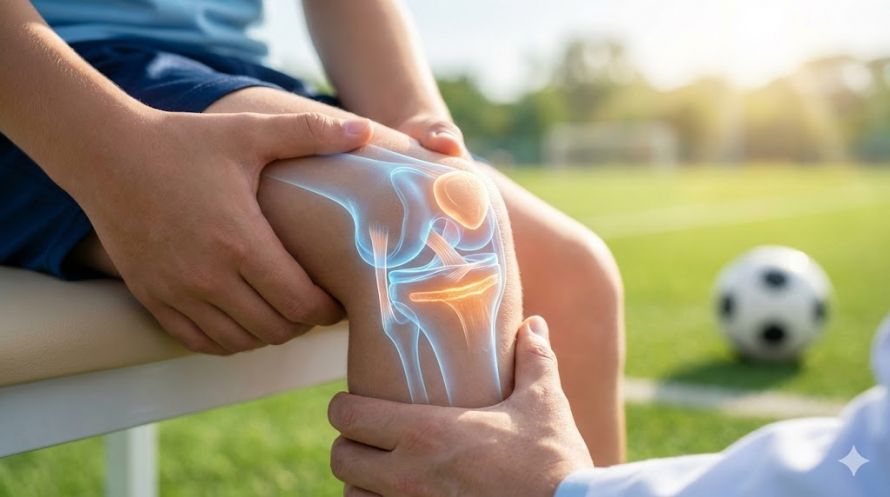
Special Considerations During Growth: The pediatric knee joint, with its sensitive growth plates, requires specialized diagnostic evaluation.
Symptoms and Diagnosis of Cruciate Ligament Tears, Meniscus Injuries, or Other Pain Around the Patella
Symptoms and typical presentations of knee pain
Typical symptoms include knee pain, swelling, difficulty bending or straightening the knee, and activity-related limitations of the knee joint. Pain around the kneecap and a feeling of instability may indicate patellar dislocation, Osgood-Schlatter disease, or a problem with the patella. Meniscus injuries often lead to locking, a snapping sensation, or sharp pain in the inner or outer joint area.
Osteochondrosis dissecans often causes diffuse pain that worsens with activity and may radiate down into the lower leg. Swelling, warmth, limited mobility, or a sudden “giving way” are typical of acute ligament injuries or a rupture of the anterior cruciate ligament.
Cartilage damage, meniscus injuries, or problems with the growth plate also often cause gradually worsening symptoms in the knee joint area. The sooner the symptoms are evaluated, the lower the risk of long-term damage.
Diagnosis of Knee Injuries
Diagnosis involves a thorough clinical examination to assess joint mobility, swelling, tender points, and instability. Orthopedic surgeons check for a torn cruciate ligament, a meniscus injury, patellar dislocation, or irritation in the growth plate area.
Imaging techniques such as X-rays and MRI are important for accurately identifying bone or cartilage damage, osteochondrosis dissecans, meniscus tears, or ligament injuries. In cases of unclear symptoms in children, precise diagnosis is crucial, as open growth plates are sensitive to improper loading.
Malalignments such as bowlegs, knock-knees, or an unstable patella can also be diagnostically relevant. Some injuries can be directly assessed, stabilized, or treated arthroscopically. Accurate localization of the symptoms also helps identify overuse injuries such as Osgood-Schlatter disease or irritation at the patellar tendon insertion.
Treatment for Patellar Dislocation and Other Knee Injuries in Children
Treatment Options: Conservative and Surgical
Many knee injuries can be treated conservatively—depending on the type, location, and severity of the injury. This includes immobilization, physical therapy, a break from sports, weight-bearing restriction, and targeted muscle stabilization. However, meniscal tears, cruciate ligament tears, osteochondrosis dissecans, or patellar dislocation often require arthroscopic or minimally invasive procedures.
Meniscus tears are often repaired or smoothed, while a cruciate ligament tear is treated with cruciate ligament reconstruction or a tendon graft. Depending on the stage, osteochondrosis dissecans can be drilled, stabilized, or repaired to preserve the fragment.
In cases of persistent patellar instability, surgical stabilization is recommended to prevent recurrent dislocations. After any surgery, careful rehabilitation is crucial to ensure that the patella, meniscus, cruciate ligaments, and affected bony structures heal completely and the knee joint regains its stability.
FAQ
How dangerous are childhood knee injuries to the joint?
Depending on their type and severity, knee injuries in children can significantly impair the joint, especially when growth plates are involved. Even seemingly minor sports injuries should be taken seriously, as they can lead to misalignments or long-term stress-related problems if left untreated. Early diagnosis helps detect damage to the tibia, meniscus, or cartilage in a timely manner. Therefore, an orthopedic evaluation should always be performed if symptoms persist.
When is arthroscopy necessary for children?
Arthroscopy is primarily used when tears are suspected in the meniscus, the anterior cruciate ligament, or the cartilage. The procedure is minimally invasive and well-suited for children, as it preserves surrounding structures while allowing for precise treatment. Especially in cases of complex sports injuries, arthroscopic surgery can be used to treat or repair the injury directly. Arthroscopy also provides important information even when findings are unclear.
Can children return to sports after a knee injury?
It is advisable to wait until the injury has fully healed and there is no longer any pain before resuming sports. It is crucial that the joint’s stability and mobility are restored before returning to sports. A stabilizer, such as a bandage or brace, is often used to protect the knee during the recovery phase. Physical therapy also helps to compensate for muscle weakness and prevent future sports injuries.
What role do growth plates and the completion of growth play in knee injuries?
Since growth plates are sensitive during childhood, they react much more strongly to traumatic or rheumatic changes. If left untreated, injuries near the growth plate can lead to misalignment or problems with weight-bearing. The bony structures do not fully stabilize until growth is complete. Therefore, an accurate diagnosis is particularly important in young patients to prevent permanent damage.
Why are knee injuries more common in children than in adults?
Children and adolescents are more active, have softer bone structures, and have knee joints that are not yet fully mature, making them more susceptible to sports injuries. The interaction between muscles, ligaments, and joints is still developing during growth, which can lead to tears more quickly. Everyday accidents, overuse, and typical stress patterns during play or sports also often lead to symptoms. Appropriate treatment protects the knee in the long term and prevents further damage until growth is complete.
Share this article