News
Why Modern Heart Valve Treatments Are Becoming Increasingly Minimally Invasive

Melanie Al Tikriti, BSc ·
Shortness of breath when climbing stairs, dizziness, or a feeling of tightness in the chest—many older adults initially attribute these symptoms to aging or declining physical fitness. In fact, however, a narrowed aortic valve may be the cause. Aortic valve stenosis is one of the most common heart valve diseases in older adults and can have serious consequences if left untreated. Just a few years ago, open-heart surgery was almost always necessary to replace the heart valve. Today, transcatheter aortic valve implantation (TAVI) offers a minimally invasive procedure that allows many patients to undergo heart valve replacement without opening the chest cavity.
TAVI has fundamentally changed the treatment of aortic valve stenosis in recent years. Thanks to modern technology, it is no longer just high-risk patients who benefit from this procedure. People with moderate or, in some cases, even low surgical risk may also be candidates for TAVI—depending on their individual situation. A specialized cardiac team determines which treatment is the best choice after a comprehensive evaluation.
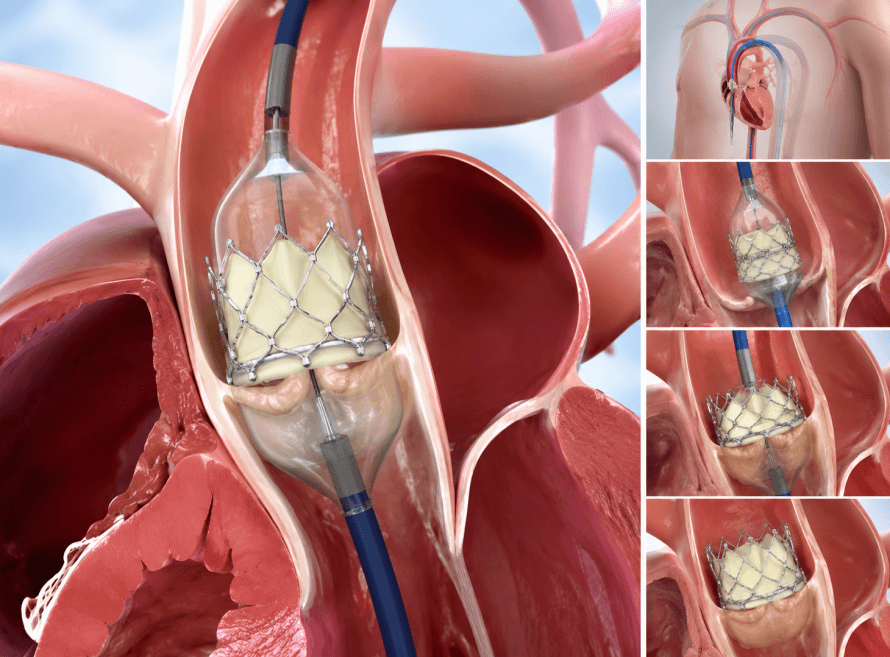
Image generated by AI
What is aortic valve stenosis?
The aortic valve is located between the left ventricle and the aorta. It opens with every heartbeat and ensures that oxygen-rich blood is pumped into the body. It then closes again to prevent blood from flowing backward.
As people age, calcium deposits can form on the aortic valve. This causes the valve to lose flexibility and prevents it from opening fully. The heart must work much harder to pump blood through the narrowed opening.
Over time, this increased strain can damage the heart muscle and lead to heart failure.
What symptoms occur?
The condition usually develops gradually. Many people affected initially notice no symptoms or only mild ones. However, as the heart valve becomes increasingly narrowed, the symptoms often worsen.
Typical signs include:
- Shortness of breath during physical exertion
- Chest pain or a feeling of pressure
- Dizziness
- Fainting spells
- Reduced stamina
- Rapid exhaustion
- Heart palpitations
If these symptoms occur in conjunction with severe aortic valve stenosis, treatment should not be unnecessarily delayed.
How is the diagnosis made?
A doctor can already detect signs of a narrowed heart valve by listening to the heart. However, the most important test is echocardiography (heart ultrasound). It shows how severely the valve is narrowed and how well the heart is still functioning.
Depending on the specific situation, an electrocardiogram (ECG), stress tests, computed tomography (CT), or a cardiac catheterization may also be used. Before a planned TAVI, computed tomography in particular provides important information about the anatomy of the heart valve and blood vessels.
What is TAVI?
The abbreviation TAVI stands for transcatheter aortic valve implantation. In this procedure, the diseased heart valve is not surgically removed but is replaced with a biological prosthetic heart valve, which is delivered to its location via a catheter. In most cases, access is gained via the femoral artery. The new heart valve is advanced through the catheter to the heart in a folded state and then precisely unfolded within the diseased valve. The calcified heart valve is pushed to the side, and the new valve immediately begins to function.
Since neither the chest needs to be opened nor the heart stopped, TAVI is considered significantly less invasive than traditional open-heart surgery.
Who is a candidate for TAVI?
Whether a TAVI or traditional open-heart surgery is more suitable depends on various factors. These include, among others, age, comorbidities, the anatomy of the heart valve, and the individual’s surgical risk.
TAVI is often suitable for:
- older patients
- People with an increased surgical risk
- Patients with multiple underlying medical conditions
- selected individuals with moderate or low surgical risk
Today, the decision is generally made jointly by an interdisciplinary cardiac team consisting of cardiologists and cardiac surgeons.
What are the benefits of this procedure?
TAVI has established itself as a safe and effective procedure in recent years. Many patients benefit from a faster recovery and rapid improvement in their symptoms.
Among the most important advantages are:
- no major incision in the chest
- a shorter hospital stay in most cases
- faster mobilization
- less physical strain
- rapid improvement in exercise tolerance
- High success rates
Are there any risks?
Like any medical treatment, TAVI also carries risks. These include, among others, bleeding, vascular injuries, cardiac arrhythmias, or strokes. In some cases, a pacemaker may need to be implanted after the procedure.
However, thanks to modern valve systems, improved imaging, and the extensive experience of the treating centers, these risks have been significantly reduced in recent years.
What does follow-up care involve?
After a successful TAVI, most patients spend a short time in a monitoring unit. Often, they can resume cautious physical activity just a few hours or days later.
Regular follow-up visits with a cardiologist are important to monitor the long-term function of the new heart valve. In addition, anticoagulant medications are adjusted, and risk factors such as high blood pressure or diabetes are treated.
Conclusion: Safe Treatment Thanks to Modern Technology
TAVI has fundamentally changed the treatment of aortic valve stenosis and enables many patients to undergo heart valve replacement without open-heart surgery. This minimally invasive catheter procedure offers an effective and safe treatment option, particularly for older adults or patients with an increased surgical risk. Thanks to modern technology, thorough diagnostics, and close collaboration among specialized cardiac teams, excellent treatment outcomes can be achieved today. Anyone experiencing shortness of breath, dizziness, or chest pain should have these symptoms evaluated by a cardiologist as soon as possible so that a narrowed heart valve can be detected and treated in a timely manner.
Share this article
Verified expertise
Recommended specialists
21 specialists
21 results



Dr. med. Dipl. oec. med., FESC Michael Lichtenberg
Chief Physician


Dr. med. Konstantinos Verginis
Duisburg


Dr Thomas Riester
Karlsbad






Prof. Dr. med. Alexander Albert
Dortmund




Professor Frank Breuckmann
Kitzingen






1 / 3
News
Read next
- News
Scabies: A contagious skin disease that is easily treatable
Oct 26, 2026
Severe itching and minor skin changes should be taken seriously
Read more - News
Heat Rash: What's Behind the Itchy Blisters
Oct 23, 2026
Heat Rash: Heat and Sweat Can Disrupt the Skin's Balance
Read more - News
Enlarged Prostate – When Medication Is Sufficient and When Surgery Is Recommended
Oct 21, 2026
Why Many Men Ignore Urinary Problems for Too Long
Read more