Here you will find further information as well as a selection of doctors who treat anal fistulas.
What Is an Anal Fistula? Definition and Basics
A fistula is generally defined as an abnormal passageway in the tissue that is not part of normal development. Fistulas can form in various parts of the body. In some cases, they are present at birth (e.g., in anal atresia); however, they most often develop later in life as a result of other medical conditions.
Anal fistulas originate at the proctodeal glands (scent glands) in the anal canal and open to the skin’s surface. They continuously discharge secretions and, depending on their size, may also pass stool, which is why they can often lead to extremely uncomfortable symptoms.
The course of the fistula tract varies from person to person: it may be superficial or run deeper through the tissue and the sphincter muscle. The condition is considered chronic, as it rarely heals on its own without treatment. Patients notice recurrent oozing, itching, irritation, or pain in the anal region. A fistula is often initially perceived as a “pimple” or a small swelling. It is important to distinguish it from the acute inflammation of an anal abscess, as the abscess usually represents a precursor but requires a different treatment strategy.
Are anal fistulas a rare condition?
The risk of developing an anal fistula is 1 to 3 percent, which means that 1–3 out of every 100 people will develop an anal fistula at some point in their lives. Men are affected more often than women. It is a relatively common condition among young men between the ages of 30 and 50.
Causes—How Does an Anal Fistula Develop?
An anal abscess is often the cause of an anal fistula. Anal fistulas and anal abscesses share some similarities. An anal abscess is caused by bacteria. In this condition, pus accumulates in a capsule near the anal canal, from which it can spread further into the surrounding tissue. If this inflammation becomes chronic, channels can form, leading to the development of an anal fistula.
Most commonly, it begins with an inflammation of the proctal glands. The inflammatory reaction and the buildup of pressure in the tissue lead to the formation of an abscess. If this is not treated surgically in a timely manner or heals only partially, a fistula develops.
Other causes of an anal fistula may include:
- Anal fissures
- Hemorrhoids
- Chronic inflammatory bowel diseases such as Crohn’s disease or ulcerative colitis
- Tumors
- Recurrent infections
- Local injuries
Anal fissures are small tears in the anal area. If inflammation develops as a result, it can eventually progress to a fistula.
Hemorrhoids are protrusions of the mucous membrane in the anal region. Fistulas can also form in this area, particularly in the event of infections.
Fistulas can also develop in chronic inflammatory bowel diseases such as ulcerative colitis or Crohn’s disease. This occurs more frequently in Crohn’s disease; however, in this case, fistulas form throughout the entire gastrointestinal tract, from the mouth to the anus. In ulcerative colitis, the risk of fistula formation is lower but is limited to the rectum.
Malignant diseases of the rectum (rectal carcinoma and anal carcinoma) can also lead to the formation of anal fistulas, though here as well, this is usually a consequence of a secondary infection.
Types of Anal Fistulas—An Overview of Fistula Course
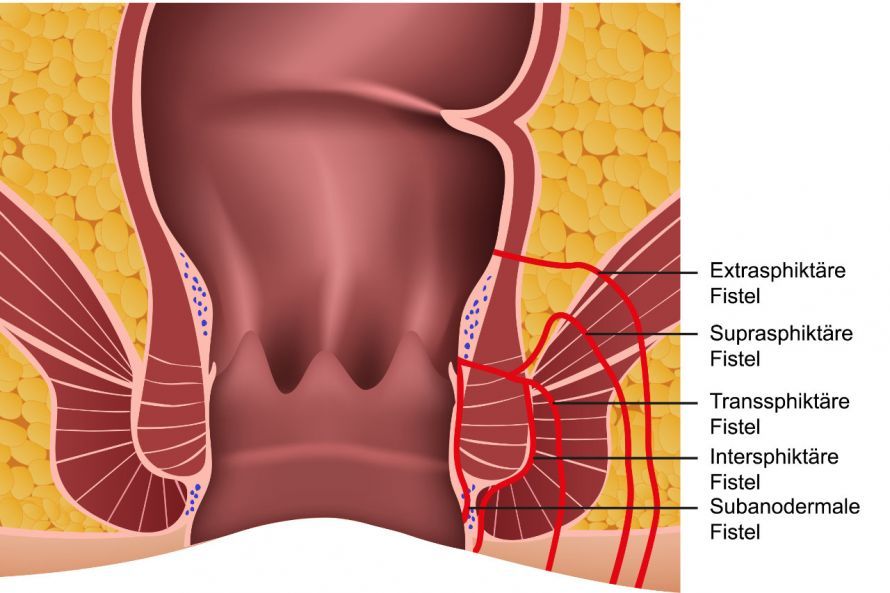
Anal fistulas differ in terms of their location, course, and relationship to the sphincter muscles. These factors influence both the symptoms and the treatment strategy. The key factors are the locations of the internal and external fistula openings and the path the fistula takes through the tissue and the sphincter muscle.
Generally, the fistula tract usually begins in the area of the anal canal and may open outward toward the skin. Depending on whether and to what extent the internal or external sphincter is affected, different types of anal fistulas are distinguished. Deeper fistula tracts carry a higher risk of affecting the sphincter muscle, which is why treatment must be approached with particular care.
Symptoms—How Can You Recognize an Anal Fistula?
At first, those affected either do not notice the fistula at all or perceive it as a kind of pimple in the anal area. This supposed pimple may swell, itch, or cause pain. It may also be accompanied by purulent discharge. At times, bleeding or pain may occur during bowel movements.
An abscess can also cause these symptoms. However, general symptoms such as fever or a general feeling of being unwell may also develop. Once the fistula has formed, these symptoms have usually already improved. This is because the fistula allows pus to drain, significantly reducing the pressure.
The following symptoms may occur with an anal fistula:
- Redness
- Swelling
- Itching
- Pain
- purulent discharge, sometimes mixed with stool
Anyone who repeatedly notices weeping sores, painful swelling, purulent discharge, or symptoms such as pain in the anal area should seek a medical examination to determine the cause at an early stage.
Diagnosis and Diagnostic Procedures for an Anal Fistula
If an anal fistula is suspected in a patient, a visit to a specialist in rectal diseases—a proctologist—is recommended.
Following a detailed medical history interview, the examination begins with a palpation of the anal area. In addition, a rigid metal tube with a light source at the end (medically known as a proctoscope) is often inserted. This allows for an assessment of the walls of the anal canal, enabling the detection not only of anal fistulas but also
- abscesses
- fissures
- hemorrhoids, and
- tumors
can be identified.
Since an anal fistula may also be caused by a malignant tumor, it is essential to take tissue samples from suspicious findings and subsequently examine them histologically.
A fistula probe is used to determine the course of a fistula. This is a small metal tube that is carefully inserted from the outside into the fistula tract and, ideally, can be visualized internally using a proctoscope.
Most uncomplicated fistulas can be diagnosed using this method. In cases of complex or multiple fistulas, or when abscesses are suspected, ultrasound examinations and an MRI are also helpful tools for identifying any damage in the anal region.
In certain cases, an examination under anesthesia is recommended to allow for a complete, pain-free diagnosis with optimal visibility.
Treatment of Anal Fistulas—What Treatment Options Are Available?
An anal fistula is primarily treated surgically, as it rarely heals on its own. The goal of treatment is to completely remove or obliterate the fistula tract without impairing the function of the sphincter muscle (to avoid causing complications such as incontinence, for example). The surgical approach depends on the course of the fistula, the location of the fistula openings, and the extent of the inflammatory changes.
Standard treatment procedures include fistulotomy, in which the fistula tract is opened and the wound is allowed to heal openly, as well as fistulectomy, in which the tract is completely excised. Fistulectomy refers to a surgical technique for the targeted opening of the fistula tract. For deep or complex fistulas, a suture drain may also be used to initially stabilize the fistula and drain the pus in a controlled manner. Modern procedures such as laser therapy can also be used in selected cases.
In all procedures, it is important to avoid damaging the sphincter muscle in order to minimize complications such as urinary or fecal incontinence. Surgical treatment should therefore be performed by an experienced surgeon.
After the procedure, rest, careful anal hygiene, and support for wound healing are important. The overall healing rate is good, but it varies depending on the type of fistula and any underlying conditions.
For patients with a bowel disease such as Crohn’s disease, treatment is tailored to the individual. In these cases, anti-inflammatory medications may be necessary before or in conjunction with surgery to alleviate symptoms. Conservative measures are primarily intended to reduce symptoms until surgery and prevent the recurrence of an abscess.
Prognosis, Course, and Prevention
If the anal fistulas are completely eliminated, the prognosis is good to very good. However, the healing process can often take several weeks and may sometimes be very painful. It is particularly important for patients to maintain adequate anal hygiene—especially after surgery. The preventive benefits of good anal hygiene should also be emphasized here, particularly since it can prevent anal fistulas or inhibit their growth.
However, if the fistulas cannot be completely removed, problems may continue to arise. People with Crohn’s disease or other intestinal disorders are at particularly high risk of developing anal fistulas.
Frequently Asked Questions
Does an anal fistula heal on its own?
An anal fistula rarely heals without treatment. In most cases, surgical treatment is necessary.
How painful is anal fistula surgery?
Pain may occur after the procedure, but it can be effectively managed with pain medication. The discomfort subsides as the wound heals.
How long does it take for the wound to heal?
Wound healing usually takes several weeks. The duration depends on the size of the wound, the type of fistula, and any underlying medical conditions.
When should you visit a specialized center?
In cases of recurrent fistulas, chronic bowel diseases, complex fistulas, or unclear symptoms, treatment at a specialized proctology center is recommended.
Share this article

About the medical author
Prof. Dr. med. Susanne Regus
Medical Author
Prof. Dr. med. Susanne Regus – medical author: expert articles, professional insights and medical expertise in the Leading Medicine Guide.
View full expert profile →