Stomach cancer, also known as gastric carcinoma, is a malignant disease of the stomach. It develops when certain cells in the stomach become malignant and multiply uncontrollably.
Here you will find further information as well as a selection of specialists and centers for stomach cancer.
Definition: What is stomach cancer?
In most cases, a stomach tumor develops in the stomach lining. In 95% of cases, it originates from cells in the glandular tissue. Doctors also refer to these classic stomach cancers, which originate from glandular cells, as adenocarcinomas.
In rare cases, however, stomach tumors can originate from other cells in the stomach, such as
- cells of the lymphatic tissue (MALT lymphomas) or
- cells of the muscle or connective tissue of the stomach wall (sarcomas or gastrointestinal stromal tumors (GISTs)).
Anatomy and Function of the Stomach
The stomach is a tubular to sac-shaped hollow organ that is part of the digestive tract. It is located in the upper left abdomen, below the diaphragm and between the spleen and the liver. At its upper end, the esophagus opens into the stomach. At its lower end, the stomach transitions into the duodenum.
The stomach’s function is to receive ingested food and initiate the initial stages of digestion. With the help of gastric juice, the chyme is prepared for further digestion in the intestines and then released in portions into the duodenum.
The stomach is divided into five distinct sections. These include
- the esophageal opening (cardia),
- the gastric fundus below the left diaphragm,
- the body of the stomach (corpus),
- the section before the stomach outlet (antrum), and
- the pyloric sphincter at the exit of the stomach into the duodenum (pylorus), which controls the passage of chyme into the intestine.
The stomach wall, which is two to three millimeters thick, consists of four layers, namely
- the gastric mucosa,
- a layer of connective tissue,
- a layer of muscle, and
- the peritoneum, which surrounds the stomach on the outside.
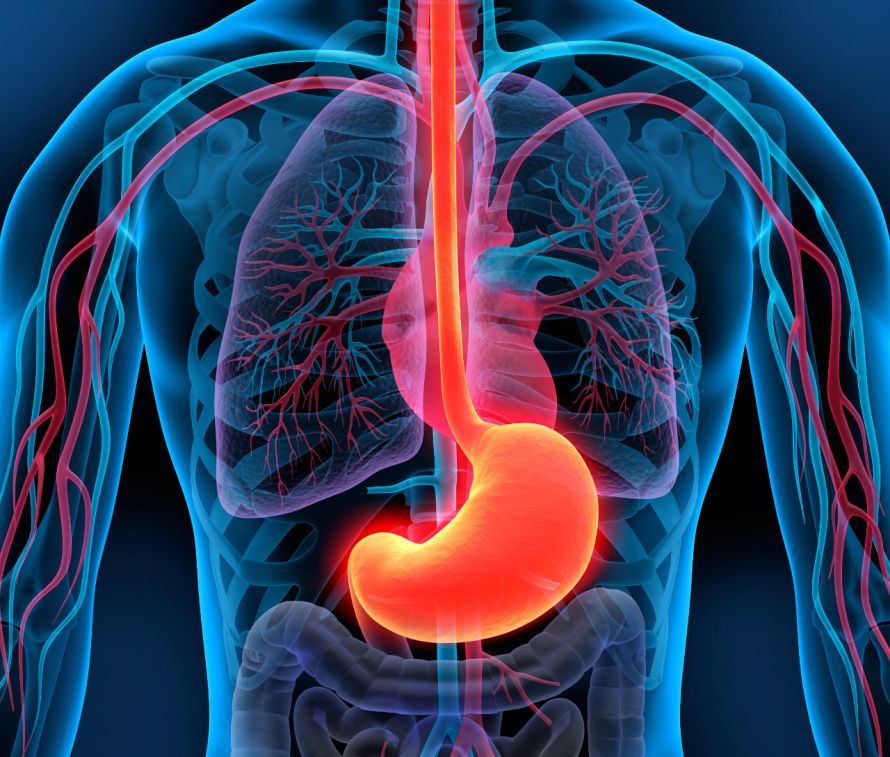
The location of the stomach in the human body © peterschreiber.media | AdobeStock
Incidence of Stomach Cancer
According to data from the Robert Koch Institute, approximately 17,000 people in Germany are diagnosed with stomach cancer each year. Stomach cancer is slightly more common in men than in women. Gastric cancer is thus the sixth most common cancer in men and the eighth most common in women.
It mostly affects older adults. The median age at diagnosis is 69 years for men and 72 years for women. Middle-aged people are diagnosed with stomach cancer significantly less often. Young adults and children are virtually never affected.
The number of stomach cancer cases in Germany has been declining for more than 30 years. However, despite this downward trend in incidence, stomach cancer remains one of the leading causes of cancer-related deaths. This is primarily because stomach cancer is usually detected too late.
Causes and Risk Factors for Stomach Cancer
The exact causes and mechanisms leading to the development of stomach cancer have not yet been clearly established. However, several risk factors are known to increase the likelihood of developing a malignant stomach tumor. These include, in particular,
- a number of stomach diseases,
- certain dietary habits, and
- a genetic predisposition.
The most important risk factor for stomach cancer is a bacterial infection of the stomach caused by Helicobacter pylori.
Stomach Disorders
Stomach disorders associated with an increased risk of stomach cancer include, among others,
- inflammation of the stomach lining (gastritis) caused by the bacterium Helicobacter pylori,
- recurrent and slow-healing stomach ulcers,
- adenomatous gastric polyps, and
- chronic atrophic autoimmune gastritis, a form of stomach inflammation caused by the body’s immune system malfunctioning (an autoimmune disease).
In addition, previous stomach surgeries can also increase the risk of gastric cancer.
Dietary Habits
Dietary habits and lifestyle also play a role. For example,
- frequent consumption of heavily salted, cured, smoked, or heavily grilled foods,
- low consumption of fresh fruits and vegetables, as well as
- excessive alcohol consumption and
- smoking
increase the risk of developing stomach cancer.
Genetic predisposition
A genetic predisposition to stomach cancer exists when there are multiple cases of stomach cancer in the family. If a first-degree relative—that is, a parent, child, or sibling—has had stomach cancer, your own risk of developing the disease is also increased.
Symptoms of stomach cancer
In its early stages, stomach cancer usually causes no symptoms at all or only very nonspecific ones. As a result, stomach cancer is often not detected until it is at an advanced stage. The nonspecific symptoms that may occur at the onset of the disease include, among others
- fatigue and weakness,
- digestive problems such as bloating,
- a feeling of fullness,
- heartburn,
- loss of appetite,
- nausea and vomiting.
In addition,
- a feeling of pressure in the upper abdomen,
- bad breath,
- black stools,
- unintentional, significant weight loss,
- a slightly elevated body temperature,
- night sweats,
- difficulty swallowing,
- anemia, and
- a sudden aversion to certain foods, typically meat,
may indicate stomach cancer.
Stomach Cancer – Diagnosis
If stomach cancer is suspected, several tests are necessary to confirm the diagnosis. The first step involves taking the patient’s medical history, known as an anamnesis. During this process, the doctor asks questions about the specific symptoms as well as the patient’s diet and lifestyle habits.
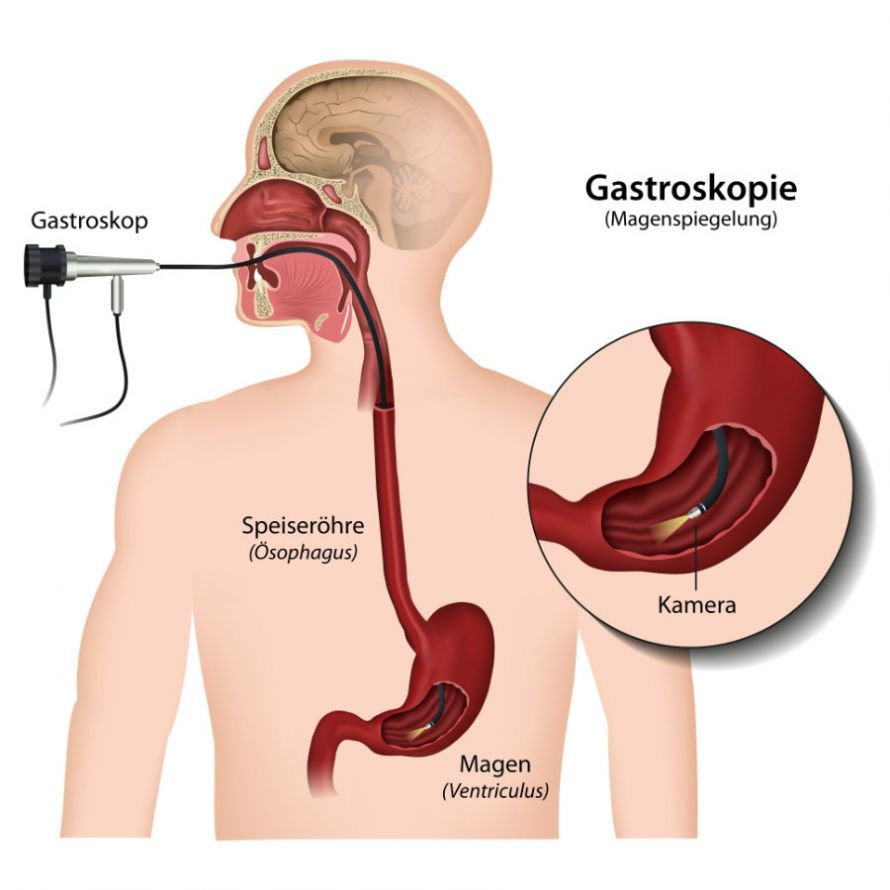
This is usually followed by a gastroscopy. This procedure allows the doctor to examine the inside of the stomach and identify any changes in the stomach lining. If abnormalities are found during the gastroscopy, a tissue sample (biopsy) is taken immediately. The sample is then examined under a microscope in the laboratory to check for malignant cancer cells. If malignant, abnormal cells are detected, a diagnosis of “stomach cancer” is made.
Following the diagnosis, doctors must determine
- how deeply the cancer cells have already penetrated the stomach wall, and
- whether the gastric carcinoma has already spread beyond the stomach.
This requires further testing. Endoscopic ultrasound (endosonography) is used to determine
- the depth of tumor invasion into the stomach wall as well as
- the presence of metastases in the regional lymph nodes.
Tumor deposits in other organs, known as distant metastases, can be detected using computed tomography (CT) or magnetic resonance imaging (MRI). These are most commonly found in the abdomen and chest.
A laparoscopy is performed to look for diffuse tumor spread in the abdominal cavity and, hopefully, to rule it out.
Treatment of Stomach Cancer
The treatment of stomach cancer is usually carried out by specialists in the medical fields of medical oncology and surgical oncology.
Various treatment options are available to them for gastric cancer, including
- in particular surgery,
- chemotherapy, and
- radiation therapy.
The choice of treatment method depends primarily on the stage of the disease.
Surgical Treatment of Stomach Cancer
Surgery is the most important treatment option for cancer. It is considered when
- the stomach tumor can be completely removed and
- the stomach cancer has not yet spread to other organs.
The goal of stomach cancer surgery is to surgically remove the tumor and all cancer cells.
The extent of the surgery depends on the size and type of the stomach tumor. In some cases, the entire stomach must be removed; in others, only part of the stomach needs to be removed to eliminate all cancer cells.
In addition, the surrounding connective tissue and lymph nodes must be precisely and thoroughly removed (known as D2 lymph node dissection). The surgeon plays a crucial role in determining the prognosis. He or she should therefore have a sufficient number of cases under their belt, as well as the appropriate training and experience.
Chemotherapy for Stomach Cancer
Chemotherapy aims to kill cancer cells using drugs that inhibit cell growth, also known as cytostatic agents. It is often used as an adjunct to surgery in cases of stomach cancer. If it is administered as part of the treatment plan only after surgery, it is also referred to as adjuvant chemotherapy.
For locally and regionally advanced gastric carcinomas, chemotherapy is also administered neoadjuvantly—that is, before surgery. The goal in this case is to shrink the stomach tumor so that it can be removed surgically more easily, or at all.
If metastases have already formed in other organs, a cure is no longer possible. In that case, chemotherapy serves only to slow tumor growth for a certain period of time and to alleviate symptoms.
This type of cancer treatment is also known as palliative chemotherapy.
Radiation Therapy for Stomach Cancer
Radiation therapy is considered for stomach cancer when
- the gastric carcinoma is inoperable and/or
- the tumor does not respond to chemotherapy.
The main goal of radiation therapy is to shrink the stomach tumor and metastases in order to relieve pain.
What sets stomach cancer specialists apart?
The treatment of a patient with stomach cancer should be entrusted to specialists in stomach cancer. It should be carried out in hospitals that have extensive experience with stomach cancer.
The German Cancer Society certifies these oncology treatment centers, which ensures a high standard of care for patients with stomach cancer.
Stomach cancer experts are specialists in the fields of
- gastroenterology,
- oncology,
- radiation oncology,
- radiology,
- gastric surgery, and
- Pathology.
These experts discuss their patients’ individual cancer cases during tumor board meetings. Together, they develop a treatment strategy tailored to each patient, taking current guideline recommendations into account.
Specialists in gastric cancer are thoroughly familiar with all diagnostic and therapeutic procedures. They can demonstrate this through their case volumes and track records.
FAQ
1. What factors can increase the risk of stomach cancer?
Infection with the bacterium Helicobacter pylori is considered one of the most significant risk factors. Infection with the Epstein-Barr virus, unhealthy dietary habits, and a genetic predisposition can also increase the risk of stomach cancer. People over the age of 50 are particularly at risk.
2. How is stomach cancer diagnosed? A physical examination and medical history review are followed by a gastroscopy, during which the location of the tumor is assessed and tissue samples are taken. Imaging techniques such as CT and MRI show whether metastases have already formed.
3. How is stomach cancer treated surgically?
Depending on the findings, the stomach is removed either completely or partially to eliminate all cancer cells. In cases of advanced stomach cancer, chemotherapy is administered as an adjunct; for metastatic stomach cancer, palliative care is the primary focus.
4. Why are early diagnosis and treatment crucial?
If gastric cancer is diagnosed only at an advanced stage, the chances of a cure are significantly lower. Infection with Helicobacter pylori should therefore be treated promptly, and high-risk patients should undergo regular screening.
Share this article

About the medical author
Professor Christoph A. Maurer, MD, FACS, FRCS, FEBS
Medical Author · Consultant of Surgical Department · Solothurn
Prof. Dr. med. Christoph A. Maurer – Author: Discover expert medical articles at Leading Medicine Guide.
View full expert profile →Sources
- Meyer HJ & Wilke H. Behandlungsstrategien beim Magenkarzinom. Dtsch Arztebl Int 2011; 108(41): 698-706; DOI: 10.3238/arztebl.2011.0698
- Deutsche Gesellschaft für Hämatologie und Medizinische Onkologie e.V. (2018) Magenkarzinom. Leitlinie. onkopedia leitlinien
- Leitlinienprogramm Onkologie (Deutsche Krebsgesellschaft, Deutsche Krebshilfe, AWMF) (2019) S3-Leitlinie Magenkarzinom „Diagnostik und Therapie der Adenokarzinome des Magens und ösophagogastralen Übergangs“. Langversion 2.01 (Konsultationsfassung) –Januar 2019, AWMF-Registernummer: 032/009OL
- Leitlinienprogramm Onkologie (Deutsche Krebsgesellschaft, Deutsche Krebshilfe, AWMF) (2013) Magenkrebs. Ein Ratgeber für Patientinnen und Patienten
- Schünke M et al. (2018) Prometheus. Innere Organe: LernAtlas der Anatomie. Thieme, Stuttgart