News
Why a Meniscus Tear Isn't Always Detected Right Away

Melanie Al Tikriti, BSc · September 30, 2026
One wrong step, a quick twisting motion, or standing up from a squatting position—suddenly, a sharp pain shoots through the knee. Some people can barely bend or straighten the joint, while others report that the knee feels as if it’s locked. It’s not uncommon for the symptoms to subside at first, leading people to underestimate the severity of the injury. These symptoms may indicate a meniscus tear. It is one of the most common knee injuries and affects both active athletes and people whose meniscus has worn down over the years.
A meniscus tear can occur at any age. While sports injuries or accidents are usually the cause in younger people, tears in older adults are often caused by the natural wear and tear of the cartilage. Modern diagnostic procedures and individually tailored treatment options now make successful therapy possible in many cases. However, it is crucial to correctly assess the symptoms and have the knee examined early on. After all, not every meniscus tear requires surgery.
The Meniscus—an Important Shock Absorber in the Knee Joint
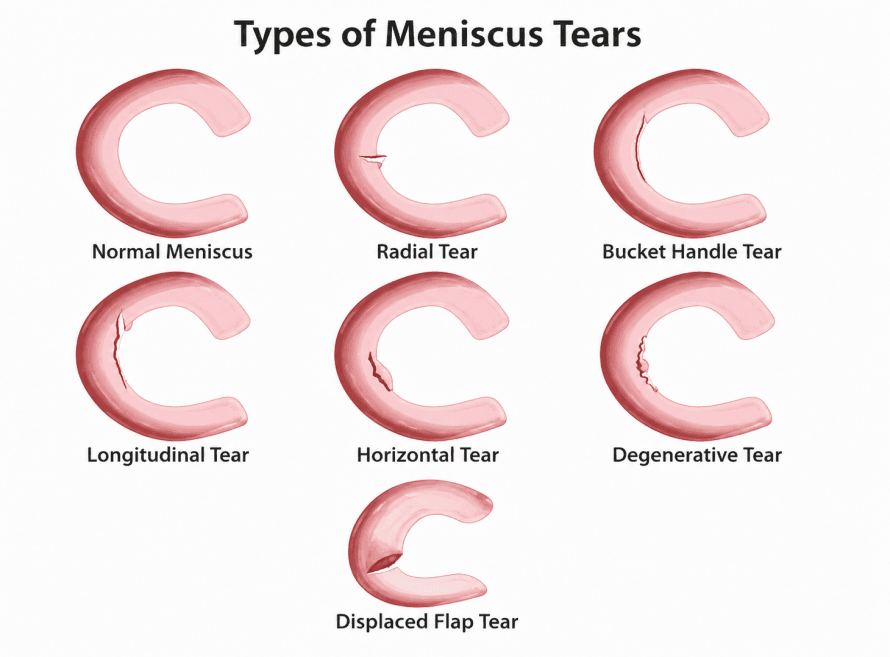
Each knee has an inner and an outer meniscus. These are crescent-shaped discs of cartilage located between the thigh and lower leg. They act as shock absorbers, distributing pressure evenly across the knee joint and contributing significantly to its stability. At the same time, they protect the articular cartilage from excessive stress and ensure that movement is as smooth as possible.
If one of the menisci is injured, it can no longer perform these functions effectively. This results in pain and increases the risk of cartilage damage and osteoarthritis.
How does a meniscus tear occur?
In younger people, a meniscus tear is often caused by sports injuries. Sports involving rapid changes in direction or twisting movements—such as soccer, tennis, handball, or skiing—increase the risk in particular. During these activities, significant stress is placed on the bent and simultaneously twisted knee, which can cause the meniscus to tear.
As we age, the cartilage tissue changes. The meniscus loses elasticity and becomes more prone to tears. At that point, even an everyday movement—such as kneeling, standing up from a squatting position, or a slight twist of the knee—can sometimes be enough to cause an injury.
What are the typical symptoms?
Not every meniscus tear causes severe pain right away. The symptoms depend on where the tear is located and how severe the injury is.
Typical symptoms include:
- sharp pain in the knee
- Pain during twisting movements
- Swelling of the joint
- A feeling of the knee locking
- limited range of motion
- Cracking or snapping in the knee
- Pain when climbing stairs or squatting
How is a meniscus tear diagnosed?
The process begins with a detailed interview about the circumstances of the injury or the symptoms. The doctor then examines the knee using various functional tests to specifically assess the meniscus.
To confirm the diagnosis, a magnetic resonance imaging (MRI) scan is usually performed. It provides a detailed view of the menisci, as well as the cruciate ligaments, collateral ligaments, and articular cartilage.
Does a meniscus tear require surgery?
Not every meniscus tear requires surgery. Small, stable tears or changes caused by wear and tear can often be treated conservatively. This approach focuses on pain management, physical therapy, and targeted muscle strengthening. The goal is to restore mobility and permanently stabilize the knee.
Surgery is primarily recommended when pieces of the meniscus become trapped, the knee locks, or larger tears compromise the joint’s stability. Today, orthopedic surgeons strive to preserve as much healthy meniscus tissue as possible. Depending on the type of injury, the meniscus is sutured, or only the damaged portion is removed.
Why is early treatment important?
An untreated meniscus tear can have long-term consequences, because when the meniscus’s shock-absorbing function is impaired, the joint cartilage is subjected to greater stress. This increases the risk of cartilage damage and early-onset knee osteoarthritis.
An early diagnosis also makes it possible to initiate the most appropriate treatment for the individual and to prevent further damage as much as possible. At the same time, it improves the chances of being able to put full weight on the knee again and regaining normal range of motion.
A locked or painful knee should therefore not be dismissed as harmless overuse. The symptoms may indicate a meniscus tear, which requires a targeted medical evaluation. Thanks to modern diagnostic techniques and individually tailored treatment options, many meniscus injuries can be successfully treated today. Early treatment plays a crucial role in preserving the long-term function of the knee joint and permanently reducing symptoms.
Share this article
About the medical author
Melanie Al Tikriti, BSc
Editor
Melanie Al-Tikriti, BSc – author: Explore expert medical articles in the Leading Medicine Guide.
More about the medical author →Verified expertise
Recommended specialists
34 specialists
34 results






Dr Giovanni De Rosa
Dusseldorf




Dr Johannes Knipprath
Headof the Centre for Joint Replacement and Medical Director of the Avicenna Clinic
Berlin


Dr. med. Achim Preiss
Hamburg





Sportklinik Freiburg
Freiburg




Dr. med. univ. Christian Lang
Salzburg



ETHIANUM Hospital, Heidelberg
Heidelberg






Prof. Dr. Peter Schräder
Seeheim-Jugenheim


Professor Michael Hirschmann
Bruderholz


Prof. Karl-Heinz Frosch
Director of the Clinic and Polyclinic for Trauma, Hand and ReconstructiveSurgery
Hamburg



Univ.-Prof. Dr. med. Rüdiger von Eisenhart-Rothe
Medical Director Clinic and Policlinic of Orthopedics and Sports Orthopedics
Munich
1 / 4
News
Read next
- News
Suddenly, your knee makes a popping sound—could it be a torn cruciate ligament?
Sep 28, 2026
Why a torn cruciate ligament isn't always detected right away
Read more - News
Hornet Stings: When a Sting Can Be Dangerous
Sep 25, 2026
Most hornet stings are harmless—but some require immediate action
Read more - News
Pacemakers—Who Are They Suitable For?
Sep 23, 2026
Why a Slow Heart Rate Isn't Just a Natural Part of Aging
Read more