Department of Pediatric Orthopedics: The Range of Treatments Offered at the Clinic for Orthopedics
Pediatric orthopedics is often integrated as a separate section or department within a large orthopedic clinic or a university hospital (such as Heidelberg University Hospital or the UKM). Here, orthopedics and trauma surgery work closely together. The range of treatments extends far beyond just broken bones. An experienced pediatric orthopedist treats:
- Hip joint: Treatment of hip dysplasia, Perthes disease, and epiphyseolysis capitis femoris (slipping of the femoral head).
- Spine: Scoliosis and postural abnormalities.
- Systemic disorders: Muscular dystrophies and skeletal dysplasias.
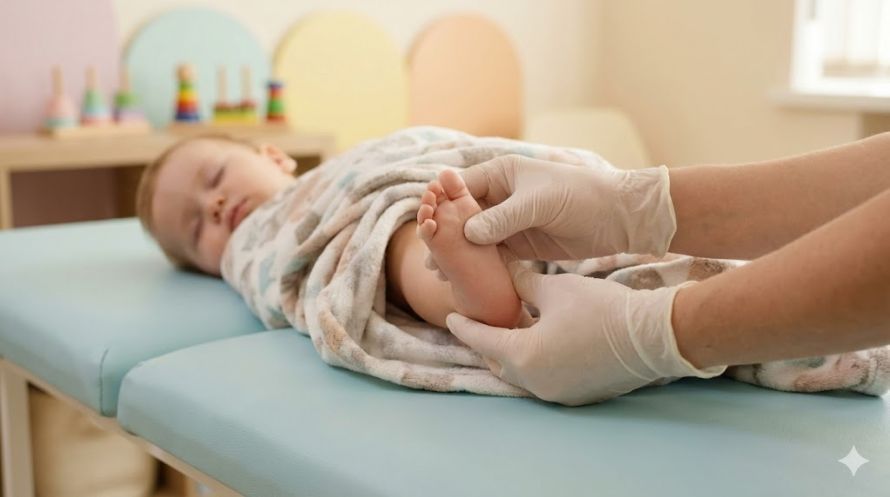
Specialists in pediatric foot care: Diagnostics in the Department of Pediatric Orthopedics.
Deformity Reconstruction and Foot Surgery
A key area of focus is deformity reconstruction and foot surgery. Many foot deformities in childhood are physiological and resolve on their own. However, specialized surgical interventions are necessary in cases of severe deformities.
Clubfoot and flatfoot
Congenital clubfoot is usually treated immediately after birth (often using the Ponseti method). If deformities persist, joint-preserving surgeries are performed. Flat feet (pes planovalgus) can also be an indication for **foot** surgery if they cause symptoms.
Hallux Valgus in Children
Hallux valgus is not exclusively an adult condition either. In adolescents, an osteotomy (bone realignment) may be necessary to correct the deformity and prevent osteoarthritis. In such cases, modern foot surgery uses implants that do not hinder growth.
Neuroorthopedics and Complex Syndromes
Neuroorthopedics cares for children with neuroorthopedic conditions, such as cerebral palsy. Spasticity often leads to gait disturbances and joint stiffness. The goal here is often not a “visually straight” limb, but rather improved function. Doctors, physical therapists, and orthopedic technicians work together in an interdisciplinary team. Surgical procedures include tendon lengthening or bone corrections. Surgical hip dislocation prevention (to prevent the hip from dislocating due to spasticity) is also an important part of deformity reconstruction and foot surgery.
Diagnostics: Consultations, gait analyses, and precise planning
During the consultation in General Pediatric Orthopedics, the orthopedic examination is the first step. Modern procedures confirm the diagnosis:
-
Ultrasound examination: The standard method for early detection of hip dysplasia in newborns.
-
X-ray: To assess bone structures in cases of orthopedic conditions.
-
Gait analysis: A professional evaluation of gait analysis and precise planning are essential before any surgery on the legs or feet is performed. This allows us to simulate how a reconstruction will affect walking.
Conclusion
Whether it’s minor foot deformities or complex conditions in neuroorthopedics, pediatric orthopedics requires a great deal of experience. In a specialized pediatric orthopedics or trauma surgery department, young patients receive diagnosis and treatment appropriate for their age. From hip dysplasia to clubfoot, the earlier orthopedic problems are detected, the better the chances of a life without mobility limitations.
FAQ
When is surgery necessary for flat feet in children?
Most cases of flat feet in children are flexible and harmless. Foot surgery is usually necessary only if the flat foot causes pain or is very stiff (coalitio).
What does neuroorthopedics involve?
Neuroorthopedics treats deformities of the musculoskeletal system caused by disorders of the nervous system (e.g., spasticity). Orthopedics and neurology work closely together in this field.
At what age do children undergo orthopedic examinations?
The first important orthopedic examination is the hip ultrasound performed as part of the U3 screening (4th–5th week of life) to detect hip dysplasia. If abnormalities such as clubfoot are present, the child is brought in for evaluation within the first few days of life.