News
Whiplash: Neck pain often does not appear immediately

Melanie Al Tikriti, BSc ·
A rear-end collision often lasts only a few seconds—but the symptoms can persist for days or even weeks. Many people involved in such accidents initially feel uninjured right after the crash. It’s not until several hours later that neck pain, stiffness, or headaches begin. These symptoms are often caused by whiplash, also known medically as acceleration trauma of the cervical spine.
Whiplash is one of the most common injuries resulting from traffic accidents. It doesn’t just affect drivers. Cyclists, motorcyclists, and passengers in the front seat can also suffer such an injury. Although most people affected make a full recovery, whiplash should be examined by a doctor to rule out more serious injuries.
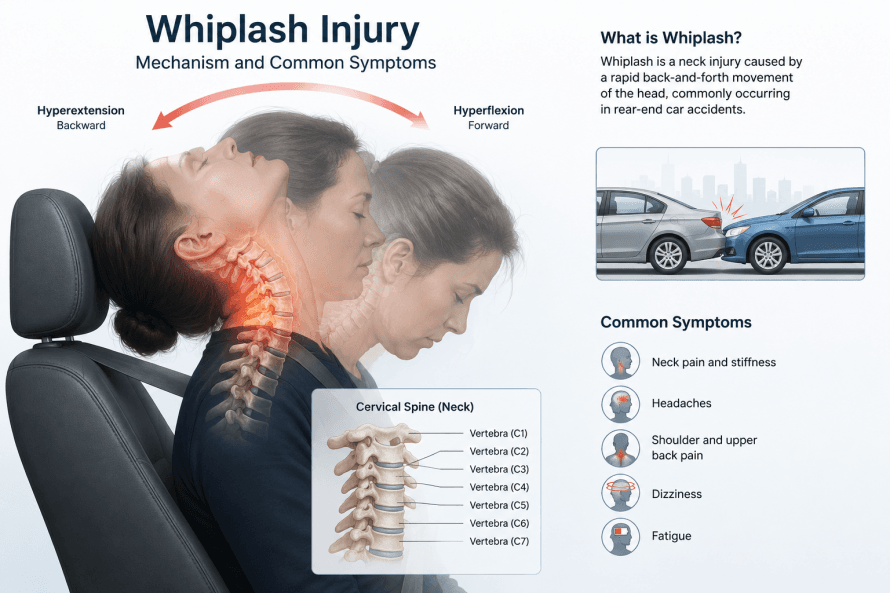
Image generated by AI
Sudden forces overload the cervical spine
In a whiplash injury, the head is jerked backward and then forward again within a very short period of time. This exerts enormous forces on the muscles, ligaments, tendons, and joints of the cervical spine. In most cases, there are no bone fractures, but soft tissues are often overstretched or irritated. As a result, pain and limited range of motion develop over time.
Rear-end collisions are the most common cause
Whiplash occurs primarily in traffic accidents, particularly when a vehicle is rear-ended.
Other possible causes include:
- Sports injuries
- Falls
- Collisions while cycling
- Motorcycle accidents
- Recreational accidents involving significant impact
Symptoms often develop later
A characteristic of whiplash is that symptoms do not always appear immediately. Many people affected feel fine at first and do not notice the symptoms until several hours later or the next morning.
The most common symptoms include:
- Neck pain
- Muscle tension
- limited mobility
- Headaches
- Shoulder pain
- Dizziness
- Fatigue
- Difficulty concentrating
Ringing in the ears, nausea, or a feeling of pressure in the head should also be evaluated by a doctor after an accident.
Not every neck injury is harmless
In most cases, whiplash heals without causing permanent damage. However, similar symptoms can also indicate more serious injuries. Severe pain, numbness or tingling in the arms or hands, signs of paralysis, or altered consciousness may indicate injuries to the cervical spine or spinal cord and require immediate treatment.
How the Diagnosis Is Made
First, the doctor will ask about the circumstances of the accident and the symptoms experienced. Next, the doctor will examine range of motion, muscle tone, and any possible neurological abnormalities. If bone injuries or other serious damage are suspected, imaging techniques such as X-rays, computed tomography (CT), or magnetic resonance imaging (MRI) are used.
In many cases, these tests reveal no structural injuries. Nevertheless, the symptoms can be quite pronounced.
What treatment options are available?
Treatment depends on the severity of the symptoms. The goal is to relieve pain and restore normal range of motion as quickly as possible. Pain-relieving and anti-inflammatory medications are often used. Heat therapy or physical therapy may also be beneficial. In the past, the neck was often immobilized with a neck brace for an extended period. Today, however, we know that immobilizing the neck for too long can actually delay healing.
Movement Supports Healing
After a whiplash injury, many people avoid any movement out of fear of pain. However, gentle everyday movements and targeted exercises help relieve tension and restore mobility to the cervical spine. Intensive physical activity, however, should only be resumed after consulting a doctor. Patience is also an important factor, because while some people recover after just a few days, others may need several weeks before all symptoms have completely subsided.
Conclusion: Symptoms following an accident should always be taken seriously.
In most cases, whiplash heals without causing permanent damage, but it often results in significant pain and restricted movement. If neck pain or other symptoms occur after a rear-end collision, a medical examination should be conducted. With early treatment and tailored physical therapy, symptoms can usually be effectively alleviated, facilitating a return to daily life.
Share this article
Verified expertise
Recommended specialists
30 specialists
30 results







Dr. med. Gregor Ostrowski
Karlsbad


Dr. med. Hans-Jürgen Becker
Wallisellen



PD Dr. med. Christopher Brenke
Gelsenkirchen



PD Dr. med. Olaf Süss
Berlin





Prof. Dr. med. Daniel Hänggi
Hannover



Prof. Dr. med. OliverP. Gautschi
In-patientphysician, St. Anna Hospital Neurology and Spinal Centre
Lucerne


Prof. Dr. med. Timo Zippelius
Karlsbad




Prof. Klaus-Dieter Schaser
Dresden

Prof. Martin Scholz
Duisburg


Sascha Zink
Bottrop


1 / 3
News
Read next
- News
Kissing Disease: Recognizing Symptoms and Treating It Properly
Oct 12, 2026
Pfeiffer's Glandular Fever: This viral infection can take a toll on the body for weeks
Read more - News
Parkinson's Disease – Modern Therapies and New Treatment Options
Oct 9, 2026
Parkinson's: Why an Early Diagnosis Can Have a Positive Impact on the Course of the Disease
Read more - News
Kidney Stones – Modern Treatments, from Shock Waves to Lasers
Oct 7, 2026
Why Sudden, Severe Flank Pain Can Be a Warning Sign
Read more