News
Osteoarthritis: Joint Degeneration with Consequences for Mobility and Quality of Life

Melanie Al Tikriti, BSc ·
How Changes in Cartilage Can Cause Pain, Inflammation, and Limitations in Daily Life
Osteoarthritis is one of the most common joint diseases worldwide and affects millions of people of all ages. For a long time, osteoarthritis was primarily viewed as a normal part of aging. Today, however, we know that significantly more complex processes are involved. It is not only the joint cartilage that changes, but often also the bone, joint capsule, muscles, and inflammatory processes in the surrounding tissue.
A particular problem is that osteoarthritis usually develops slowly. Initial symptoms often occur only during physical activity and are frequently underestimated at first. Over time, however, pain, limited mobility, and joint stiffness can increase significantly and have a major impact on daily life.
In recent years, our understanding of the disease has changed significantly. Modern research increasingly demonstrates how closely joint wear, inflammatory processes, metabolism, and mechanical stress are interrelated. This is precisely why osteoarthritis is no longer considered merely “wear and tear,” but rather a complex chronic joint disease. In the field of geriatrics and geriatric medicine, osteoarthritis is one of the central treatment priorities, as it has a particularly strong impact on the quality of life of older adults.
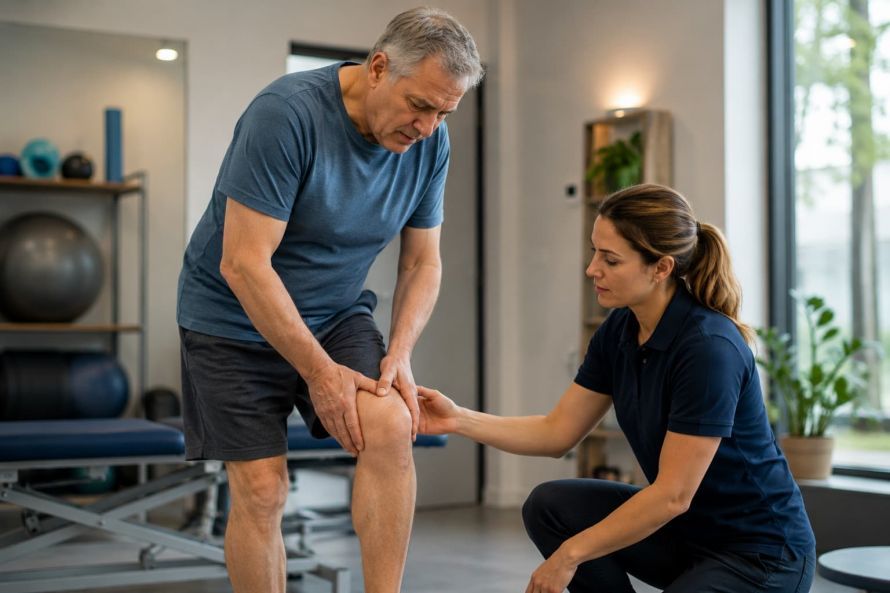
How osteoarthritis develops and which joints are particularly affected
Healthy joints have a smooth layer of cartilage that cushions movement and reduces friction. In osteoarthritis, this cartilage gradually changes. The surface becomes rougher, thinner, and increasingly loses its protective function. This increases the strain on the underlying bone structures. At the same time, changes occur in the joint capsule, ligaments, and muscles.
The following are particularly commonly affected:
- Knee joints
- Hip joints
- Finger joints
- Spine
- Shoulder joints
The causes are usually varied. In addition to age-related changes, obesity, improper weight-bearing, previous injuries, and genetic factors also play an important role. Obesity, in particular, affects joints much more significantly than was long assumed. In addition to mechanical stress, fatty tissue produces pro-inflammatory messengers that can further exacerbate joint changes. Previous injuries or misalignments also alter the stress placed on individual joints. This results in uneven wear on the cartilage over the long term.
Modern research also shows that inflammatory processes play a greater role in osteoarthritis than previously thought.
What Symptoms Are Typical
Osteoarthritis usually develops slowly over the course of several years. Initially, symptoms often occur only occasionally; later, pain and limited mobility often increase significantly.
Typical symptoms include:
- Joint pain
- Pain upon starting movement
- A feeling of stiffness
- Limited range of motion
- Swelling
- Pain on exertion
Many patients initially notice what is known as “start-up pain.” This is when joints hurt especially after periods of rest or in the morning after getting out of bed. As the disease progresses, symptoms can occur even during everyday movements. Later on, some patients may even experience pain while at rest or at night. In addition, the range of motion in many joints gradually decreases. Activities such as climbing stairs, walking for extended periods, or grasping objects can therefore become more difficult.
Inflammatory reactions also frequently play a role. Joints may swell, feel warm, or be sensitive to stress. Chronic pain, in particular, often has a significant impact on mood, sleep quality, and overall quality of life. Especially in older adults, osteoarthritis can lead to significant limitations in mobility and, consequently, to immobility.
The Role of Inflammation and Metabolism Today
For a long time, osteoarthritis was considered primarily to be mechanical wear and tear of the cartilage. However, modern research shows that inflammatory processes and metabolic changes are also involved.
Inflammatory mediators, in particular, influence:
- Cartilage degradation
- Pain perception
- Joint swelling
- Changes in bone tissue
Adipose tissue also plays a greater role than previously thought. Certain pro-inflammatory substances produced by fat metabolism can further influence joint changes. In addition, muscles and surrounding tissues often react to chronic pain with tension or compensatory postures. This places further strain on the joints and musculoskeletal system. This is precisely why modern medicine increasingly views osteoarthritis as a complex disease affecting the entire joint system, rather than merely as isolated cartilage damage.
Modern Diagnostic and Treatment Options
The diagnosis is based on symptoms, physical examinations, and imaging techniques.
Important diagnostic methods include, among others:
Treatment aims to achieve several goals simultaneously: reducing pain, improving mobility, and preserving joint function for as long as possible.
Modern treatment approaches include:
- Physical therapy
- Muscle strengthening
- Weight loss
- Pain management
- Anti-inflammatory medications
- Surgical procedures
Regular exercise, in particular, plays an important role. Joints often benefit from targeted training and strong, stabilizing muscles. Weight loss can also significantly improve symptoms, especially in cases of knee or hip osteoarthritis. In advanced stages, surgical procedures may be considered. These include joint-preserving surgeries or joint replacements in older adults. For patients over 80 years of age, the risks associated with surgery must also be carefully weighed.
Modern treatment approaches today typically follow a long-term, individually tailored strategy that combines exercise, pain management, and lifestyle factors. Geriatric assessment helps to specifically identify the individual treatment needs of older patients.
Conclusion: Preserving Joint Function in the Long Term
Osteoarthritis is one of the most common chronic joint diseases and significantly affects mobility, physical capacity, and quality of life for many people. Modern research is increasingly demonstrating how closely joint wear, inflammatory processes, and metabolism are interlinked. This is precisely why modern treatment concepts today increasingly rely on individualized, long-term, and holistic approaches. Early geriatric rehabilitation can play a decisive role in permanently maintaining the mobility and independence of older patients.
Share this article
Verified expertise
Recommended specialists
29 specialists
29 results

Asst Lect. Dr Ralf Decking
Leverkusen




Dr. Daniel Krapf
Headof the St. Anna Foot Center, Lucerne – Head of the St. Anna Department ofOrthopedics
Lucerne


Dr Giovanni De Rosa
Dusseldorf


Dr Johannes Knipprath
Headof the Centre for Joint Replacement and Medical Director of the Avicenna Clinic
Berlin



Dr. med. Dipl. Psych. Simone Heymann
PracticeProprietor




Dr René Malzkorn
Founder and Practice Proprietor


PD Dr. med. Dariusch Arbab
Herten, Westphalia

PD Dr. med. Friedrich Kutscha-Lissberg
Gelsenkirchen



Prof. Dr. Detlev Uhlenbrock
Dortmund



Prof. Dr. Peter Schräder
Seeheim-Jugenheim


Prof. Fritz Thorey
Heidelberg



Stylianos Toumasis
Landstuhl

1 / 3
News
Read next
- News
Scabies: A contagious skin disease that is easily treatable
Oct 26, 2026
Severe itching and minor skin changes should be taken seriously
Read more - News
Heat Rash: What's Behind the Itchy Blisters
Oct 23, 2026
Heat Rash: Heat and Sweat Can Disrupt the Skin's Balance
Read more - News
Enlarged Prostate – When Medication Is Sufficient and When Surgery Is Recommended
Oct 21, 2026
Why Many Men Ignore Urinary Problems for Too Long
Read more