In pancreatic surgery, a distinction is made between acute and chronic inflammation of the pancreas (pancreatitis), pancreatic pseudocysts, and benign and malignant tumors of the pancreas.
As a rule, surgery on the pancreas is not performed immediately in cases of acute pancreatitis. Surgery is required for chronic pancreatitis, pancreatic pseudocysts, and pancreatic tumors.
Below you will find further information on pancreatic surgery as well as a selection of specialists for pancreatic surgery.
Anatomy of the Pancreas
Where exactly is the pancreas located?
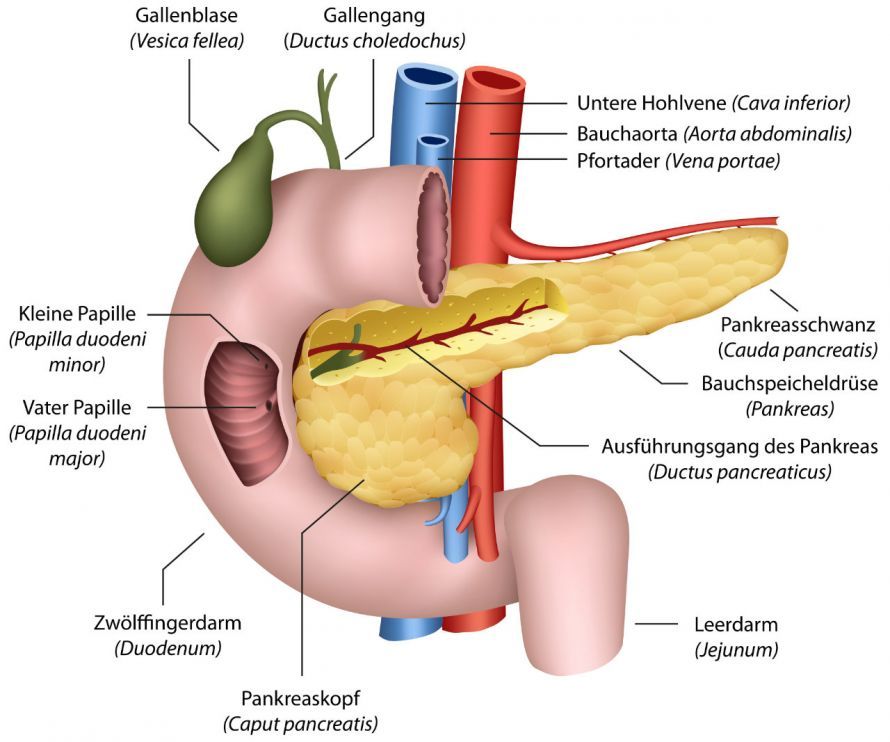
The pancreas is an elongated organ located in the upper abdomen between the small intestine and the spleen. It is situated about a hand’s width above the navel and lies in front of the spine.
What are the functions of the pancreas?
The pancreas produces important digestive juices. These contain enzymes that break down and digest fats, proteins, and carbohydrates.
The digestive juices travel through a central duct (the pancreatic duct) into the duodenum. The pancreatic duct shares a common terminal segment with the bile duct. The bile duct carries bile into the duodenum.
Another important function of the pancreas is the production of the hormones insulin and glucagon. These hormones regulate blood sugar levels. The pancreas produces them in specialized cells.
Diseases of the pancreas can have many causes.
What are the different types of pancreatic diseases?
- Inflammation (pancreatitis)
- sudden (acute)
- long-term (chronic)
- Tumor (carcinoma)
- Cysts (fluid-filled cavities)
- Loss of function (pancreatic insufficiency)
- Digestive disorder (insufficient digestive secretions)
- Diabetes (diabetes mellitus)
What causes pancreatitis?
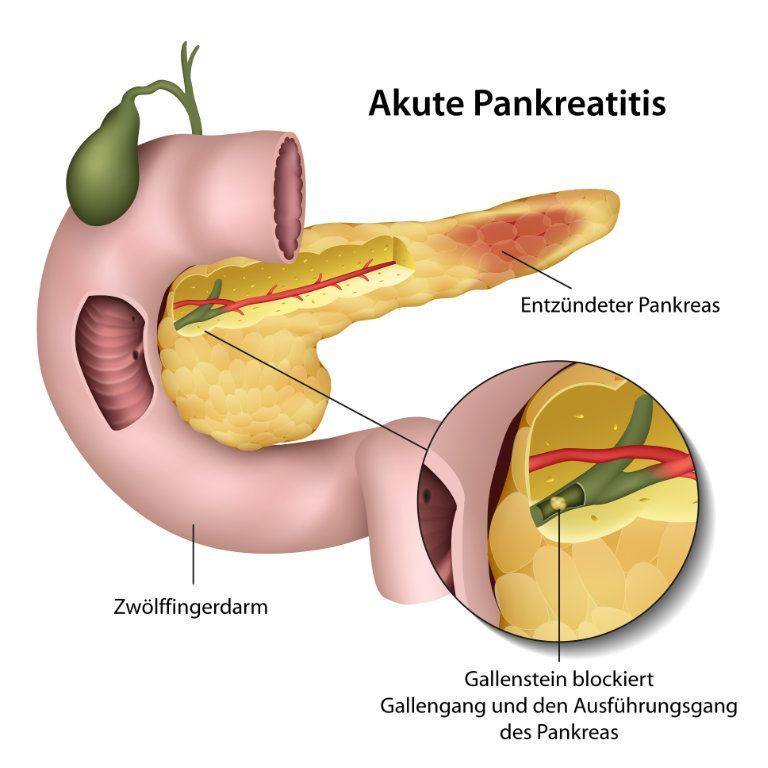
Pancreatitis can result from an obstruction in the flow of digestive juices.
The most common cause of this is, for example, a gallstone that can block the common duct of the pancreas and gallbladder.
Intense stimulation of the cells (excessive alcohol consumption) prevents the digestive enzymes from reaching the intestines.
Overproduction of these enzymes has the same effect: some of the digestive enzymes remain in the pancreas, where they damage or destroy its cells.
The resulting inflammation causes the pancreas to swell, which further impairs drainage.
If the inflammation is not treated, it continues to spread. The aggressive digestive juices can attack and destroy the structures of the pancreas and surrounding tissues.
Particularly severe forms of acute pancreatitis (necrotizing pancreatitis) can even become life-threatening.
Treatment of Pancreatitis
Treatment is initially conservative, i.e., non-surgical. It is important to abstain from food (i.e., fasting) so as not to further stimulate pancreatic secretion. Adequate fluid intake is important to support circulation.
To prevent infection of potentially necrotic tissue, prophylactic administration of an antibiotic can be effective.
Pancreatic surgery is necessary only if there is a recognizable infection of an area of necrotic tissue or if pseudocysts form (see below).
In addition, the doctor must identify the cause of the inflammation in order to treat it. If, for example, gallstones are the cause, the doctor must remove them. In some cases, removal of the gallbladder itself may also be necessary.
When does chronic pancreatitis develop?
Acute pancreatitis can heal without complications or lead to cell death and the formation of scar tissue.
If this scar tissue causes a narrowing of the pancreatic duct, it can make the pancreas susceptible to further inflammation.
Chronic pancreatitis is a long-lasting, recurrent inflammation of the pancreas.
With each new flare-up of inflammation, cells die off, leading to impaired pancreatic function. The pancreas can no longer produce enough digestive enzymes.
As a result, more nutrients enter the large intestine, where they stimulate excessive bacterial growth, leading to diarrhea.
In addition, patients experience so-called “steatorrhea” because the enzymes needed to break down fats are lacking. Other symptoms include upper abdominal pain that radiates to the back.
In advanced stages, diabetes mellitus may develop, as insulin and glucagon are no longer present.
In Western countries, the most common cause of chronic pancreatitis is alcohol. It does not always have to be excessive alcohol consumption; for some people, even a small amount is enough to trigger the disease.
Other important causes of chronic pancreatitis include:
- Chronic gallstones
- Genetic defects
- Congenital malformations of the pancreatic duct and
- Metabolic disorders
In some cases, the cause remains unclear.
How Does Pancreatic Cancer Develop?
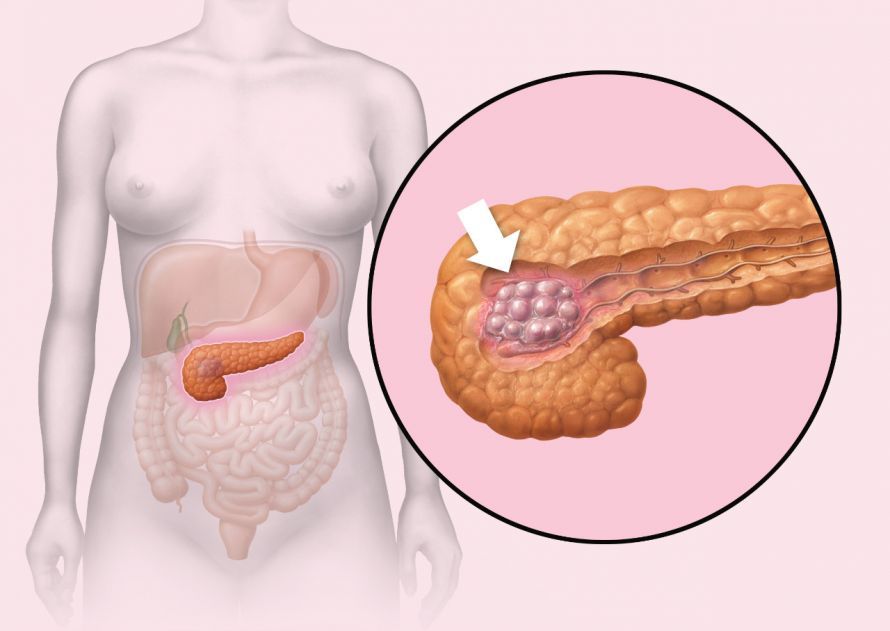
Adenocarcinoma of the pancreas (glandular tumor) is the most common type of pancreatic cancer. Pancreatic cancer is particularly aggressive because the tumor grows rapidly and can invade surrounding tissue.
In addition to a hereditary component (genetic predisposition), there are a number of risk factors for the development of pancreatic cancer.
Risk factors include:
- Tobacco
- Alcohol
- A diet high in cholesterol and nitrosamines, as well as
- the presence of chronic pancreatitis
Symptoms usually do not appear until more advanced stages and depend on the tumor’s location. If the tumor is located in the head of the pancreas, it causes narrowing of the bile duct as it grows. This leads to a backup of bile and yellowing of the skin and sclera (jaundice).
If the tumor is located in the middle or tail of the pancreas, it causes upper abdominal and back pain.
New-onset diabetes can also be a sign of a pancreatic tumor.
Pancreatic surgery remains the only treatment that offers the patient a chance of a cure.
What tests should be performed before pancreatic surgery?
Due to its location, the pancreas is difficult to visualize. The stomach, small intestine, and gallbladder—along with the bile ducts—are located in the immediate vicinity of the pancreas.
This often complicates examination and makes it impractical to recommend screening for tumors in asymptomatic individuals.
If pancreatic cancer is present, diagnosis is difficult because the cancer does not cause symptoms until a late stage. Since the pancreas lies in front of the spine and the nerve plexus located there, diseases of the pancreas can lead to back pain.
Typically, a blood test is performed to measure pancreatic enzymes in the blood. If a tumor is suspected, tumor markers (CEA, CA-19-9) are also tested.
In every case, an ultrasound of the pancreas is performed. A CT scan and an MRCP (magnetic resonance cholangiopancreatography) are usually performed to examine the bile ducts and the pancreatic duct.
If therapeutic procedures (such as the removal of gallstones) are necessary, endoscopic retrograde cholangiopancreatography (ERCP) is the procedure of choice.
What happens during an ERCP?
ERCP uses a contrast agent to visualize the gallbladder, bile ducts, and the pancreatic duct.
If narrowings or blockages caused by gallstones are detected, doctors can remove them immediately. Surgery is not necessary in such cases for the time being.
However, once the inflammation has subsided, it is recommended that the gallbladder be removed if it contains stones. Otherwise, gallstones can repeatedly pass from the gallbladder and cause such problems. It is perfectly possible to live without a gallbladder.
What is the next course of action if a malignant pancreatic tumor is suspected?
It is not possible to confirm a cancer diagnosis through a puncture or tissue biopsy because the pancreas is located in a very difficult-to-access area.
In addition, a biopsy can lead to bleeding and fistula formation.
Therefore, the goal is to surgically expose the pancreas and completely remove the tumor during pancreatic surgery.
How is pancreatic surgery performed?
If the inflammation causes obstruction of pancreatic secretions, it is advisable to consistently avoid alcohol, undergo pain management, and take digestive enzymes.
If symptoms persist, surgery is the only remaining option.
The goal of the surgery is to remove the scar tissue in the head of the pancreas and to create a pathway for pancreatic secretions to drain.
This surgery results in a significant reduction in pain in 60 to 80 percent of patients. It also helps halt the progression of diabetes or prevent its onset.
During the surgery, doctors remove the dead tissue. Furthermore, a drain flushes the space around the pancreas to prevent further infections.
Symptoms and inflammation caused by bile duct stones that block the opening into the duodenum require removal via ERCP. After acute pancreatitis has resolved, it may be necessary to remove the gallbladder.
If fluid-filled cavities (pancreatic pseudocysts) have formed, doctors should place a tube into the stomach if the cysts are in a favorable location.
This allows the contents of the cysts to drain into the stomach. This is not a surgical procedure; therefore, no abdominal incision is required—only a gastroscopy.
The drainage tube remains in place for about four to twelve weeks, which is sufficient for the cyst to heal.
If the cyst is not located near the stomach, surgery is necessary. Doctors drain the cyst contents into the intestine without allowing intestinal contents to enter the pancreas.
What does pancreatic surgery for pancreatic cancer involve?
In cases of pancreatic cancer (carcinoma), pancreatic cancer surgery offers the only chance of a cure. However, a cure is only possible if the cancer has not yet metastasized to other organs.
During the surgery, doctors remove the part of the gland affected by the tumor, as well as portions of the stomach and small intestine. They also remove all nearby lymph nodes; otherwise, the risk of recurrence (i.e., the cancer returning) is very high.
Sometimes it is also necessary to remove the spleen if it is affected by tumor growth. It is possible to live without a spleen. However, people without a spleen are more susceptible to bacterial infections, as the spleen plays an important role in the immune system.
A splenectomy may lead to an increase in blood platelets, which requires temporary medication to prevent thrombosis.
What should be considered after pancreatic surgery?
First, it is important to note that chemotherapy is necessary after surgery to reduce the risk of recurrence.
Chemotherapy is very taxing on the body. However, it should definitely be carried out as recommended by doctors if necessary.
It typically lasts 10–12 weeks and consists of several cycles. Breaks must be taken between cycles, as the strain on the body would otherwise be too great.
Regardless of whether chemotherapy is still necessary, there are a few specific considerations you need to keep in mind.
Patients who have had part of their pancreas removed must take pancreatic enzymes with their meals.
The dosage is determined on an individual basis, depending on which parts of the pancreas were removed and to what extent. It also depends on how the patient is doing after the pancreatic surgery.
If doctors removed the spleen during the pancreatic surgery, platelet levels must be monitored regularly. If platelet levels rise, thrombosis prophylaxis may be necessary.
Even if the patient does not have diabetes at the time of the pancreatic surgery, it is advisable to monitor blood sugar levels regularly.
This is because diabetes can develop after pancreatic surgery. Monitoring can be done, for example, through a 24-hour blood glucose profile or an oral glucose tolerance test.
If nutritional problems arise, nutritional counseling may be provided. If the condition is a pancreatic tumor, regular follow-up examinations are required.
In addition to a physical examination, an ultrasound of the upper abdomen is performed. Doctors also monitor the tumor markers CEA and CA 19-9 in the blood through regular blood draws.
Follow-up for people who have undergone pancreatic surgery due to a tumor initially takes place at three-month intervals.
Over time, these intervals may be extended in accordance with guidelines and in close consultation with the doctors. Any further treatment, such as chemotherapy, should also be carried out in close consultation with an oncologist.